






Weather Fears and a Vanishing Surplus Reignite Cocoa's Bid
Cocoa futures have staged an aggressive rally over the past week, climbing to their highest level since July 9 as the market repriced the outlook for the 2026/27 West African crop. On August 28, cocoa jumped roughly 5.1% to trade near 6,488 per tonne, extending a gain of more than 25% over the trailing month. The move has been driven primarily by a rapidly narrowing global surplus estimate. StoneX cut its 2026/27 global cocoa surplus forecast to approximately 25,000 tonnes from an earlier estimate of 149,000 tonnes, citing intensifying El Niño risk and weakening crop prospects in Ivory Coast and Ghana. Early surveys of the 2026/27 Ivory Coast crop point to below average cherelle formation, with preliminary estimates near 1.8 million metric tons, down about 18% from the prior season. Ghana's COCOBOD has projected its own 2026/27 output could fall to between 450,000 and 550,000 metric tons from roughly 750,000 metric tons in 2025/26, citing swollen shoot disease, aging farms, and adverse weather tied to El Niño. Both Ivory Coast and Ghana have moved the official start of the 2026/27 season forward by one month to September 1, though this does not immediately translate into new physical supply. At the same time, funds entered this window holding a near record net short position, and the combination of a tightening surplus narrative with a crowded short base has fueled an aggressive short covering rally over the past two sessions.
What the Market Has Done
- The market was in a downtrend through all of 2025 and into February 2026, when buyers began stepping in near the 3000 area, marking the start of a bottoming process.
- Since May, buyers regained control above the 3700 area (Daily level 5), a zone confluent with the yearly VWAP, and defended it through June, using it as a base for the next advance.
- Buyers then initiated an uptrend of higher highs and higher lows, extending the advance to the 6500 area (Daily level 3).
- Sellers responded at that level, and prices rotated back down to the 5000 area (Daily level 4), where buyers again stepped up and held bids, setting the stage for another rotation higher.
- Most recently, over the past two trading sessions, the market has rallied aggressively and broken above the 6500 area (Daily level 3).
What to Expect in the Coming Weeks
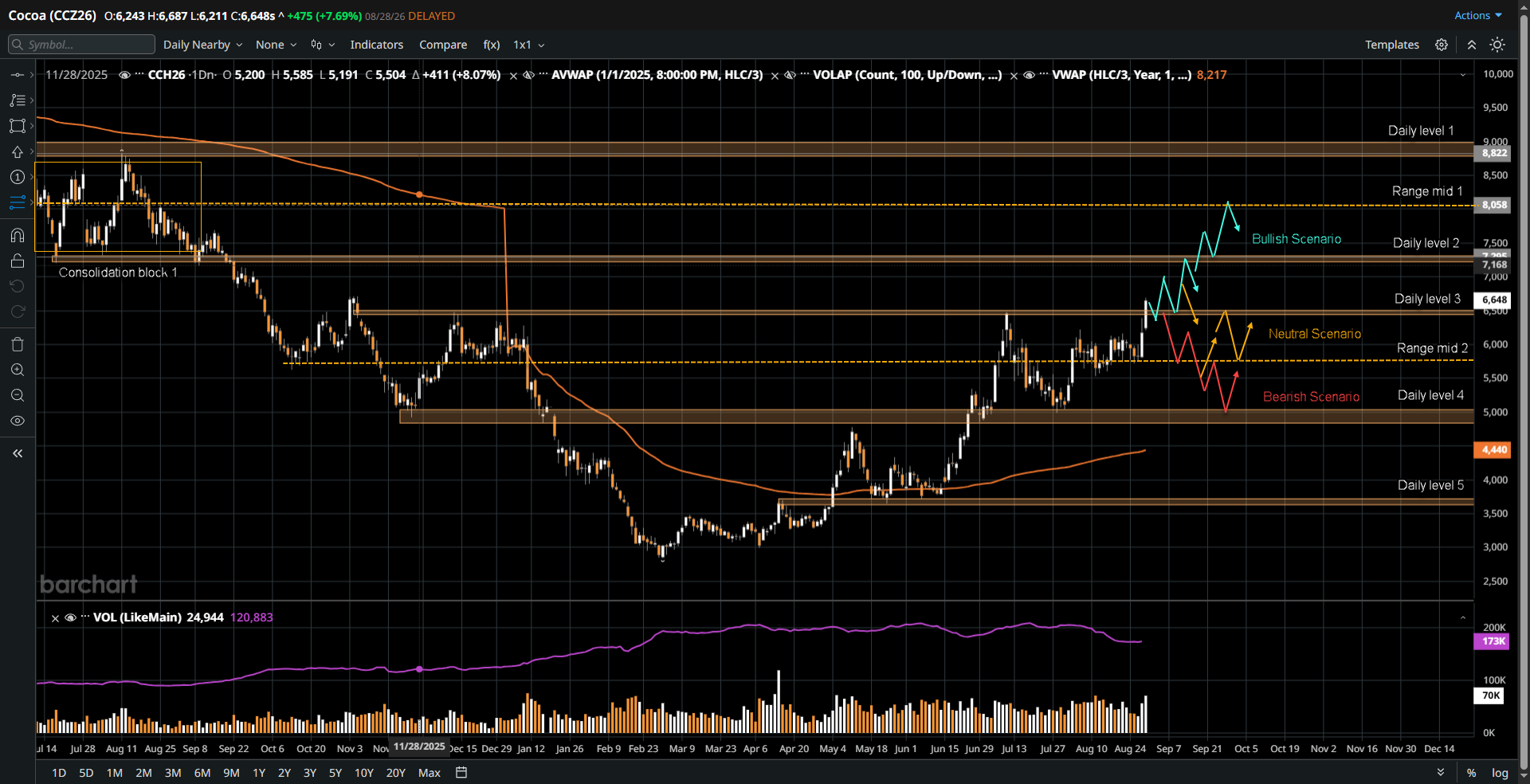
The key level to watch is the 6500 area (Daily level 3).
Bullish Scenario:
- If the market is able to accept and hold above the 6500 area (Daily level 3), or recover quickly back above it following a test below, look for a move up toward 7250 (Daily level 2), where a selling response is expected.
- If sellers fail to defend that zone, expect a continuation above 7250 toward the 8050 area (consolidation block 1 mid), back within the consolidation block 1 range.
- A possible trigger for this scenario is confirmed strengthening of El Niño conditions alongside a further downgrade to Ivory Coast or Ghana production estimates from StoneX, Ghana's COCOBOD, or the ICCO.
Bearish Scenario:
- If buyers are not able to sustain trade above the 6500 area (Daily level 3), expect a move back down to 5700 (range mid 2).
- If buyers do not defend bids at that level, expect a further move down to the 5000 area (Daily level 4).
- A possible trigger for this scenario is a sharp rise in ICE certified cocoa inventories combined with improved rainfall across Ivory Coast and Ghana that eases near term crop stress.
Neutral Scenario:
- If buyers defend 5700 (range mid 2) on a pullback and sellers defend the 6500 area (Daily level 3) on a test above, expect a two-way auction to develop within these levels as the market reestablishes value at a higher range.
- A possible supporting condition for this scenario is mixed data flow, where firm Ivory Coast shipment figures offset weaker European and North American grinding numbers, leaving the market without a clear directional catalyst.
Conclusion
Cocoa's break above the 6500 area (Daily level 3) reflects more than a technical breakout. It captures the market's attempt to reconcile a still comfortable 2025/26 surplus with a 2026/27 outlook that is deteriorating on nearly every front, from El Niño's advancing footprint to shrinking cherelle counts, delayed season starts, and a fund positioning base that remains skewed heavily short. Whether this move develops into a durable trend or fades once short covering runs its course will likely depend on the next round of West African weather updates and crop surveys due in the weeks ahead. Given how quickly sentiment has reversed more than once already this year, price behavior around the 6500 area (Daily level 3) may reveal as much about cocoa's next chapter as any single headline could.
We built EdgeClear for traders who treat trading as a business. That means low commissions, zero-friction order routing, and free access to EdgeClear Insights—a cloud-based analytics platform that tracks your P&L, discipline, and execution quality in real time. Build your trading business on a foundation that scales with you. Open an Account today.
Disclaimer:
This article is provided for informational and educational purposes only and does not constitute financial, investment, or trading advice. The analysis presented reflects the author’s market observations and opinions at the time of writing and is not a recommendation to buy or sell any futures contract, security, or financial instrument. Futures trading involves significant risk and is not suitable for all market participants. Losses may exceed initial margin deposits, and market conditions can change rapidly.
Any scenarios, levels, or market expectations discussed are hypothetical in nature and are intended solely to illustrate potential market behavior. They do not represent actual trading results and should not be interpreted as guarantees of future performance. Past performance, market behavior, or historical price action are not indicative of future outcomes.
Readers are solely responsible for their own trading decisions and risk management. Always conduct independent research, consider your financial situation and risk tolerance, and consult with a qualified financial professional, if necessary, before engaging in futures or derivatives trading.

/A%20Palantir%20office%20building%20in%20Tokyo_%20Image%20by%20Hiroshi-Mori-Stock%20via%20Shutterstock_.jpg)
/Elon%20Musk%2C%20founder%2C%20CEO%2C%20and%20chief%20engineer%20of%20SpaceX%2C%20CEO%20of%20Tesla%20by%20Frederic%20Legrand%20-%20COMEO%20via%20Shutterstock.jpg)
/Microsoft%20sign%20at%20the%20headquarters%20by%20VDB%20Photos%20via%20Shutterstock.jpg)
/Apple%20Inc%20logo%20on%20Apple%20store-by%20PhillDanze%20via%20iStock.jpg)