Dual Edge Research publishes two powerful newsletters that work great individually — and even better together. The Bull Strangle Newsletter focuses on stocks and options, combining stock ownership with premium-selling strategies to generate consistent income and market-beating returns. The Smart Spreads Newsletter specializes in seasonal commodity futures spreads, offering a diversified approach with low correlation to equities. Together, they deliver a complete investment perspective — one focused on income, the other on diversification — all under one simple subscription.
Introduction
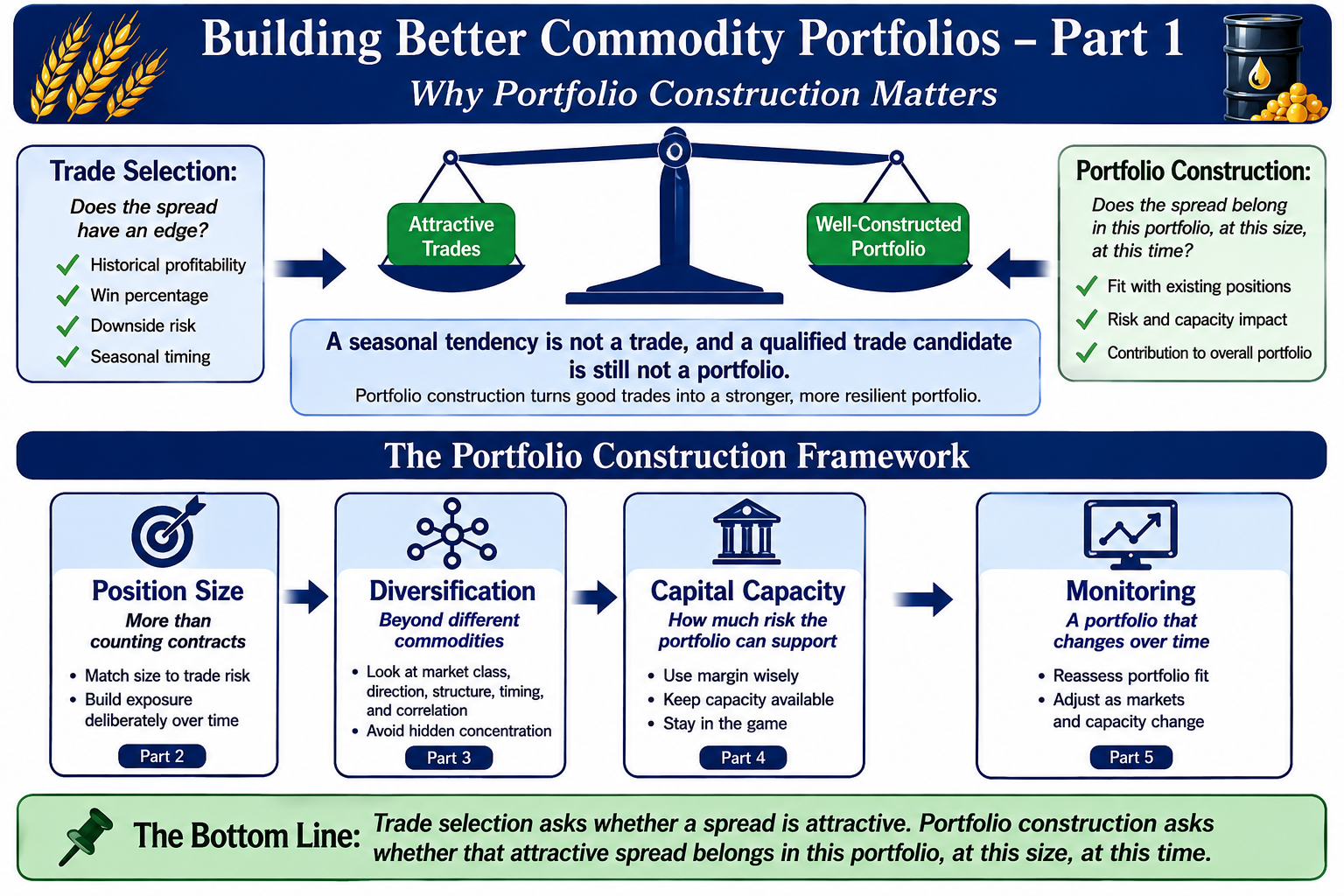
Much of the work behind successful seasonal commodity spread trading focuses on finding the right trades. Historical profitability, win percentage, downside risk, seasonal timing, direction, front-month structure, forward curves, and other factors can all help separate stronger opportunities from weaker ones. The Smart Spreads research process is designed to narrow a very large universe of possible spreads into a much smaller group of qualified candidates. But identifying an attractive spread is not the same thing as deciding that it belongs in a portfolio. As I discussed in Trading Commodity Spreads, a seasonal tendency is not a trade, and a qualified trade candidate is still not a portfolio. Once attractive opportunities have been identified, the challenge shifts from finding good trades to determining how those trades should coexist.
That distinction is the starting point for this series. Previous research has concentrated primarily on improving the quality of individual trades. Now the focus shifts from the trade to the portfolio. Once several attractive opportunities are available simultaneously, an entirely different set of decisions becomes necessary. How much should be allocated to each trade? How similar are the risks already in the portfolio? How much capital should remain available? How much total risk is being carried? And perhaps most importantly, does adding another attractive trade actually improve the portfolio?
Good Trades Don't Automatically Create a Good Portfolio
Suppose that ten commodity spreads independently satisfy all requirements of the selection process. Each has favorable historical profitability, an acceptable win rate, manageable downside characteristics, and attractive seasonal timing. It might seem logical to trade the highest-ranked opportunities. But that ignores the relationships among them. Several could be concentrated in petroleum markets that respond to many of the same fundamental forces. Others might have similar directional exposure, enter more volatile periods at approximately the same time, or depend upon related seasonal forces. Individually, every trade may still be attractive. Collectively, however, they could create substantially more risk than their individual statistics suggest.
This is the difference between trade risk and portfolio risk. Trade-level analysis asks whether an individual opportunity is attractive. Portfolio analysis asks what happens when that opportunity is combined with everything already being held. A trade that appears entirely reasonable in isolation can become problematic when combined with positions sharing similar volatility, timing, or behavior. The portfolio therefore becomes another important filter in the selection process.
Position Size Is More Than Counting Contracts
The first question is how large each position should be. One contract is a convenient unit of measurement, but one contract of every spread does not necessarily represent the same amount of risk. Some spreads develop gradually and historically experience relatively contained movement, while others can move rapidly and experience much larger excursions. Position sizing should therefore consider the characteristics of the trade rather than simply assigning the same number of contracts to every opportunity.
Exposure can also be built more deliberately. Instead of establishing the entire desired exposure to a commodity through a single spread, multiple qualifying opportunities can sometimes be used to construct that exposure over time. Part 2 will explore how position size can be approached as an allocation decision rather than simply a contract-count decision.
Diversification Goes Beyond Different Commodities
Diversification is another area where appearances can be misleading. A portfolio containing several different futures contracts may appear diversified, but commodity markets frequently share common economic and structural drivers. Petroleum markets can respond together to changes in supply, refining economics, inventories, and global demand. Agricultural markets can cluster around weather and important seasonal periods. In some environments, several individually sound positions can behave more like one large exposure than a collection of independent trades.
For that reason, diversification needs to extend beyond simply counting commodities. Market class, direction, spread structure, entry timing, seasonal exposure, and historical correlation can all provide additional information about how positions might interact. Part 3 will examine these relationships using actual commodity correlation analysis and examples of diversification both across and within individual commodity markets.
Capital Creates Staying Power
Portfolio construction also involves determining how much capital to deploy. Futures spreads often require relatively low margin compared with their underlying contract values, but available margin should not be mistaken for appropriate portfolio capacity. The important question isn't simply how many positions an account can hold. It is how many positions can coexist while still allowing the portfolio to withstand normal market variation without forcing unwanted decisions.
This creates what I consider one of the most important advantages of conservative capital deployment: staying power. Seasonal tendencies rarely develop in a straight line. Trades can experience temporary drawdowns, periods of stagnation, or short-term moves that deviate from the expected seasonal pattern. When capital is stretched too far, normal fluctuations can create pressure to act prematurely. When adequate capacity remains available, trades have more room and time for their structural and seasonal tendencies to develop. Part 4 will examine capital capacity, margin, and why unused capital can be an important component of portfolio construction rather than an inefficiency.
The Portfolio Is Always Changing
Portfolio construction doesn't end when positions are entered. Trades reach their seasonal exits, new opportunities appear, market relationships change, and available capacity expands and contracts. As a result, portfolio fit is not permanent. A trade that does not belong today may fit extremely well after another position exits, while an opportunity that could have been added comfortably last week may create too much concentration today.
Part 5 will focus on this continuing process. Rather than monitoring each spread solely by its individual profit or loss, the portfolio itself should be monitored for changes in exposure, concentration, heat, and available capacity—and existing positions should continually be evaluated alongside new opportunities.
Building the Portfolio, Not Just the Watch List
Over the next several parts, we will move systematically through position sizing, diversification and correlation, capital capacity, portfolio heat, and ongoing portfolio management before bringing everything together in Part 7. The objective isn't to accumulate the greatest possible number of attractive spreads. It is to construct a portfolio of attractive spreads that can coexist amid normal market variation and remain in place long enough for their historical edges to develop.
That leads to the central idea behind this series: Trade selection asks whether a spread is attractive. Portfolio construction asks whether that attractive spread belongs in this portfolio, at this size, at this time.
Additional Details
The Bull Strangle Newsletter focuses on stocks and options, combining stock ownership with disciplined option-selling techniques designed to generate consistent income while managing risk.
The Smart Spreads Newsletter focuses on seasonal commodity spreads, a historically proven approach that seeks opportunities across agricultural, energy, metal, and financial futures markets.
Each strategy is designed to stand on its own, but together they provide a diversified approach that can perform across a wide range of market environments. For traders looking to deepen their education, The Bull Strangle Strategy and Trading Commodity Spreads are both available on Amazon.
Visit BullStrangle.com to subscribe for just $1 for the first month.
For a video overview of the Bull Strangle Newsletter
For a video overview of the Smart Spreads Newsletter
Darren Carlat
Dual Edge Research
(214) 636-3133
DualEdgeResearch@gmail.com
Disclaimer
This information is for informational purposes only and should not be considered as investment advice. Past performance is not indicative of future results, and all investments carry inherent risk. Consult with a financial advisor before making any investment decisions.


/AI%20(artificial%20intelligence)/Ai%20chip%20by%20Quality%20Stock%20Arts%20via%20Shutterstock.jpg)

/A%20close-up%20of%20the%20Broadcom%20logo%20on%20a%20smartphone%20by%20Timon%20via%20Adobe%20Stock.jpeg)