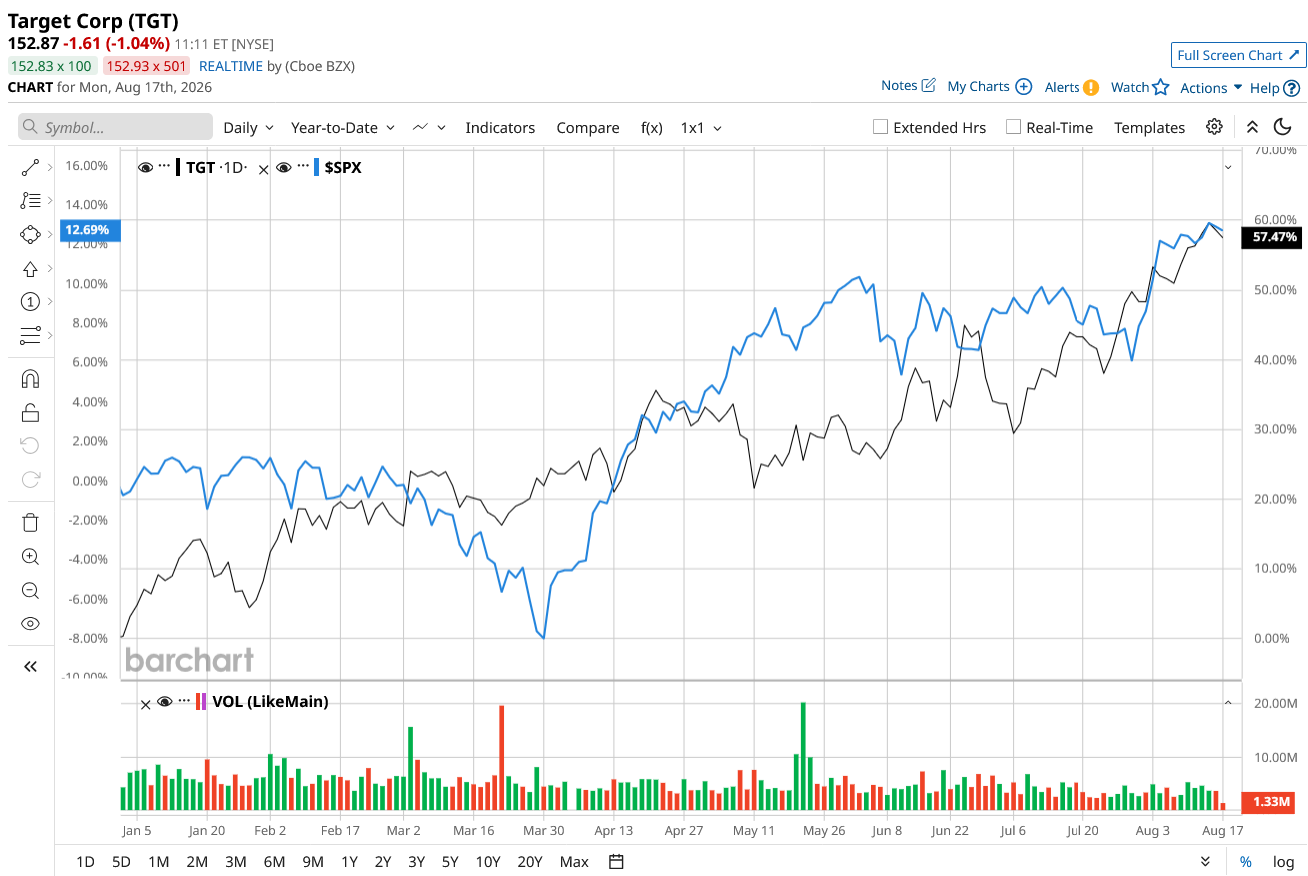
Target Corporation (TGT), a large U.S. retailer, is heading into its second-quarter earnings with strong momentum. TGT stock is up 56% year-to-date (YTD), touching a new 52-week high of $156.47 on Aug. 13. More importantly, Wall Street has high hopes that the company will beat estimates and has already started to price in that possibility. Many analysts have raised the target price for Target's stock.
Let’s find out what analysts are expecting from Target this quarter.
Wall Street Is No Longer Waiting for the Turnaround to Prove Itself
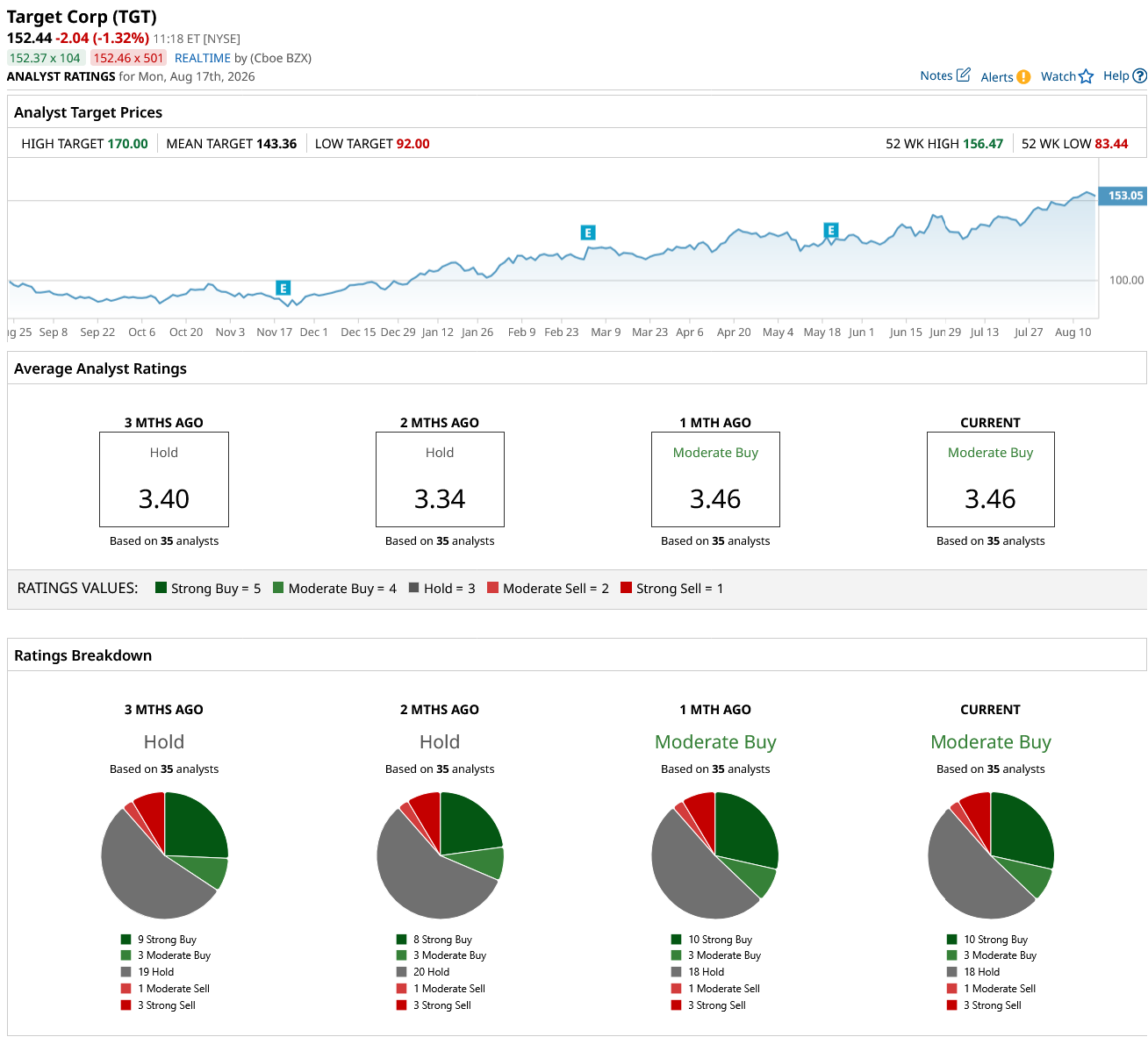
Analysts have been raising Target’s price target before its Q2 earnings report on Aug. 19, believing its turnaround story is gaining momentum. Jefferies initiated coverage with a “Buy” rating and a $177 price target, which is the highest price estimate now, implying a 16% upside from current levels. Telsey Advisory has raised the price target to $170 while maintaining a “Buy” rating. Piper Sandler has lifted its target to $146 from $127, although it retained a “Hold” rating. Truist also moved its target to $147 from $130.
RBC Capital had already raised the price target to $166 from $153 while maintaining a “Buy” rating. Oppenheimer went even further, raising its target to $170 from $140. Analyst Rupesh Parikh believes that management could raise the fiscal 2026 guidance as Target's turnaround efforts are showing continued traction. J.P. Morgan lifted its target to $157 from $129, while UBS raised its target to $166 from $144.
However, not every analyst suddenly became bullish. There were a few skeptics, including Bank of America. The firm increased the target price to $124 but maintained a “Sell” rating for the stock.
Overall, Wall Street has assigned a “Moderate Buy” rating for TGT stock. Of the 35 analysts covering TGT, 10 rate it a “Strong Buy,” three say it is a “Moderate Buy,” 18 rate it a “Hold,” one says it is a “Moderate Sell,” and three say it is a “Strong Sell.” Target's stock has already surpassed its average target price of $143.46. Analysts are now willing to give Target the benefit of the doubt, which is why they have raised the target price for the stock, raising the bar for the Q2 earnings report.
Q1 Was the First Real Sign That Target’s Strategy Is Working
Target’s first quarter results provided enough reasons for analysts to be this optimistic. Net sales rose 6.7% to $25.4 billion, while comparable sales increased 5.6%. Digital sales also increased 9%, while same-day delivery sales jumped more than 27%. What’s more, Target Plus, the company's third-party marketplace, saw a roughly 60% growth in Q1 gross merchandise volume. Adjusted earnings per share climbed 32% to $1.71 per share, with gross margin landing at 29%. The company beat Wall Street’s estimates for both revenue and earnings.
Target's turnaround is not based on one promotional push. Instead, management is trying to change the way the company chooses its merchandise, manages inventory, and presents its stores.
During Q1, the company identified areas that generate about half of its sales now. These categories include beauty, wellness, groceries, children's products, fashion, home furnishings, toys, and entertainment. Target has now added around 1,500 health and wellness items, which generated double-digit sales growth in the category in Q1. The company also added 3,000 new items in the food category, which resulted in 50% growth compared to the previous assortment. Toys also delivered double-digit comparable sales growth.
The company now expects these areas to account for roughly three-quarters of its growth going forward. Target planned its largest grocery transition in more than a decade, resetting nearly half of its center-store assortment and increasing the pace of newness by almost 50%. Furthermore, Target expanded its footprint by adding seven new stores during Q1, including its 2,000th store, and expects to exceed 30 new store openings for the full year. At the same time, the retailer has more than 100 store renovation projects in progress. It is also preparing to roll out its new Target Beauty Studio format across more than 600 locations this fall.
Therefore, the Q2 earnings report is critical as it will show investors whether these merchandising changes and investments can translate into sustained traffic and sales. This is crucial as it will also reveal if Target can continue to grow earnings to be able to maintain its status as a Dividend King. Target has earned this title by paying and increasing dividends for the last 55 years in a row, including its recent 1.8% increase in quarterly dividends.
Currently, Target offers a forward dividend yield of 2.9%, which is higher than the consumer staples and the market average, and also pays a sustainable payout ratio of 56%. The company paid $516 million in dividends in Q1. While Q1 numbers were positive, management warned that Q2 would have the hardest year-over-year (YoY) comparison of the year as Target began lapping the previous year's Nintendo (NTDOY) Switch 2 launch. Management also anticipates that the larger tax refunds that boosted consumer spending in Q1 will wane in the second half of the year. However, for the full year, Target raised its net sales outlook to a range centered around 4% growth and to hit the high end of the $7.50 and $8.50 adjusted EPS range.
Analysts expect the company to report Q1 revenue of $26.1 billion, with EPS landing at $2.34. For the full year, analysts forecast revenue and earnings to increase by 4.1% and 11.9%, respectively.
Investors want to see that Target’s business is progressing despite tougher comparisons and a less favorable consumer backdrop.
On the date of publication, Sushree Mohanty did not have (either directly or indirectly) positions in any of the securities mentioned in this article. All information and data in this article is solely for informational purposes. For more information please view the Barchart Disclosure Policy here.


/Alphabet%20(Google)%20Image%20by%20Markus%20Mainka%20via%20Shutterstock.jpg)
/Netflix%20on%20tv%20with%20remote%20by%20freestocks%20via%20Unsplash.jpg)