Discount grocery store chain Grocery Outlet (NASDAQ:GO) reported Q2 CY2026 results topping the market’s revenue expectations, with sales up 1.1% year on year to $1.19 billion. The company’s full-year revenue guidance of $4.71 billion at the midpoint came in 1.1% above analysts’ estimates. Its non-GAAP profit of $0.20 per share was 60.9% above analysts’ consensus estimates.
Is now the time to buy Grocery Outlet? Find out by accessing our full research report, it’s free.
Grocery Outlet (GO) Q2 CY2026 Highlights:
- Revenue: $1.19 billion vs analyst estimates of $1.17 billion (1.1% year-on-year growth, 2.1% beat)
- Adjusted EPS: $0.20 vs analyst estimates of $0.12 (60.9% beat)
- Adjusted EBITDA: $65.66 million vs analyst estimates of $56.53 million (5.5% margin, 16.1% beat)
- The company lifted its revenue guidance for the full year to $4.71 billion at the midpoint from $4.66 billion, a 1.1% increase
- Management raised its full-year Adjusted EPS guidance to $0.53 at the midpoint, a 6% increase
- EBITDA guidance for the full year is $230 million at the midpoint, above analyst estimates of $226 million
- Operating Margin: 1.3%, in line with the same quarter last year
- Free Cash Flow Margin: 0.1%, down from 1.2% in the same quarter last year
- Locations: 547 at quarter end, down from 552 in the same quarter last year
- Same-Store Sales were flat year on year (1.1% in the same quarter last year)
- Market Capitalization: $972.4 million
Company Overview
Due to its differentiated procurement and buying approach, Grocery Outlet (NASDAQ:GO) is a discount grocery store chain that offers substantial discounts on name-brand products.
Revenue Growth
A company’s long-term sales performance is one signal of its overall quality. Any business can put up a good quarter or two, but the best consistently grow over the long haul.
With $4.74 billion in revenue over the past 12 months, Grocery Outlet is a small retailer, which sometimes brings disadvantages compared to larger competitors benefiting from economies of scale and negotiating leverage with suppliers.
As you can see below, Grocery Outlet’s 7.4% annualized revenue growth over the last three years was tepid.
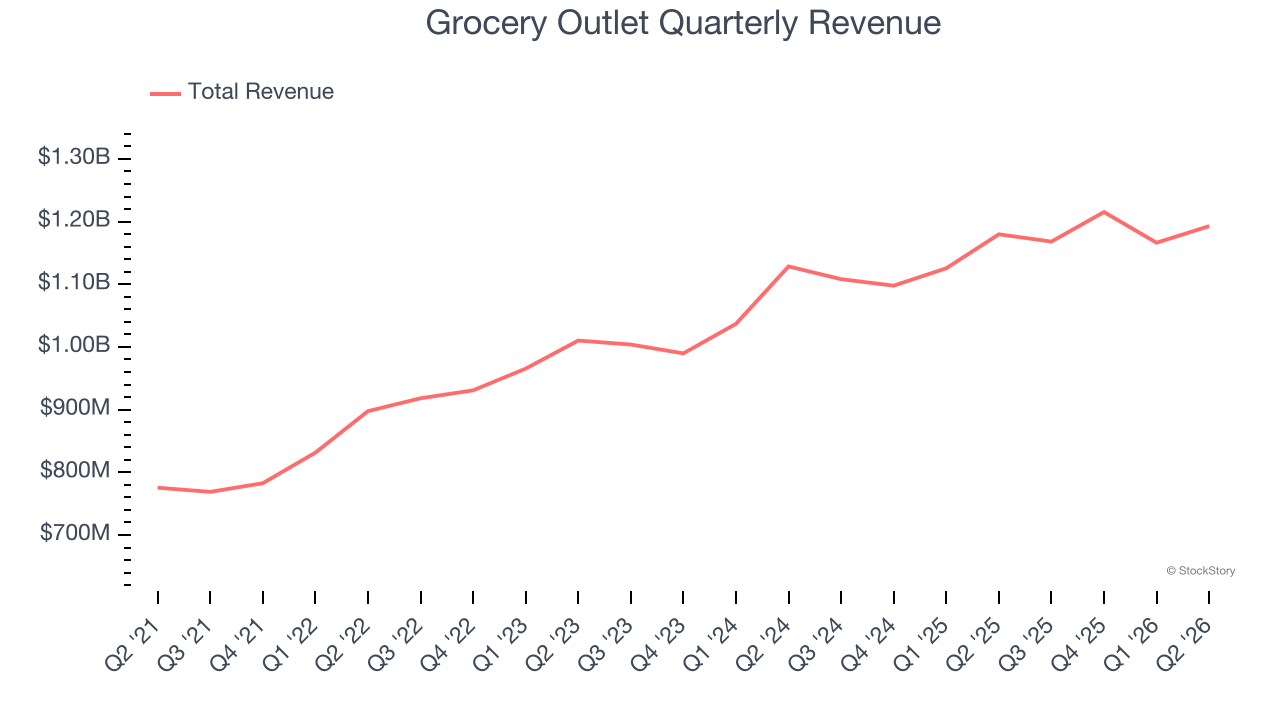
This quarter, Grocery Outlet reported modest year-on-year revenue growth of 1.1% but beat Wall Street’s estimates by 2.1%.
Looking ahead, sell-side analysts expect revenue to remain flat over the next 12 months, a deceleration versus the last three years. This projection is underwhelming and indicates its products will see some demand headwinds.
ONE MORE THING: The $21 AI Application Stock Wall Street Forgot. While Wall Street obsesses over who’s building AI, one company is already using it to print money. And nobody’s paying attention.
AI chip stocks trade at ridiculous valuations. This company processes a trillion consumer signals monthly using AI and trades at a third of the price. The gap won’t last. The institutions will figure it out. You need to see this first. Read the FREE Report Before They Notice.
Store Performance
Number of Stores
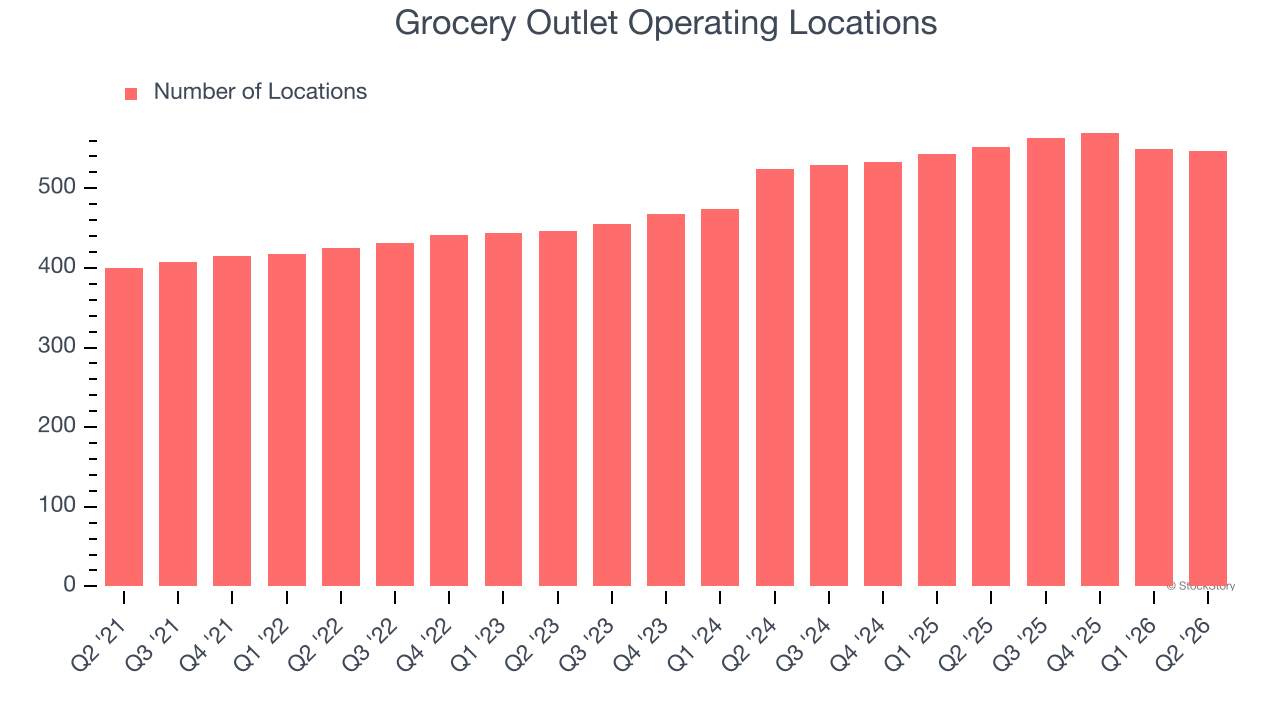
Grocery Outlet sported 547 locations in the latest quarter. Over the last two years, it has opened new stores at a rapid clip by averaging 8% annual growth, among the fastest in the consumer retail sector. This gives it a chance to scale into a mid-sized business over time.
When a retailer opens new stores, it usually means it’s investing for growth because demand is greater than supply, especially in areas where consumers may not have a store within reasonable driving distance.
Same-Store Sales
The change in a company’s store base only tells one side of the story. The other is the performance of its existing locations and e-commerce sales, which informs management teams whether they should expand or downsize their physical footprints. Same-store sales gives us insight into this topic because it measures organic growth for a retailer’s e-commerce platform and brick-and-mortar shops that have existed for at least a year.
Grocery Outlet’s demand within its existing locations has barely increased over the last two years as its same-store sales were flat. Grocery Outlet should consider improving its foot traffic and efficiency before expanding its store base.
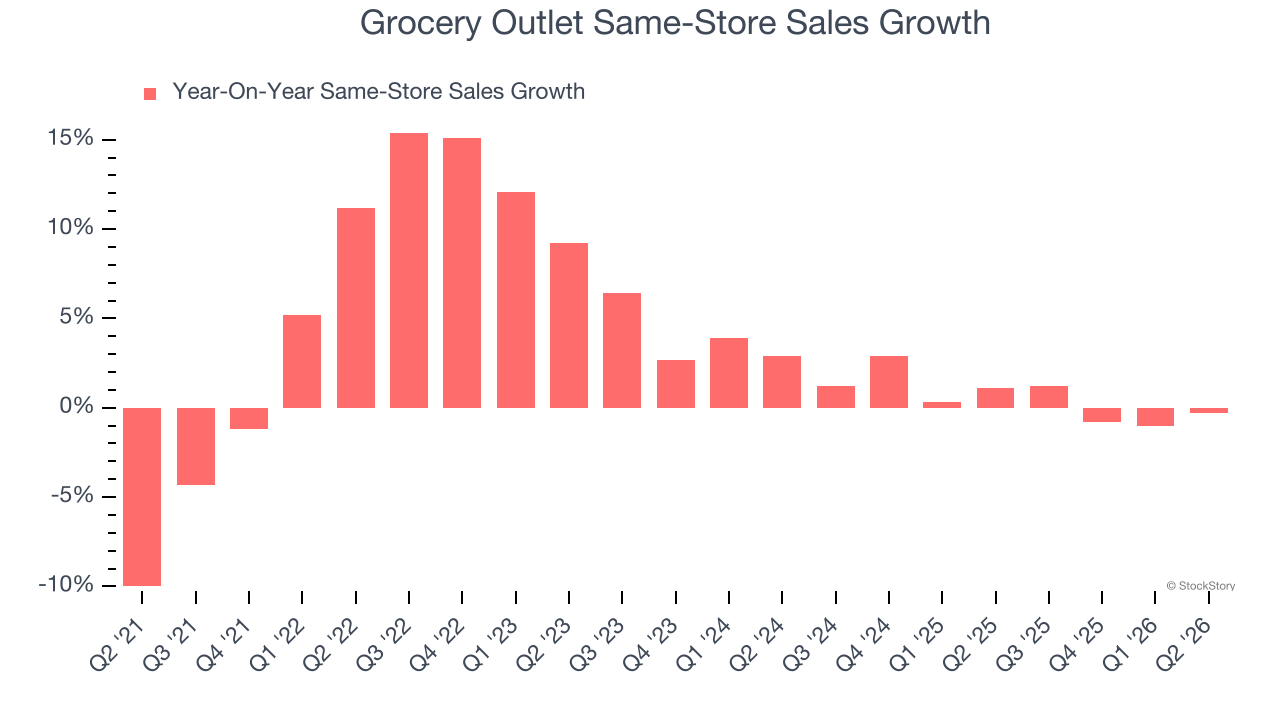
In the latest quarter, Grocery Outlet’s year on year same-store sales were flat. This performance was more or less in line with its historical levels.
Key Takeaways from Grocery Outlet’s Q2 Results
It was good to see Grocery Outlet beat analysts’ EPS expectations this quarter. We were also excited its EBITDA outperformed Wall Street’s estimates by a wide margin. Zooming out, we think this was a solid print. The stock traded up 13.7% to $11.59 immediately following the results.
Grocery Outlet put up rock-solid earnings, but one quarter doesn’t necessarily make the stock a buy. Let’s see if this is a good investment. We think that the latest quarter is only one piece of the longer-term business quality puzzle. Quality, when combined with valuation, can help determine if the stock is a buy. We cover that in our actionable full research report which you can read here (it’s free).

/Sign%20of%20Intel%20at%20entrance%20%20by%20michaelmond.jpeg)

/NVIDIA%20Corp%20logo%20outside%20building-by%20BING-JHEN_HONG%20via%20iStock.jpg)