




Dual Edge Research publishes two powerful newsletters that work great individually — and even better together. The Bull Strangle Newsletter focuses on stocks and options, combining stock ownership with premium-selling strategies to generate consistent income and market-beating returns. The Smart Spreads Newsletter specializes in seasonal commodity futures spreads, offering a diversified approach with low correlation to equities. Together, they deliver a complete investment perspective — one focused on income, the other on diversification — all under one simple subscription.
Introduction
In the previous article, we introduced the step-by-step implementation framework used to build a stock and option income portfolio. Every cycle, the process begins with approximately 5,000 optionable stocks and ends with a carefully selected watch list of just 15 to 25 candidates. The obvious question is:
- How do thousands of stocks become only a handful of opportunities
The answer isn't by searching for reasons to buy stocks. It's by systematically eliminating stocks that do not meet objective criteria. Every filter is designed to improve the overall quality of the remaining candidates. Individually, each filter contributes only a small improvement. Collectively, they dramatically increase the probability that the remaining stocks possess the characteristics we want for a successful stock and option income strategy.
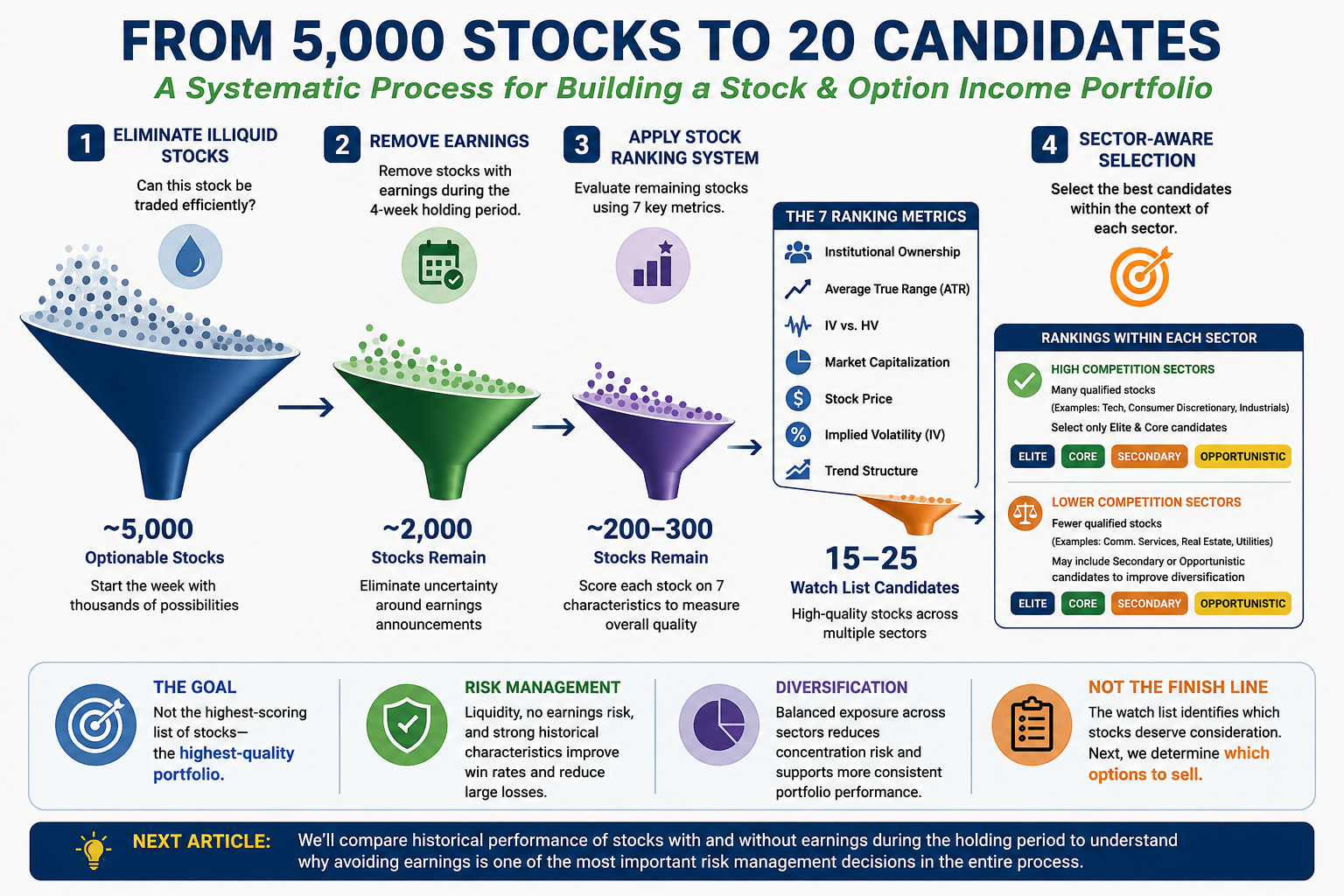
Step 1: Eliminate Illiquid Stocks
The first screen has nothing to do with earnings, valuation, or technical analysis. Instead, it asks a simple question:
- Can this stock be traded efficiently?
For an option-selling strategy, execution quality is critical. Wide bid-ask spreads can quietly erode returns, especially when positions are opened and closed every week. Many otherwise attractive companies are removed immediately because their options do not trade with sufficient liquidity. The objective isn't to find the highest option premiums. It's to find stocks where those premiums can be captured efficiently. This first screen immediately reduces the universe while improving the quality of every trade that follows.
Step 2: Remove Earnings
The next filter removes stocks scheduled to report earnings during the expected four-week holding period. This is one of the most important filters in the entire process. Although earnings often create attractive option premiums, they also introduce a level of uncertainty that differs fundamentally from normal day-to-day market movement.
Rather than attempting to predict how the market will react to an earnings announcement, the Bull Strangle process simply steps aside. We'll examine the historical research supporting this decision in the next article, but for now it's enough to understand that removing earnings significantly changes the overall risk profile of the remaining stocks.
Step 3: Apply the Stock Ranking System
After liquidity and earnings have been addressed, the remaining stocks are evaluated using the seven ranking metrics introduced throughout the previous series. Those characteristics include:
- Institutional Ownership
- Average True Range
- Implied Volatility versus Historical Volatility
- Market Capitalization
- Stock Price
- Implied Volatility
- Trend Structure
Each metric contributes to an overall score. No single characteristic determines whether a stock survives the process. Instead, the objective is to evaluate the stock as a whole.
A company may score exceptionally well in trend structure while receiving a slightly lower score for implied volatility. Another may benefit from strong institutional ownership but rank only average in market capitalization. The combined score provides a more complete picture than any single metric alone. To simplify the results, stocks are grouped into four categories:
- Elite
- Core
- Secondary
- Opportunistic
These classifications make it much easier to compare candidates while maintaining consistency from week to week.
Rankings Are Only Part of the Story
Many ranking systems sort every stock from highest score to lowest score and select the top twenty. At first glance, that seems logical. In practice, however, it often produces a portfolio heavily concentrated in only a few sectors.
If Technology and Consumer Discretionary happen to dominate the rankings during a particular week, those sectors could easily account for most of the watch list. While the individual stocks may all be attractive, the resulting portfolio becomes increasingly dependent on a narrow segment of the market.
The objective of the Bull Strangle process is different. Rather than building the highest-scoring list of stocks, the goal is to build the highest-quality portfolio.
Ranking Within the Context of Each Sector
This is where the Elite, Core, Secondary, and Opportunistic rankings work together with sector diversification. Some sectors naturally produce a large number of qualified candidates. Consumer Discretionary, Technology, and Industrials frequently have multiple stocks that survive the screening process. Because the competition within these sectors is strong, only the highest-ranked candidates—typically Elite and Core—advance to the watch list.
Other sectors provide fewer opportunities. Communication Services, Real Estate, and Utilities may have only one or two stocks that satisfy the liquidity and earnings requirements. In these sectors, a Secondary or occasionally an Opportunistic candidate may still deserve consideration if it improves the overall diversification of the portfolio. This does not mean the standards are relaxed. It means the rankings are evaluated within the context of each sector rather than across the market as a whole. The result is a watch list that balances individual stock quality with portfolio diversification.
The Final Watch List
After applying each of these filters, the original universe of roughly 5,000 stocks has been reduced to approximately 15 to 25 carefully selected candidates. Those stocks are not expected to be the biggest winners over the next month. Instead, they represent companies that have historically exhibited the combination of characteristics associated with successful stock and option income trades. Equally important, they provide broad exposure across multiple sectors rather than concentrating risk in only one or two areas of the market. At this point, however, the work is only half finished. The watch list identifies which stocks deserve consideration. It does not determine which options should be sold.
Other Articles in the Series
Looking Ahead
Every stock on the watch list has already passed multiple objective filters. So why eliminate another group of stocks simply because they report earnings? The answer lies in the historical data.
In the next article, we'll compare the performance of stocks that reported earnings during the holding period with those that did not. As we'll see, avoiding earnings has historically improved returns, increased win rates, and significantly reduced the frequency of large losses—making it one of the most important risk management decisions in the entire implementation process.
Want to build a more complete trading toolkit?
The Bull Strangle Newsletter focuses on stocks and options, combining stock ownership with disciplined option-selling techniques designed to generate consistent income while managing risk.
The Smart Spreads Newsletter focuses on seasonal commodity spreads, a historically proven approach that seeks opportunities across agricultural, energy, metal, and financial futures markets.
Each strategy is designed to stand on its own, but together they provide a diversified approach that can perform across a wide range of market environments. For traders looking to deepen their education, The Bull Strangle Strategy and Trading Commodity Spreads are both available on Amazon.
Visit BullStrangle.com to subscribe for just $1 for the first month.
For a video overview of the Bull Strangle Newsletter
For a video overview of the Smart Spreads Newsletter
Darren Carlat
Dual Edge Research
(214) 636-3133
DualEdgeResearch@gmail.com
Disclaimer
This information is for informational purposes only and should not be considered investment advice. Past performance is not indicative of future results, and all investments carry inherent risk. Consult with a financial advisor before making any investment decisions.




/Netflix%20on%20tv%20with%20remote%20by%20freestocks%20via%20Unsplash.jpg)
/Netflix%20open%20on%20tablet%20by%20rswebsols%20via%20Pixabay.jpg)