




Dual Edge Research publishes two powerful newsletters that work great individually — and even better together. The Bull Strangle Newsletter focuses on stocks and options, combining stock ownership with premium-selling strategies to generate consistent income and market-beating returns. The Smart Spreads Newsletter specializes in seasonal commodity futures spreads, offering a diversified approach with low correlation to equities. Together, they deliver a complete investment perspective — one focused on income, the other on diversification — all under one simple subscription.
Introduction
Energy markets are always sensitive to geopolitics, but there are periods when geopolitical developments become the dominant force behind day-to-day price movement. The current situation involving Iran is a good example. A negative headline can quickly send crude oil and refined products higher as traders price additional risk into global energy supplies. A positive development can have exactly the opposite effect, removing some of that risk premium almost as quickly as it appeared. Trying to predict the next headline is difficult enough; predicting exactly how the market will react can be even harder.
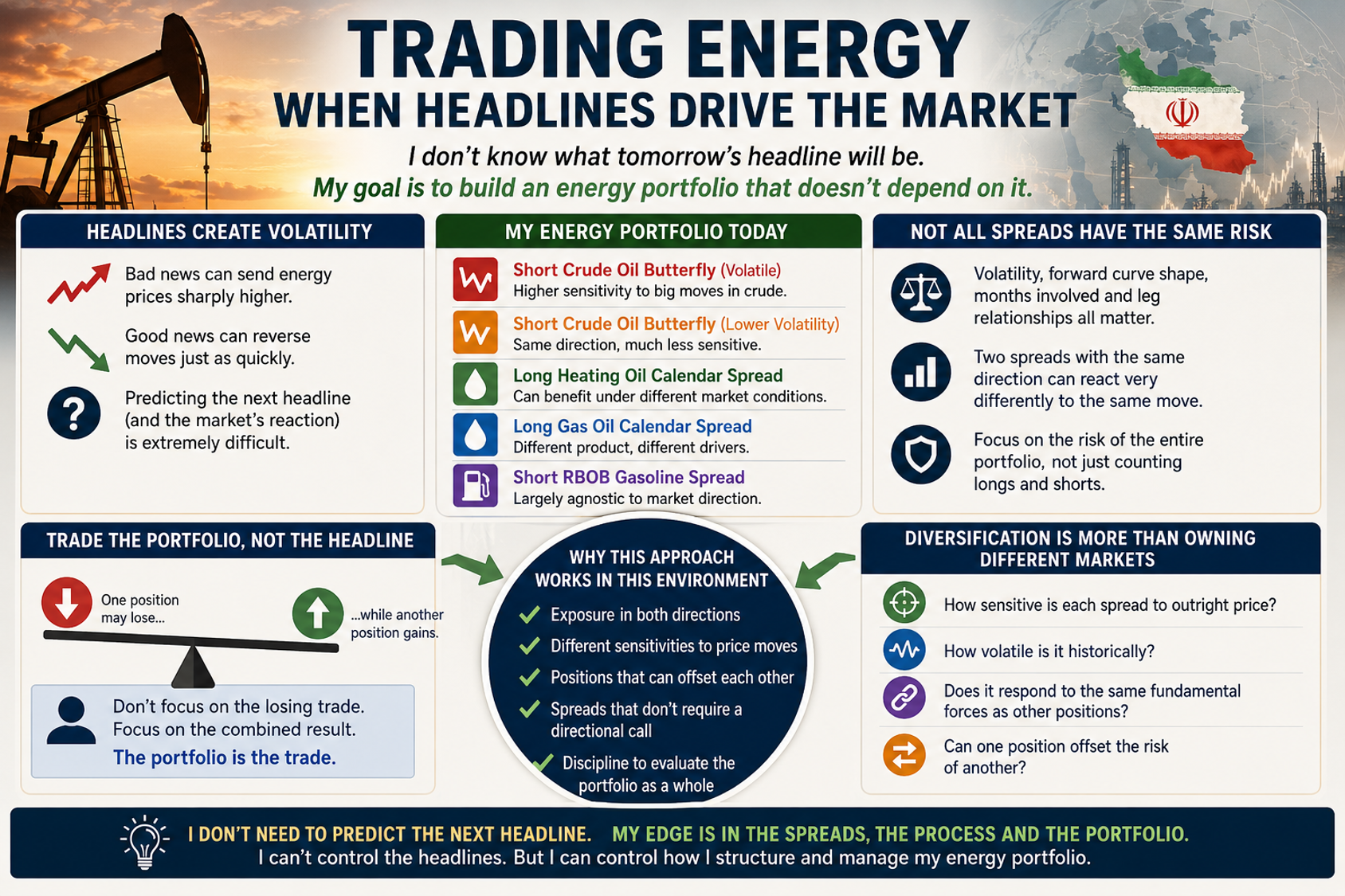
My response has not been to eliminate energy exposure or make a large directional bet. Instead, I have built a portfolio of energy spreads with exposure in both directions and with very different sensitivities to movements in the underlying markets. The objective is straightforward: I don't want the success of the portfolio to depend on correctly predicting tomorrow's headline.
Trading Both Sides of the Market
At the moment, my energy positions include two short crude oil butterfly spreads, a long heating oil calendar spread, a long gas oil calendar spread, and a short RBOB gasoline spread. At first glance, that collection may appear contradictory. Some positions are long, others are short, and one has relatively little sensitivity to the outright direction of energy prices. That's intentional. If every position benefited from higher crude oil prices, I wouldn't really have a diversified portfolio of spreads. I would have one large bullish energy position expressed several different ways. The same would be true if everything benefited from falling prices.
When geopolitical news is driving the market, I want different trades capable of responding differently to the same event. I am not trying to construct a portfolio in which every position wins every day. Instead, I want the positions to complement one another so that the portfolio isn't overly dependent on a single market outcome.
Not All Spreads Have the Same Risk
Even the two crude oil butterfly spreads I currently hold are quite different. One is relatively volatile, so a substantial move in crude oil can produce meaningful swings in the value of the spread. The other is considerably less volatile and tends to respond more modestly to movements in the underlying market. Simply labeling both positions as short crude oil butterflies doesn't adequately describe their risk.
Commodity spread trading is about much more than being long or short. The months involved, the relationship between the legs, the shape of the forward curve, and the historical volatility of the spread can all influence how a position behaves. A volatile spread may react dramatically to a geopolitical event while another spread with the same nominal direction barely moves. Understanding those differences allows me to think about the risk of the entire portfolio rather than simply counting how many positions are long and how many are short.
Different Markets, Different Opportunities
The long heating oil and gas oil calendar spreads add another dimension. Refined products don't always move in lockstep with crude oil. Supply conditions, refinery operations, inventories, transportation constraints, and regional market dynamics can cause different parts of the energy complex to behave very differently. That is one reason I prefer trading spreads rather than simply trying to forecast the direction of crude oil. I can participate in relationships within the energy complex without requiring a specific prediction for the outright price of oil.
The short RBOB gasoline spread takes this concept even further. This particular spread is largely agnostic to the overall direction of gasoline prices. Its opportunity is based more on the relationship between the individual contracts than on whether gasoline itself moves sharply higher or lower. In a market where everyone seems focused on whether energy is going up or down, sometimes the better opportunity is finding a trade that doesn't require answering that question.
Trade the Portfolio, Not the Headline
Perhaps the most important part of managing these positions has been reminding myself to evaluate them collectively. Suppose geopolitical news sends crude oil sharply higher and my more volatile crude oil butterfly suffers a significant loss. The natural reaction is to focus on that position because it is the trade flashing red on the screen. But what if the same market move produces a substantial gain in the heating oil spread? If one trade loses $1,500 while another gains $2,000, concentrating exclusively on the $1,500 loss misses the point of how the portfolio was constructed.
This doesn't mean ignoring a losing trade. Every position still has to be monitored, and a trade that no longer meets its underlying criteria should be reevaluated. But there is an important difference between a trade behaving badly and a trade behaving exactly as expected during a market move that benefits another part of the portfolio. My primary concern isn't whether every position makes money. It is whether the combined portfolio of energy spreads is behaving as intended.
Diversification Is More Than Owning Different Markets
This environment reinforces an important lesson from my commodity spread research: diversification isn't simply a matter of holding several different trades. Five energy spreads that all respond similarly to a sharp increase in crude oil may look diversified on a position sheet, but from a risk perspective they can behave much more like one large trade.
True diversification requires looking beneath the trade labels. How sensitive is each spread to outright price movement? How volatile is it historically? Does it respond to the same forces as the other positions? Could one trade potentially offset some of the risk created by another? These questions matter in normal markets, but they become particularly important when geopolitical headlines can produce sudden moves across the entire energy complex.
I Don't Need to Predict the Next Headline
There will undoubtedly be more developments involving Iran, and energy markets will continue trying to determine what each one means for global supply and risk. Some headlines will be interpreted as bullish, others as bearish, and markets may occasionally reverse their initial reaction altogether. I don't believe I have an edge in predicting those developments, and I don't want to structure a portfolio that requires me to.
My edge is more likely to come from identifying historically attractive spread relationships, understanding how those spreads behave, controlling exposure, and combining positions whose risks aren't identical. So far, maintaining both long and short exposure across several different energy spread structures has worked well. That doesn't mean every trade has worked, nor should it. When a losing position is offset by a profitable position elsewhere, I need to resist the temptation to judge that trade in isolation. The individual positions are the pieces. The portfolio is the trade.
I don't know whether the next headline involving Iran will send crude oil sharply higher or sharply lower. In this environment, I'm trying to make sure I don't have to.
Additional Details
The Bull Strangle Newsletter focuses on stocks and options, combining stock ownership with disciplined option-selling techniques designed to generate consistent income while managing risk.
The Smart Spreads Newsletter focuses on seasonal commodity spreads, a historically proven approach that seeks opportunities across agricultural, energy, metal, and financial futures markets.
Each strategy is designed to stand on its own, but together they provide a diversified approach that can perform across a wide range of market environments. For traders looking to deepen their education, The Bull Strangle Strategy and Trading Commodity Spreads are both available on Amazon.
Visit BullStrangle.com to subscribe for just $1 for the first month.
For a video overview of the Bull Strangle Newsletter
For a video overview of the Smart Spreads Newsletter
Darren Carlat
Dual Edge Research
(214) 636-3133
DualEdgeResearch@gmail.com
Disclaimer
This information is for informational purposes only and should not be considered investment advice. Past performance is not indicative of future results, and all investments carry inherent risk. Consult with a financial advisor before making any investment decisions.





/Netflix%20open%20on%20tablet%20by%20rswebsols%20via%20Pixabay.jpg)