



/Standard%20Uranium%20geologists%20prospecting%20outcrops%20on%20the%20Sun%20Dog%20Project%20near%20Uranium%20City%2C%20northern%20Saskatchewan_.png)
This is sponsored content. Barchart is not endorsing the websites or products set forth below.
- Global nuclear power is surging back into long-term energy plans, driving structural uranium shortages as years of underinvestment leave mine supply trailing rapidly rising reactor demand.
- Standard Uranium is a pure-play discovery company with 13 projects covering more than 235,000 acres in Canada’s Athabasca Basin region—the world’s top district for high-grade uranium discovery—leveraging a project-generator model that advances multiple assets through partner-funded exploration while preserving capital for its flagship Davidson River Project.
- With drilling planned across several projects through 2026, including an 8,000-metre program at Davidson River along strike from significant uranium discoveries, the company offers investors multiple discovery catalysts and leveraged exposure to the world’s premier uranium district.
Around the globe, nuclear power is re-emerging as a cornerstone of long-term energy planning, elevating uranium from a forgotten fuel to a critical input for reliable, carbon-free baseload electricity. But years of limited exploration and delayed mine development have left new uranium discoveries and supply lagging behind demand.
That imbalance is pushing attention toward companies focused on discovery rather than production. Standard Uranium Ltd. (TSXV: STND | OTCQB: STTDF | FSE: 9SU0) sits squarely in that space, targeting new discoveries in Canada’s Athabasca Basin, the world’s highest-grade uranium district.
“Our main goal as an exploration and project generator company is to have as many of our projects advanced every year as possible. With our project generator model, we bring in other companies to fund and advance those projects. If they stay, the project advances on their dollar. If they walk away, we get 100% of the project back along with all the data and work that’s been paid for.” —Jon Bey, CEO of Standard Uranium
According to the World Nuclear Association’s 2025 Fuel Report, global reactor uranium requirements in 2025 total approximately 68,920 tonnes of uranium, equivalent to roughly 179 million pounds of U₃O₈.
Industry production data indicate that current primary mine supply covers only about 130 to 140 million pounds, with the balance being met through depleting secondary sources such as inventories, reprocessed fuel, and government stockpiles.
Sprott Asset Management’s latest uranium market analysis estimates a cumulative global uranium supply shortfall of approximately 1.4 billion pounds by 2045. Under an accelerated pathway aligned with the Net Zero Nuclear pledge, which calls for tripling global nuclear capacity by mid-century, Sprott estimates that the deficit could expand to nearly 3.1 billion pounds.
That structural deficit is likely to grow as nuclear power gains ground globally. Reactors that were once slated for retirement are returning to service, while new units continue to move through construction pipelines.
International nuclear industry data show that 14 reactors have restarted in Japan since the Fukushima shutdowns, while approximately 165 nuclear power reactors are currently operating across Europe. Globally, there are about 440 reactors in service and roughly 65 additional units under construction, with China and India accounting for a significant share of new-build activity.
“Global demand for uranium has never been stronger,” said Jon Bey, CEO of Standard Uranium (STND.VN) (STTDF), which holds interests across 13 projects spanning 235,000 acres in the Athabasca Basin, a region that supplies roughly 20% of the world’s uranium.

“We are a pure exploration company. Our job is to make the discovery and then sell that project to a uranium mining company,” he said, noting that there is no better place on the planet to make these discoveries than the Athabasca Basin.
A capital-efficient project generator model
What sets Standard apart from many junior explorers is how it funds its ambition.
“Our main goal as an exploration and project generator company is to have as many of our projects advanced every year as possible,” Bey explained.
“With our project generator model, we bring in other companies to fund and advance those projects. If they stay, the project advances on their dollar. If they walk away, we get 100% of the project back along with all the data and work that’s been paid for.”
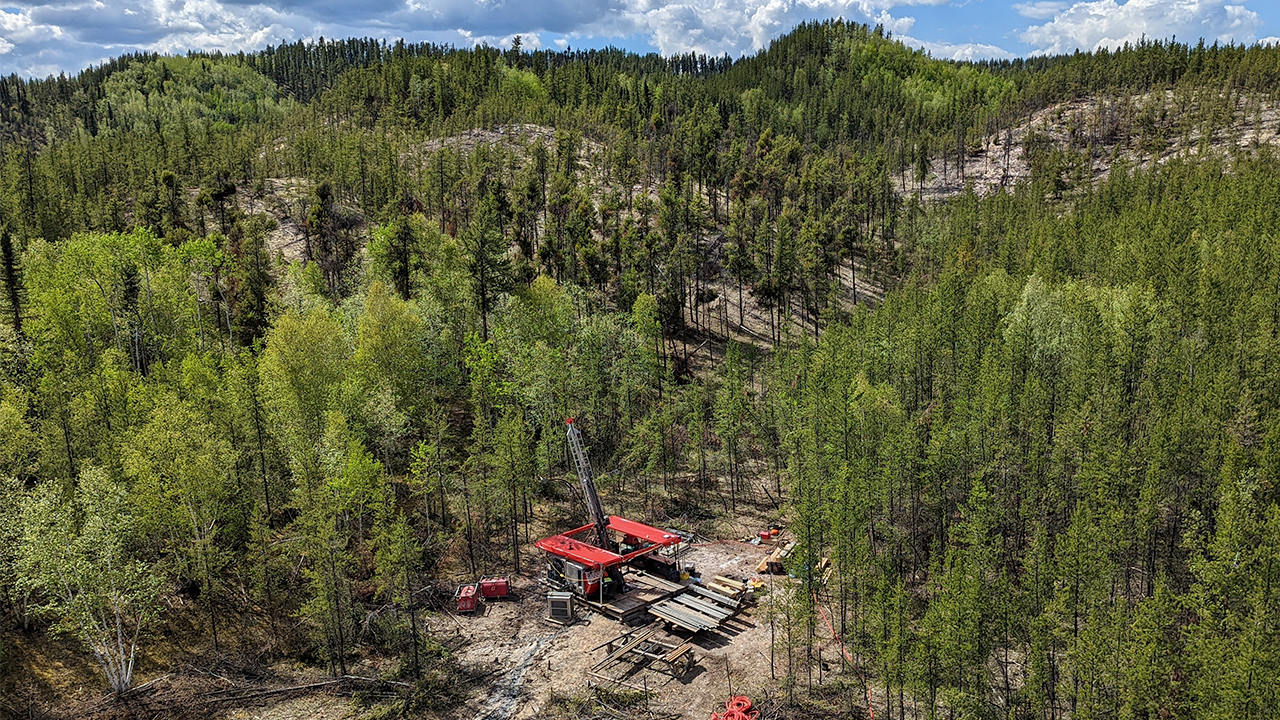
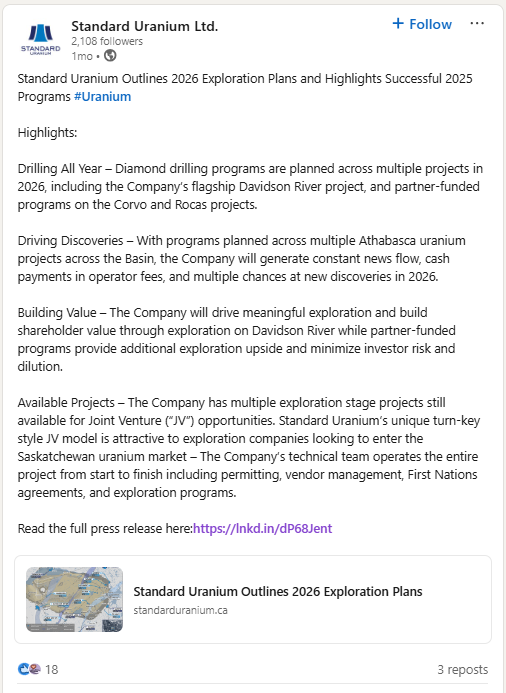
In practice, that means Standard concentrates its own capital on its flagship Davidson River Project while joint venture partners fund exploration on other projects including Corvo, Rocas, and Sun Dog.
Currently, the Corvo Project is under a joint venture with Aventis Energy and Rocas is optioned to Collective Metals. In each case, partners are funding exploration while Standard operates the programs, retaining exposure to discovery upside without bearing the full cost of drilling.
That structure allows the company to keep multiple projects active across the Athabasca Basin, generate steady news flow, and limit shareholder dilution, while preserving its highest-conviction capital for Davidson River.
For investors, the structure provides two layers of exposure. There is direct upside from Davidson River, and additional optionality from partner-funded drilling elsewhere in the portfolio.
Davidson River: operating in a proven company
Davidson River sits in the southwest Athabasca Basin, approximately 25 to 30 kilometres west of the Arrow and Triple R deposits, along the same structural trends that host these discoveries.
The Arrow deposit, discovered by NexGen Energy, is regarded as one of the largest undeveloped uranium projects in the world. It hosts probable mineral reserves of approximately 240 million pounds of U₃O₈ at an average grade of about 2.4%, supported by total measured, indicated, and inferred resources well in excess of 300 million pounds.
That combination of size and grade places Arrow among a very small group of tier-one uranium assets and makes it central to discussions about future global supply.
To the east along the same corridor, the Triple R deposit hosts about 115 million pounds of indicated and roughly 15 million pounds of inferred resources, again at strong grades that underpin advanced engineering and economic studies. Like Arrow, Triple R is a basement-hosted deposit, which is the dominant discovery model in the southwest Athabasca Basin, and the same geological setting is being targeted at Davidson River.
Taken together, Arrow and Triple R represent more than 430 million pounds of contained U₃O₈ discovered along this structural corridor, underlining the exceptional endowment of the district. For Standard Uranium, having Davidson River positioned directly along this proven trend reinforces the view that the southwest Athabasca remains one of the most fertile uranium exploration addresses globally and explains why the project continues to attract exploration focus and capital.
“We haven’t made a discovery yet, and we don’t have a resource,” Bey said. “What you can do is look across the street. There are three to four hundred million pounds of uranium already discovered right next to Davidson River. That’s the scale of what we’re targeting.”
A portfolio built to keep drills turning
With the southwest Athabasca defining the scale of what is possible at Davidson River, Standard’s broader portfolio is designed to ensure exploration momentum does not hinge on a single drill program. Instead, the company has structured its project pipeline to keep drills turning across multiple assets, backed by experienced technical leadership and strong First Nations partnerships.
Beyond Davidson River, Standard’s eastern Athabasca projects are positioned to deliver steady exploration activity through 2026. The Corvo Project, under option to Aventis Energy, is slated for a comprehensive ground gravity survey, followed by approximately 3,000 metres of drilling in 2026. That campaign will mark the first drilling on Corvo in more than four decades and will test priority targets, including a never-drilled location, where surface samples have returned uranium grades as high as 8.10% U₃O₈.
The Rocas Project is also scheduled for its first-ever drill program next year. Drilling will focus on a 7.5-kilometre target zone where recent surveys have highlighted areas that show the kinds of geological characteristics often linked to uranium deposits.
Further north, Sun Dog sits in Saskatchewan’s historic Uranium City district. Previous drilling and surface work have already returned widespread anomalous uranium, and the project continues to advance toward future partner-funded drilling as targeting is refined.
Taken together, the schedule reflects a deliberate strategy to maintain year-round exploration activity. “We’ll essentially be drilling all year, at a minimum on three different projects,” said Sean Hillacre, Standard Uranium’s President and VP of Exploration.
That drilling pipeline is underpinned by groundwork already in place at Davidson River. The company has secured multi-year drill permits, retained key contractors, and signed exploration agreements with the Clearwater River Dene Nation, positioning the flagship project for a planned 8,000-metre drill program beginning in early spring 2026.
“This is the project the company was built around,” Hillacre said. “The big opportunity is to find something even close to Arrow.”
Hillacre’s confidence is grounded in direct experience. He completed his master’s research on the Arrow deposit while working with NexGen Energy. That work shaped his technical approach and informs how Standard Uranium is targeting Davidson River today. Since joining Standard, Hillacre has helped assemble a technical team drawing on experience from across the Basin, applying modern geophysics and data-driven targeting to ground that has seen little systematic drilling relative to its potential.
Why investors are watching Standard Uranium now
At current levels, Standard Uranium trades with a market capitalization in the mid-teens of millions, with roughly 140 million shares outstanding. That valuation reflects exploration risk, but it also leaves room for appreciation if drilling delivers results.
“If you believe in where nuclear is heading and how valuable uranium is going to be, you want companies with real upside,” Bey said. “Every one of our drill programs has home-run potential.”
For investors, the appeal is straightforward. Standard Uranium offers concentrated exposure to the Athabasca Basin, a disciplined project generator model that limits dilution, multiple shots on goal through partner-funded drilling, and a near-term catalyst path that aligns with a tightening uranium market.
In a cycle increasingly defined by scarcity, discovery remains the highest-impact lever. Standard Uranium is positioning itself where that leverage matters most.
To learn more about Standard Uranium, visit their website or follow them on social media: LinkedIn, X, Facebook
The above is sponsored content. Barchart was paid up to two thousand dollars for placement and promotion of the content on this site and other forms of public distribution covering the period of December 2025. For more information please view the Barchart Disclosure Policy here.



/AI%20(artificial%20intelligence)/3D%20Graphics%20Concept%20Big%20Data%20Center%20by%20Gorodenkoff%20via%20Shutterstock.jpg)
/A%20Virgin%20Galactic%20banner%20displayed%20on%20the%20New%20York%20Stock%20Exchange%20by%20Christopher%20Penler%20via%20Shutterstock.jpg)