




Happy Halloween and the start of November market watchers!
It is the beginning of the holiday season and there is nothing better than seeing how excited my kids are to kick it off with costumes and candy.
Temperatures are dropping and the feel of fall is in the air. We are thankful for the recent moisture ahead of the first freeze. While the rain slowed the progress of fall crop harvest, it was worth the delay.
It would also have been worth the wait to sell soybeans with the return of China buying and President Trump’s meeting on Thursday in South Korea sparking optimism of further orders. November soybean futures traded a near 50-cent range this week although with significant volatility. While I was expecting that we’d see a spike higher, but followed by a selloff to finish the week that was also the end of the month, it turned out to be more of a sell the fact and buy the rumor rather than the other way around.
I ended up following the news in the early morning hours of Thursday to follow the updates of President Trump and Xi’s meeting late morning Asia-time. While there was no press conference immediately after the meeting, President Trump gave his usual off-the-cuff comments to reporters aboard Air Force One, describing how “amazing” the meeting was and calling it a 12 out of 10. We have seen that level of optimism before that is then not reciprocated by the other side. However, while there was a pregnant pause of the “agreement”, actual numbers of commitments did surface for soybeans that sparked the markets additional push.
As has become custom, the Chinese bought US soybeans ahead of the meeting and then announced more purchases on Friday morning. In total, they have committed to buying 12 million metric tons by January and then at least 25 million metric tons every year for the remainder of President Trump’s term compared to an average purchase volume of around 30 million metric ton annually from 2020-2024. There were apparently other agricultural products including grain sorghum discussed as well, but no details have been released. I also understand that Brazil soybean bids have suddenly dropped 50 cents per bushel since the US deal was made given China is back in an arbitrage position.
In a calculated move ahead of the Trump-Xi meeting, the US Trade Representative's office announced an investigation into China’s ag purchase commitments under the prior Trump Administration given that all the agreed purchases were not made. Therefore, while there are announced commitments, there can always be exceptions based on relative pricing. The bottomline is that these agreements are really only as good as the paper they are written on. China is known for cancelling even routine orders and shipments and so it is difficult to read into this “deal” with much certainty.
President Trump said he will be visiting China in April followed by a visit of President Xi to the US. Therefore, we have a trade truce now with more definition likely in April, but with plenty of opportunity for positioning between now and then.
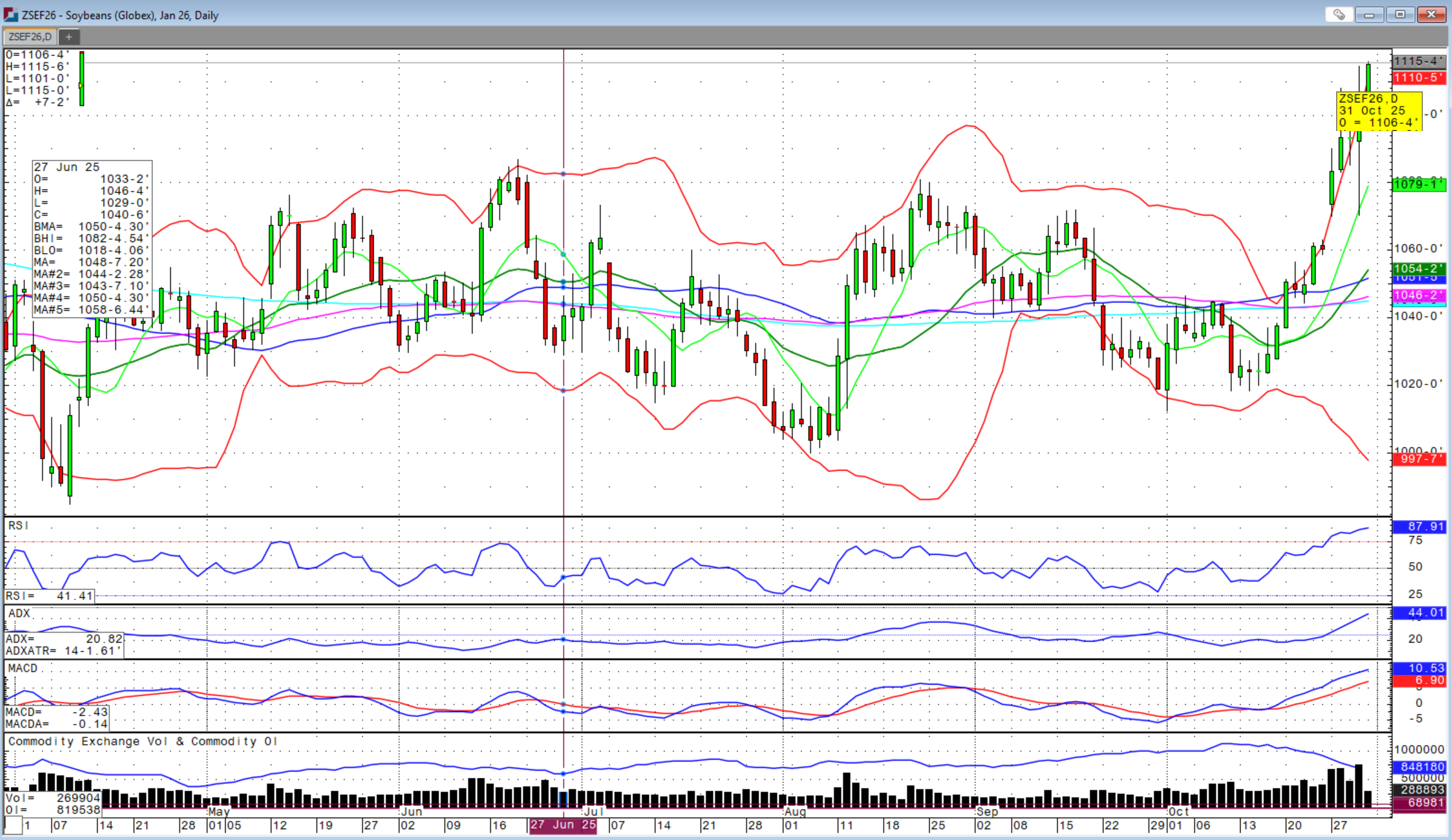
January futures are now the front-month soybean contract for cash pricing purposes that made a new high on Friday and even closing above Thursday’s high.
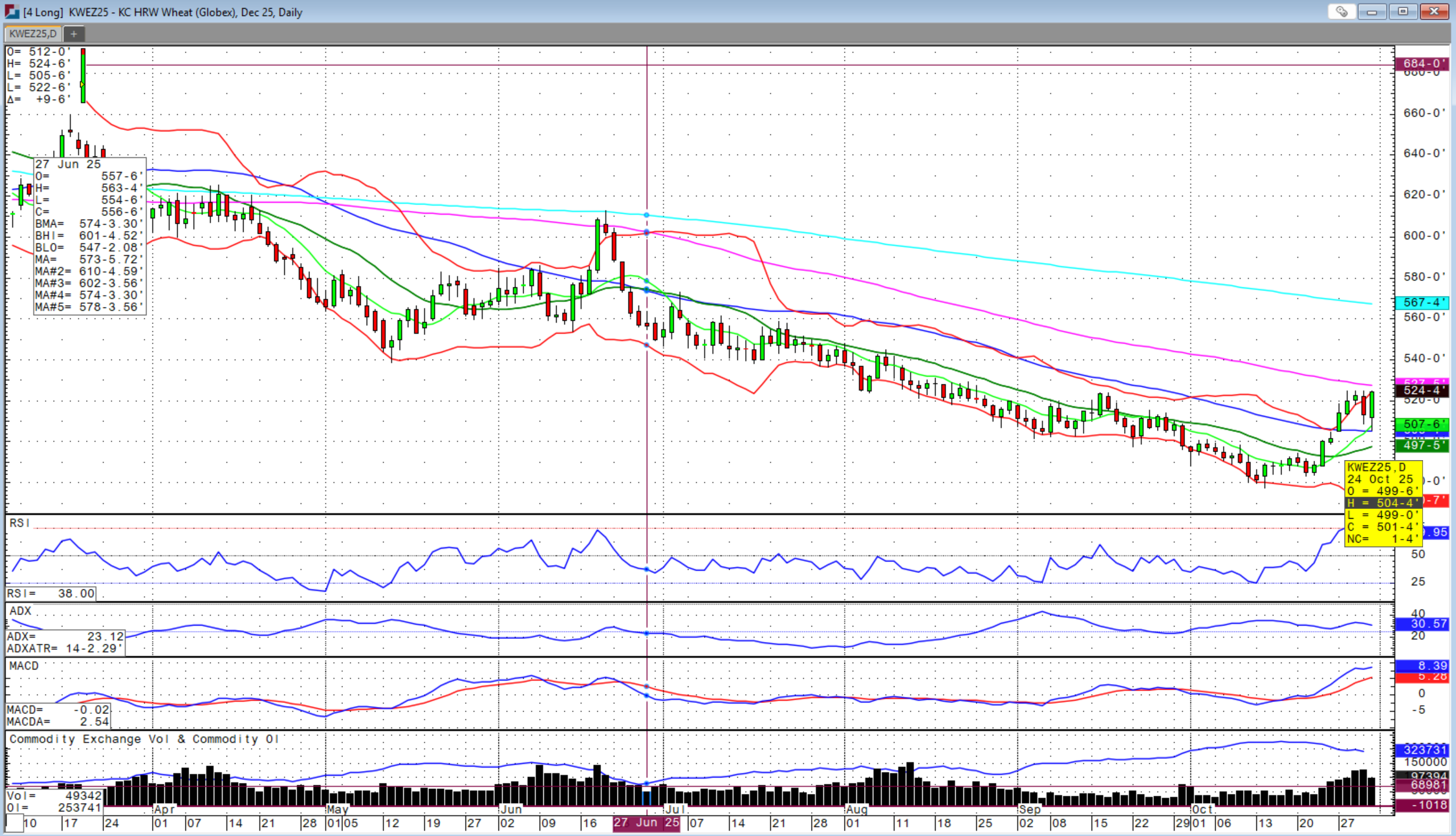
In fact, all grain charts surged on Friday after early weakness. Wheat contracts almost filled the chart gaps from Sunday night’s opening, but bounced off key moving averages before doing so. While wheat contracts did not make a Friday high above Thursday’s high, it came very close, but did close right near session highs. The 100-day moving averages are just above for wheat contracts, which will likely be resistance unless we see bullish news to push above.
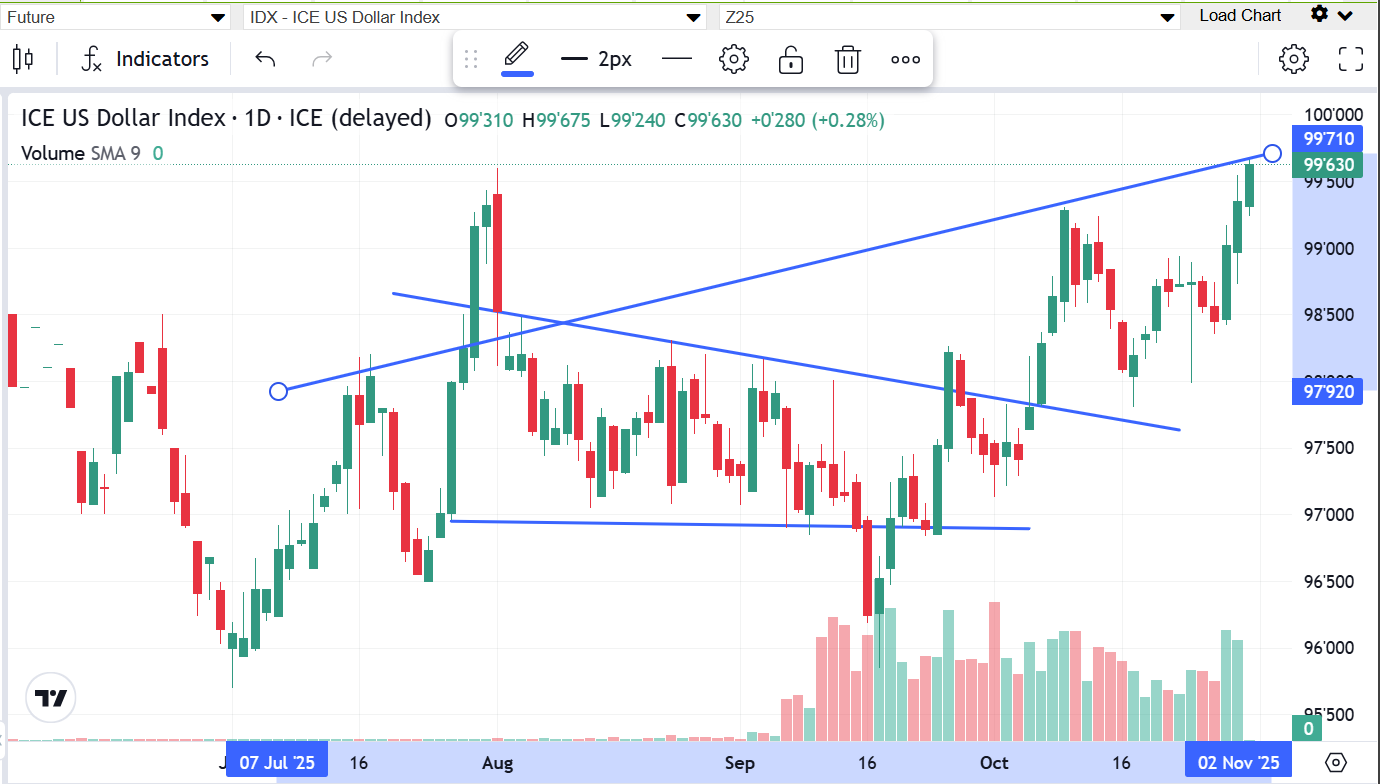
The US dollar surged this week after Fed Chair Powell cut interest rates by 25 basis points, but warned that inflationary pressures were likely to prevent another rate cut this year. KC Fed President Schmid dissented to the rate cut with concerns that inflation is yet to be tamed. However, the weakening employment outlook led to the majority of FOMC voting members deciding that a rate cut was needed at this time. It is a tricky time for monetary policy as the Fed’s two mandates are moving in the opposite direction that a rate cut or rate rise would solve.
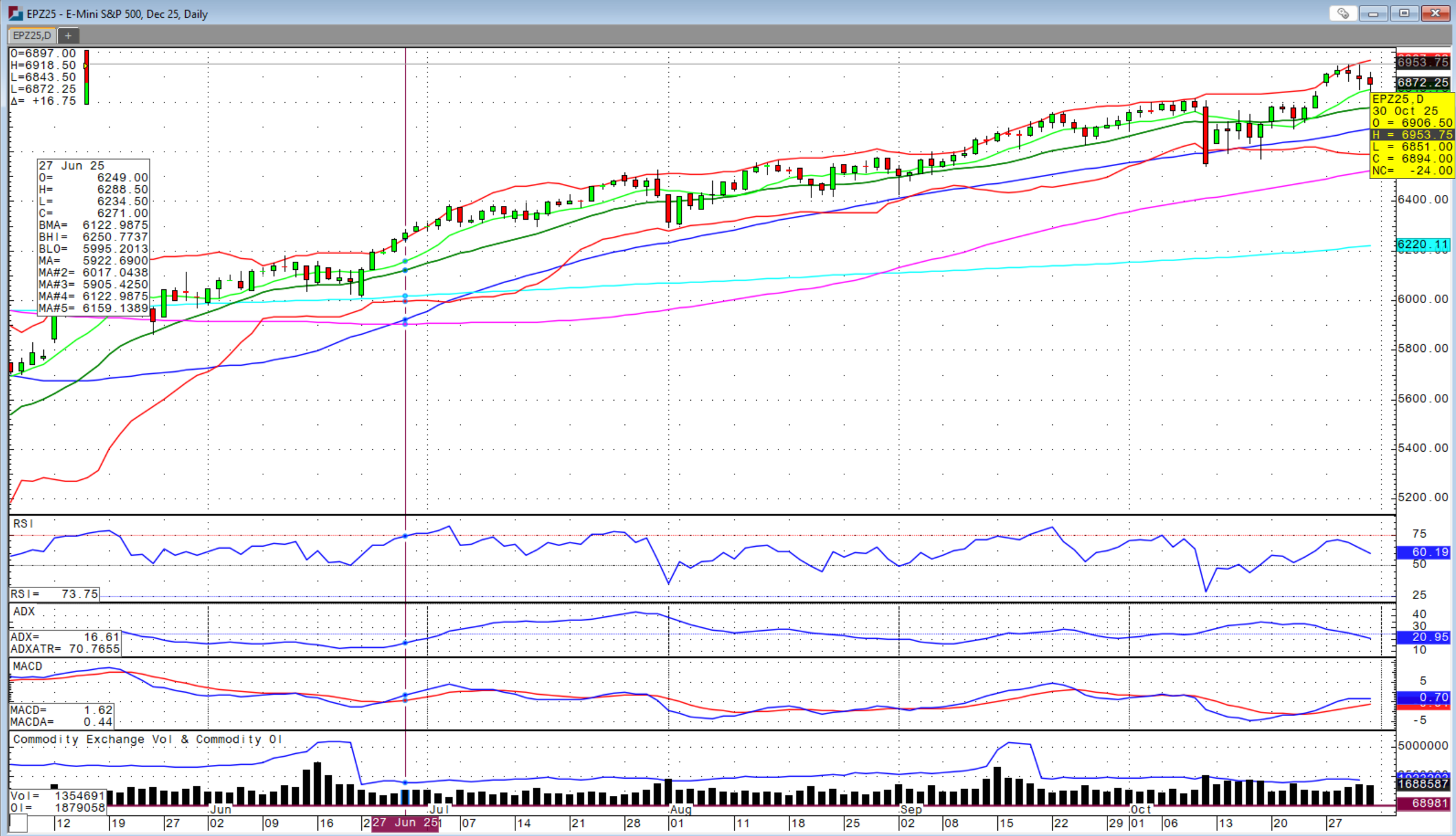
Meanwhile, equity markets made new, record highs again in choppy trade with the lead up and post emotions of the week’s geopolitical events.
With cattle markets often following stock market sentiments, this week was different. The confluence of political statements and headlines directly involving beef prices led to one of the wildest weeks in the cattle market ever. From the October 14th high to this Wednesday’s low, feeder futures dropped $55.10 per cwt!
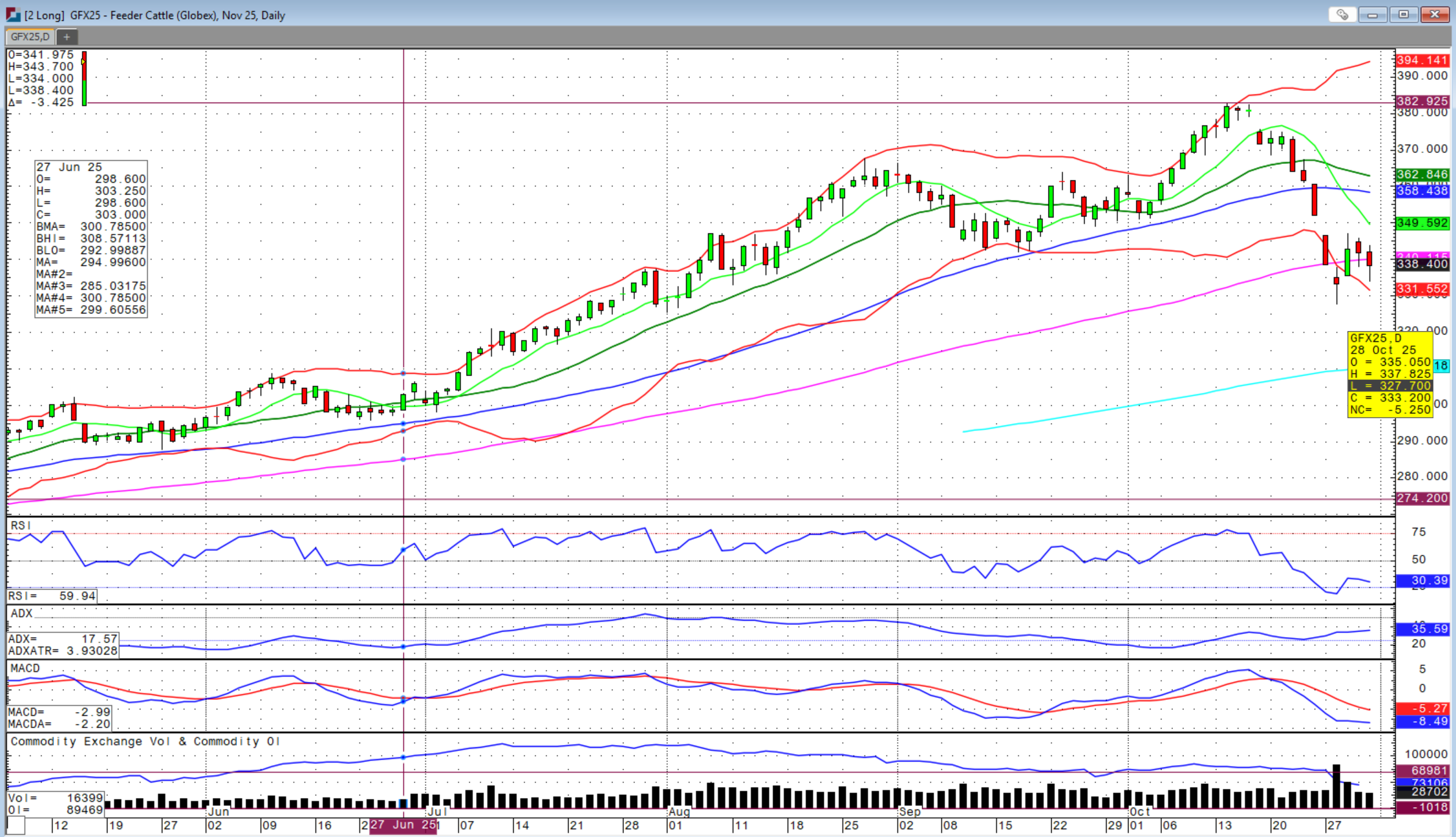
While last week’s news that the Mexican Ag Minister would visit the US this week led to the drop in the market, this week’s news that the border would not reopen resulted in feeder futures being limit up on expanded limits of $13.75 at one point while closing over $9.00 per cwt higher on the day. It is said that the Mexican Ag Minister will be visiting the US this next week given this week’s meeting was over a video conference. While the border will remain shut in the near term, any timeline of a reopening would pressure the cattle market lower.
There are chart gaps above that this feeder market should fill with a rally, but nothing about this cattle market is certain in the current environment. Headlines have and can continue to viciously move this market beyond expectations in either way. The lack of government reports in all markets has made trading all the more sensitive to headline risk.
The US government shutdown has now extended over 30 days. There are rumors that we could see the government reopen this next week. Whenever this happens, there will be a slew of government data for the market to catch up on that will likely create volatility in the markets. The Russia-Ukraine negotiations will also become a key headline in the coming weeks as could the reemergence of the Israeli-Palestinian ceasefire that nearly fell apart this past week. The situation in Venezuela is also heating up.
The US Senate voted this week to stop Brazilian and Canadian tariffs calling them illegal with several Republicans siding with Democrats to pass them. The Brazilian tariffs will have a direct impact on the beef market as well.
All of these items could have consequences for market sentiment with only two months remaining to the end of the year. There is a lot of uncertainty ahead both domestically and internationally. The cattle market, in particular, will be sensitive to such rhetoric not to mention the Trump Administration talking more about bringing down beef prices. However, I believe we could rally back to the 50-day moving averages in both feeder and fed cattle futures contracts. I would advise taking price protection action at those levels unless there is news to suggest otherwise.
Sidwell Strategies is the one-stop shop to protect cattle with futures, puts, LRP or a combination of all, which is probably the best strategy overall. If you’re ready to trade commodity markets, give me a call at (580) 232-2272 or stop by my office to get your account set up and discuss risk management and marketing solutions to pursue your objectives. Self-trading accounts are also available. It is never too late to start and there is no operation too small to get a risk management and marketing plan in place.
Wishing everyone a successful trading week! Let us know if you'd like to join our daily market price and commentary text messages to stay informed!
Brady Sidwell is a Series 3 Licensed Commodity Futures Broker and Principal of Sidwell Strategies. He can be reached at (580) 232-2272 or at brady@sidwellstrategies.com. Futures and Options trading involves the risk of loss and may not be suitable for all investors. Review full disclaimer at https://www.sidwellstrategies.com/fccp-disclaimer-21951.


/NVIDIA%20Corp%20logo%20on%20phone-by%20Evolf%20via%20Shutterstock.jpg)
/Micron%20Technology%20Inc_%20logo%20on%20building-by%20vzphotos%20vis%20iStock.jpg)
/Tesla%20Inc%20tesla%20by-%20Iv-olga%20via%20Shutterstock.jpg)
/Amazon_com%20Inc_%20storefront%20by-%20%20Markus%20Mainka%20via%20Shutterstock.jpg)