




Genomics company Illumina (NASDAQ:ILMN) reported revenue ahead of Wall Street’s expectations in Q2 CY2026, with sales up 9.4% year on year to $1.16 billion. The company’s full-year revenue guidance of $4.62 billion at the midpoint came in 1.1% above analysts’ estimates. Its non-GAAP profit of $1.31 per share was 6.8% above analysts’ consensus estimates.
Is now the time to buy Illumina? Find out by accessing our full research report, it’s free.
Illumina (ILMN) Q2 CY2026 Highlights:
- Revenue: $1.16 billion vs analyst estimates of $1.13 billion (9.4% year-on-year growth, 2.5% beat)
- Adjusted EPS: $1.31 vs analyst estimates of $1.23 (6.8% beat)
- Adjusted Operating Income: $260 million vs analyst estimates of $248.1 million (22.4% margin, 4.8% beat)
- The company lifted its revenue guidance for the full year to $4.62 billion at the midpoint from $4.57 billion, a 1.1% increase
- Management raised its full-year Adjusted EPS guidance to $5.35 at the midpoint, a 2.4% increase
- Operating Margin: 21.1%, in line with the same quarter last year
- Free Cash Flow Margin: 14%, down from 19.3% in the same quarter last year
- Organic Revenue rose 6.5% year on year (beat)
- Market Capitalization: $29.48 billion
"Illumina delivered strong results during the second quarter. Momentum continued to build through the first half of 2026, as our technology is enabling clinical customers to expand sequencing-intensive applications. Based on this performance, we are increasing our revenue and earnings guidance for the year," said Jacob Thaysen, Chief Executive Officer of Illumina.
Company Overview
Pioneering the ability to read the human genome at unprecedented speed and affordability, Illumina (NASDAQ:ILMN) develops and sells advanced DNA sequencing and microarray technologies that allow researchers and clinicians to analyze genetic variations and functions.
Revenue Growth
Reviewing a company’s long-term sales performance reveals insights into its quality. Any business can put up a good quarter or two, but many enduring ones grow for years. Regrettably, Illumina’s sales grew at a tepid 2.5% compounded annual growth rate over the last five years. This was below our standards and is a poor baseline for our analysis.
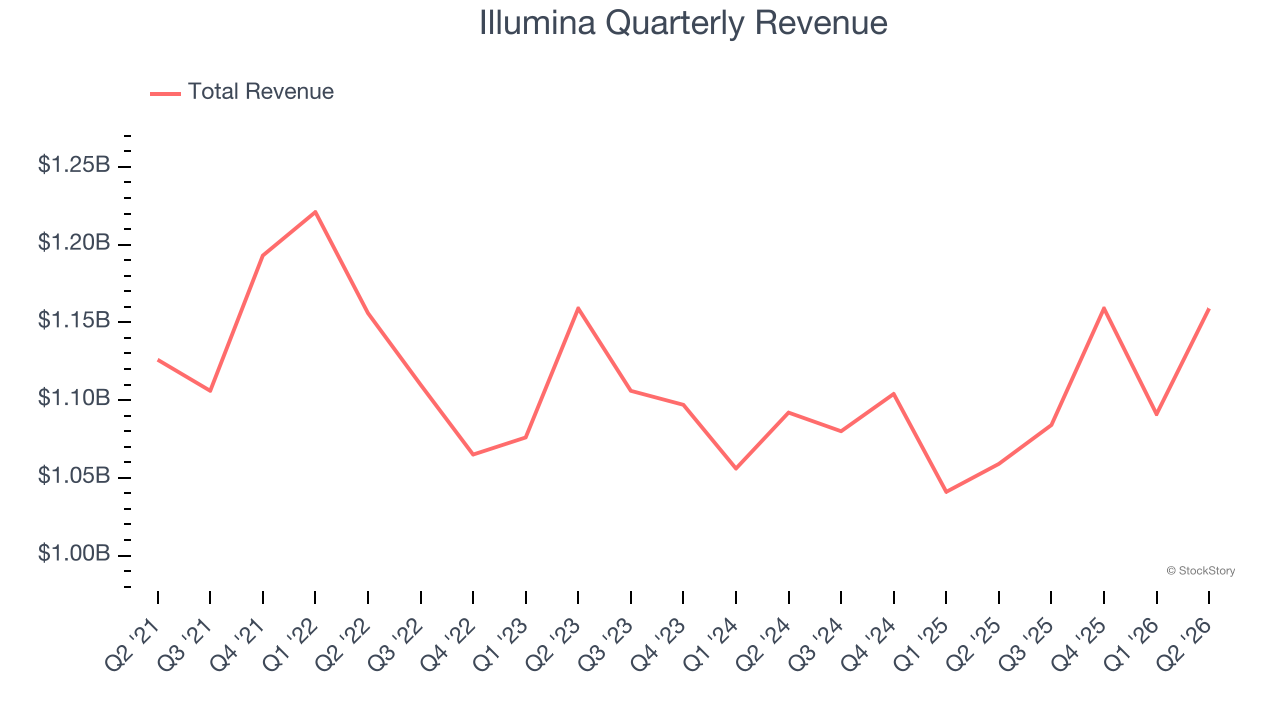
We at StockStory place the most emphasis on long-term growth, but within healthcare, a half-decade historical view may miss recent innovations or disruptive industry trends. Illumina’s annualized revenue growth of 1.6% over the last two years aligns with its five-year trend, suggesting its demand was consistently weak. 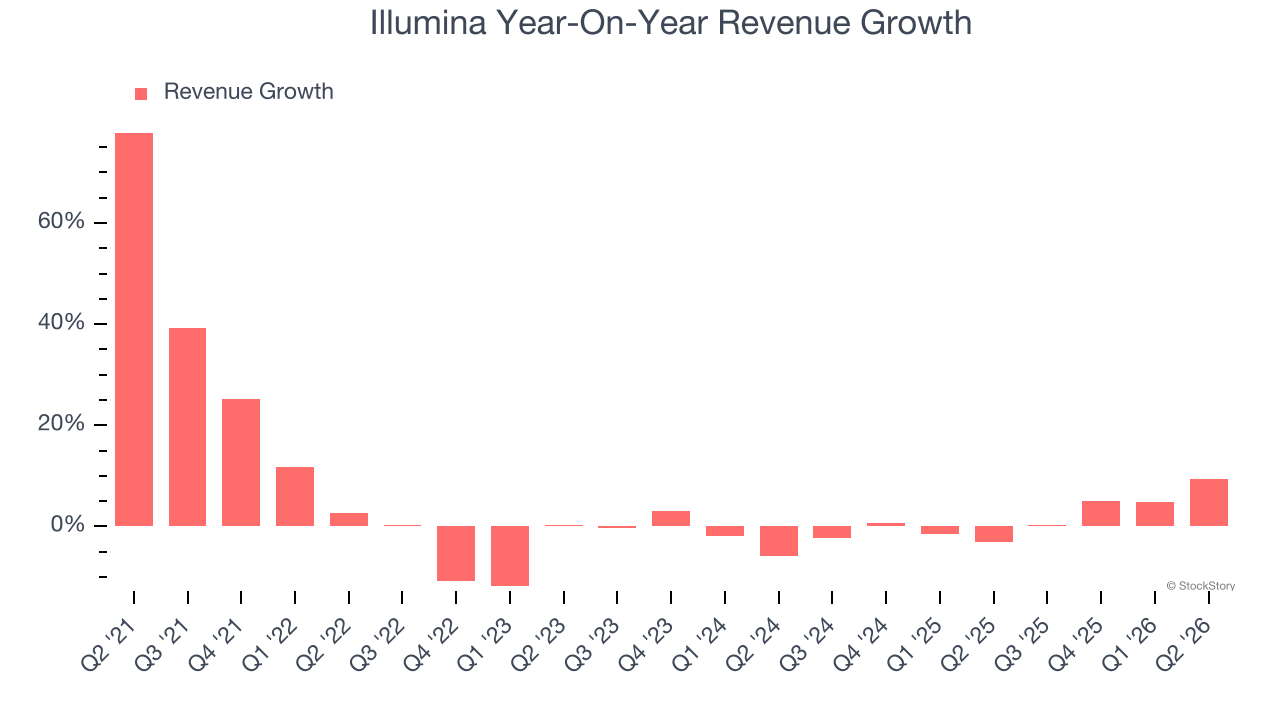
Illumina also reports organic revenue, which strips out one-time events like acquisitions and currency fluctuations that don’t accurately reflect its fundamentals. Over the last two years, Illumina’s organic revenue was flat. Because this number aligns with its two-year revenue growth, we can see the company’s core operations (not acquisitions and divestitures) drove most of its results. 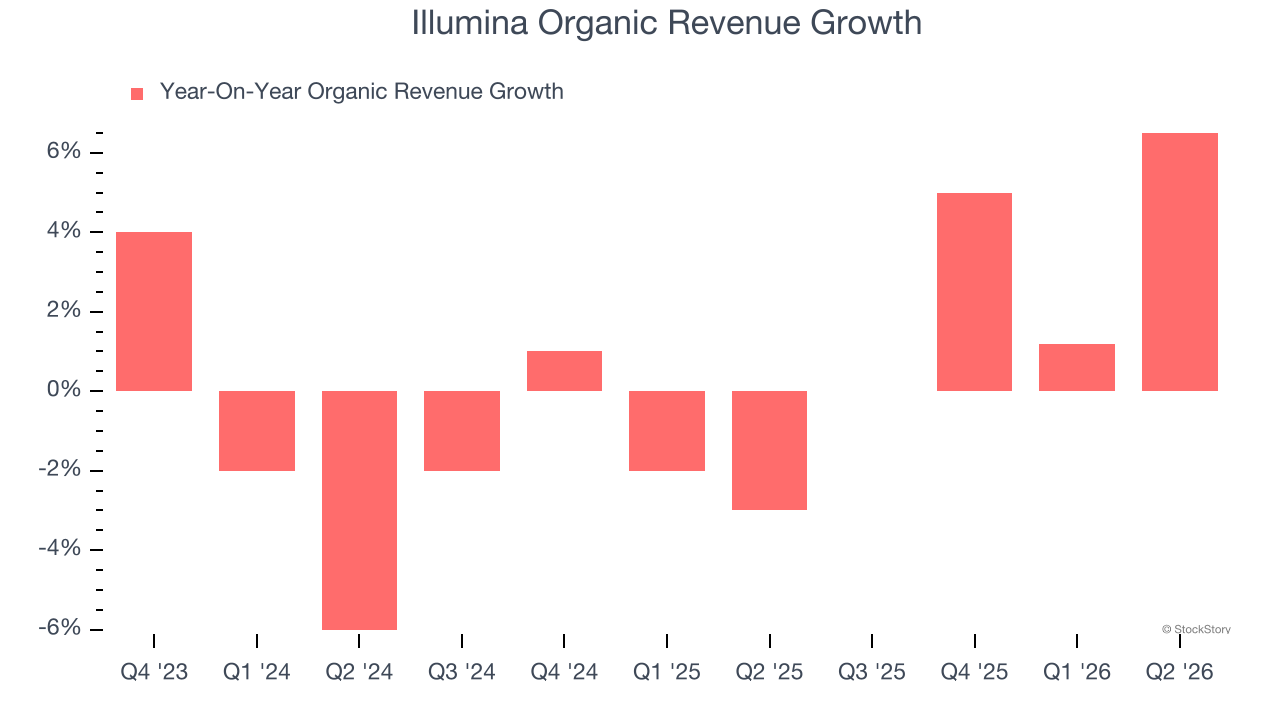
This quarter, Illumina reported year-on-year revenue growth of 9.4%, and its $1.16 billion of revenue exceeded Wall Street’s estimates by 2.5%.
Looking ahead, sell-side analysts expect revenue to grow 4.3% over the next 12 months. While this projection implies its newer products and services will catalyze better top-line performance, it is still below average for the sector.
ONE MORE THING: The $21 AI Application Stock Wall Street Forgot. While Wall Street obsesses over who’s building AI, one company is already using it to print money. And nobody’s paying attention.
AI chip stocks trade at ridiculous valuations. This company processes a trillion consumer signals monthly using AI and trades at a third of the price. The gap won’t last. The institutions will figure it out. You need to see this first. Read the FREE Report Before They Notice.
Adjusted Operating Margin
Illumina has been an efficient company over the last five years. It was one of the more profitable businesses in the healthcare sector, boasting an average adjusted operating margin of 21.2%.
Looking at the trend in its profitability, Illumina’s adjusted operating margin rose by 2.9 percentage points over the last five years, as its sales growth gave it operating leverage. The company’s two-year trajectory shows its performance was mostly driven by its recent improvements.
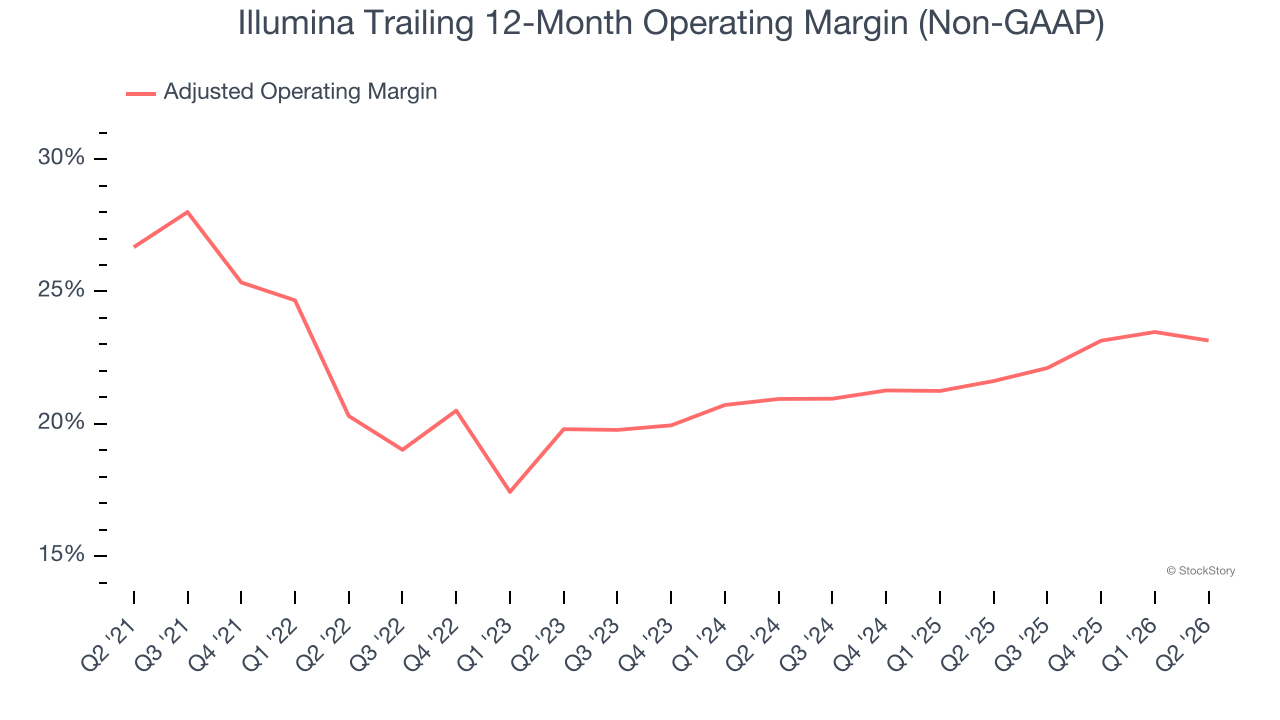
This quarter, Illumina generated an adjusted operating margin profit margin of 22.4%, down 1.3 percentage points year on year. This reduction is quite minuscule and indicates the company’s overall cost structure has been relatively stable.
Earnings Per Share
Revenue trends explain a company’s historical growth, but the long-term change in earnings per share (EPS) points to the profitability of that growth — for example, a company could inflate its sales through excessive spending on advertising and promotions.
Sadly for Illumina, its EPS declined by 3% annually over the last five years while its revenue grew by 2.5%. However, its adjusted operating margin actually improved during this time, telling us that non-fundamental factors such as interest expenses and taxes affected its ultimate earnings.
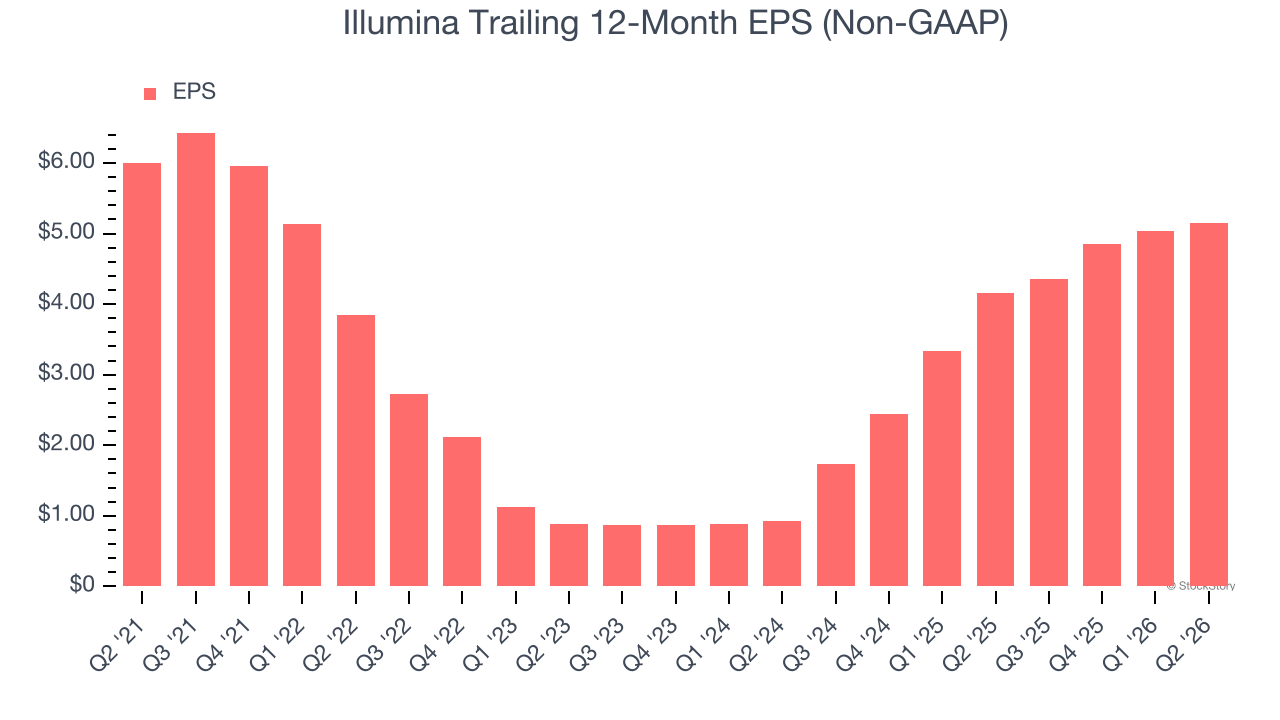
We can take a deeper look into Illumina’s earnings to better understand the drivers of its performance. A five-year view shows Illumina has diluted its shareholders, growing its share count by 4.1%. This dilution overshadowed its increased operational efficiency and has led to lower per share earnings. Taxes and interest expenses can also affect EPS but don’t tell us as much about a company’s fundamentals. 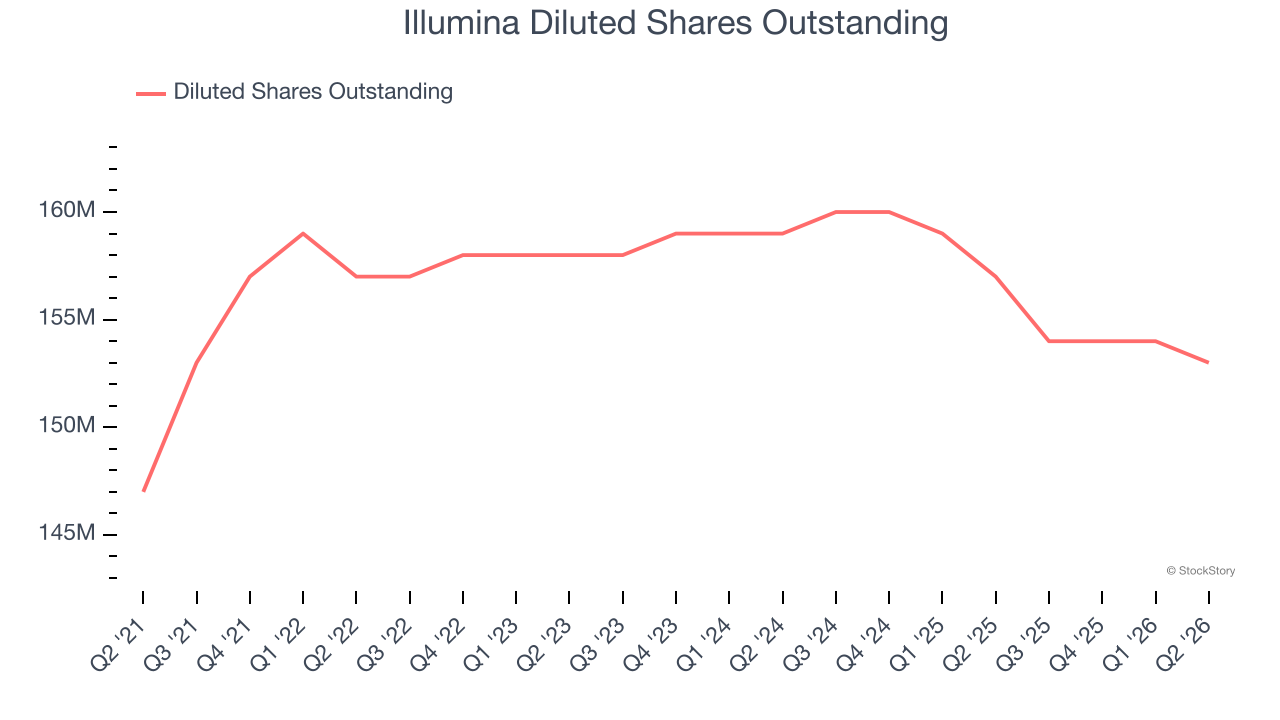
In Q2, Illumina reported adjusted EPS of $1.31, up from $1.19 in the same quarter last year. This print beat analysts’ estimates by 6.8%. Over the next 12 months, Wall Street expects Illumina’s full-year EPS to grow 8.3% from $5.15 to $5.58.
Key Takeaways from Illumina’s Q2 Results
We enjoyed seeing Illumina beat analysts’ organic revenue expectations this quarter. We were also glad its revenue outperformed Wall Street’s estimates. Overall, we think this was a solid quarter with some key areas of upside. The stock traded up 3.8% to $213 immediately after reporting.
Sure, Illumina had a solid quarter, but if we look at the bigger picture, is this stock a buy? When making that decision, it’s important to consider its valuation, business qualities, as well as what has happened in the latest quarter. We cover that in our actionable full research report which you can read here (it’s free).



/Alibaba%20by%20Photo%20Agency%20via%20Shutterstock.jpg)
/Space/Cargo%20spacecraft%20in%20low-Earth%20orbit%20by%20Paopano%20via%20Shutterstock.jpg)
/Micron%20Technology%20Inc_%20logo%20on%20building-by%20vzphotos%20vis%20iStock.jpg)