



Hormuz Headlines Collide with Harvest Optimism
Corn has been trading in a tug of war between geopolitical risk premium and crop progress news. Corn futures have traded above $4.6 per bushel, hovering near a nine-week high as higher crude oil prices outweighed better than expected US crop conditions. Fighting between the United States and Iran has continued near the Strait of Hormuz, while Houthi militants in Yemen attacked two vessels transiting the region, pushing crude oil sharply higher and lifting the outlook for corn-based ethanol demand.
On the supply side, the picture is mildly bearish on its own, since the USDA's latest crop rating showed 67% of the corn crop in good to excellent condition, one point lower than the previous week but still above the 66% analysts expected, with extreme heat giving way to forecasts of cooler temperatures and more rainfall, pointing toward a larger harvest and more supply. That bearish supply picture, however, is being outweighed by a bullish demand and stocks story. Total US corn sales commitments for the 2025/26 marketing year have reached 3.41 billion bushels, up almost 24% year over year and already ahead of the USDA's own full year export forecast of 3.325 billion bushels, showing buyers absorbing supply faster than expected, while the USDA's July report cut its 2025/26 ending stocks estimate by 125 million bushels down to 2.02 billion, signaling a thinner supply cushion. Adding further support, managed money added nearly 50,000 contracts to their net long position during the week of July 21, bringing their total net long position up to 92,909 contracts, showing large speculative traders growing more confident that prices will keep rising. Taken together, tightening stocks, firm export demand, and growing speculative buying have been strong enough to outweigh the mildly bearish crop condition news, which helps explain why corn has continued grinding higher
What the Market Has Done
- From March to May, buyers were consistently present on each dip to 450 level, stepping in to bid prices back up and maintaining an overall constructive tone.
- At the start of June, buyers failed to show up at the yearly VWAP near 450, and this absence of demand resulted in an aggressive selloff that drove the price down to 420, corresponding to Daily level 4.
- From mid-June through the end of the month, sellers attempted to hold offers down at the yearly VWAP, keeping price capped in that region.
- Buyers ultimately overcame that resistance, reclaiming price back above 450 and continuing to bid the market higher, eventually reaching 487, which corresponds to Minor level 1.
What to Expect in the Coming Weeks
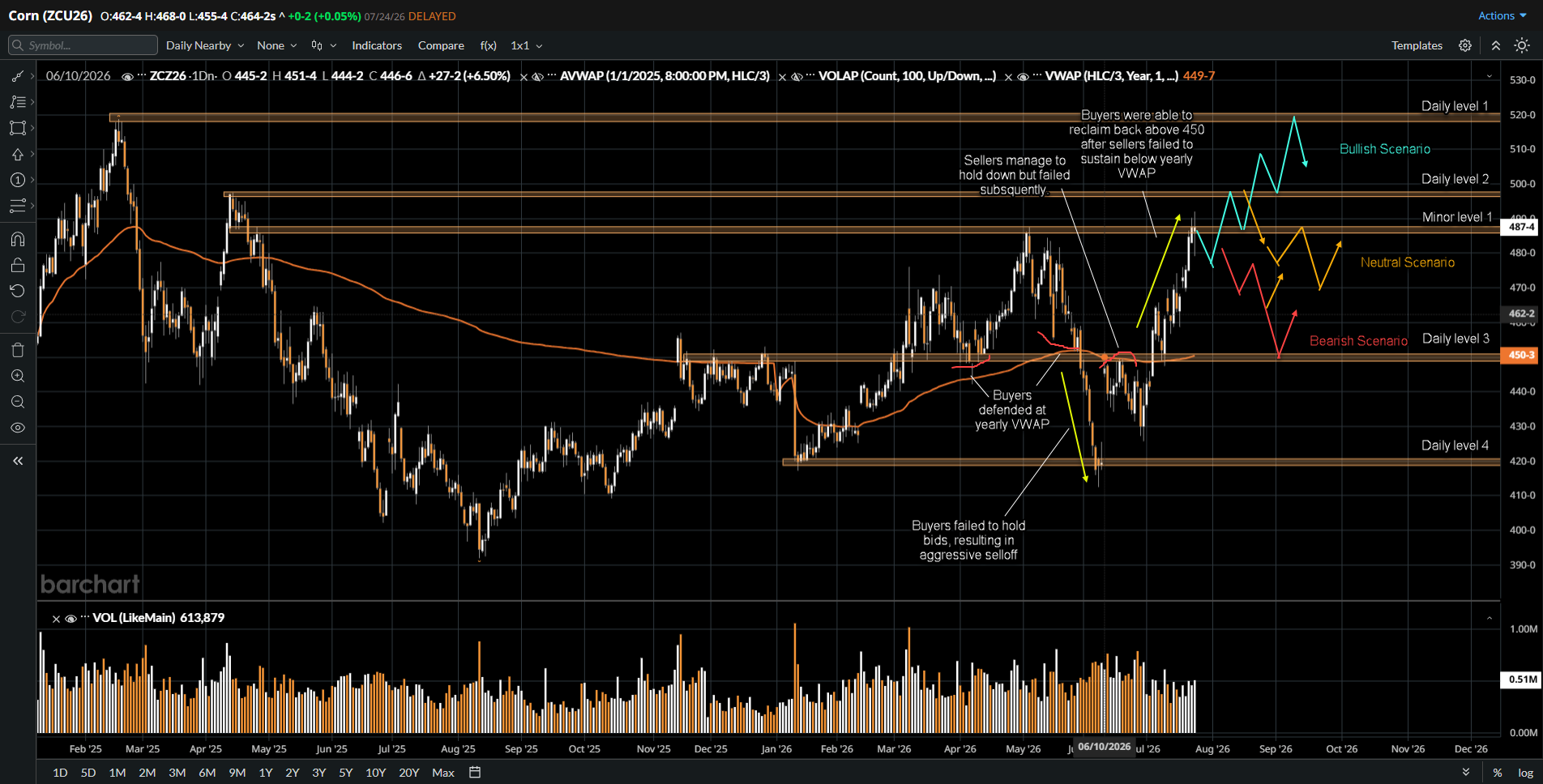
The key level to watch going forward is 487, corresponding to Daily level 2. How the market reacts at this level will likely set the tone for the next leg of the move.
Bearish Scenario
- If sellers respond firmly at 487, Daily level 2, and buyers fail to step up their bids, expect a move back down toward 450, Daily level 3.
- A potential trigger for this scenario would be a de-escalation in the Strait of Hormuz conflict or a ceasefire announcement, which could remove the energy driven risk premium currently embedded in prices.
- A further improvement in crop ratings alongside favorable rainfall through the pollination window could also weigh on prices and validate this scenario.
Bullish Scenario
- If buyers are able to reclaim price back above 487, Minor level 1, expect continuation toward 497, Daily level 2, and subsequently toward 520, Daily level 1.
- A potential trigger for this scenario would be a further escalation of hostilities near the Strait of Hormuz, including additional attacks on shipping vessels that push crude oil prices higher and reinforce the biofuel demand narrative.
- A stronger than expected export sales report or additional large new crop bookings from buyers such as Mexico or unknown destinations could also reinforce bullish momentum.
Neutral Scenario
- Expect two-way rotation between the 487 and 460 levels as the market works to re-establish fair value after the sharp run up from the June lows.
- A possible situation supportive for this scenario would be a period of mixed headlines, where energy markets stabilize and/or crop condition reports remain range bound rather than decisively bullish or bearish.
Conclusion
Corn futures currently sit at a pivotal technical juncture near 487, a level that previously capped rallies in June and now stands as the line in the sand for the next directional move. From a fundamental standpoint, the market remains caught between two competing forces, tightening ending stocks and record pace export commitments on one hand, and generally favorable crop conditions with improving weather on the other. Layered on top of this is the geopolitical risk premium tied to the ongoing conflict near the Strait of Hormuz, which has kept crude oil elevated and continues to spill over into the grain complex through the ethanol demand channel. Watch both the technical reaction at 487 and any fresh developments out of the Middle East or upcoming USDA reports, since either could tip the balance toward the bullish or bearish scenario outlined above. Where do you see corn heading next, and are you positioning for a breakout above 487 or a fade back toward the yearly VWAP?
We believe that professional growth is impossible without the truth found in your own data. Our presence on Barchart bridges the gap between complex exchange data and professional execution. Open an Account and access the tools you need to see your performance clearly.
Disclaimer:
This article is provided for informational and educational purposes only and does not constitute financial, investment, or trading advice. The analysis presented reflects the author’s market observations and opinions at the time of writing and is not a recommendation to buy or sell any futures contract, security, or financial instrument. Futures trading involves significant risk and is not suitable for all market participants. Losses may exceed initial margin deposits, and market conditions can change rapidly.
Any scenarios, levels, or market expectations discussed are hypothetical in nature and are intended solely to illustrate potential market behavior. They do not represent actual trading results and should not be interpreted as guarantees of future performance. Past performance, market behavior, or historical price action are not indicative of future outcomes.
Readers are solely responsible for their own trading decisions and risk management. Always conduct independent research, consider your financial situation and risk tolerance, and consult with a qualified financial professional, if necessary, before engaging in futures or derivatives trading.

/AI%20(artificial%20intelligence)/AI%20technology%20concept%20by%20NMStudio789%20via%20Shutterstock.jpg)



/Space/Planet%20earth%20with%20flying%20rocket%20by%20Sergey%20Mironov%20via%20Shutterstock.jpg)