/Delta%20Air%20Lines%2C%20Inc_%20passanger%20plane-by%20viper-zero%20via%20iStock.jpg)
With a market cap of $39.5 billion, Delta Air Lines, Inc. (DAL) is one of the largest U.S. carriers, controlling a significant share of the domestic aviation market. The company operates through two segments: Airline and Refinery, with the majority of revenues coming from its airline operations.
Companies valued at more than $10 billion are generally considered “large-cap” stocks, and Delta Air Lines fits this criterion perfectly. With a global network of hubs, a fleet of nearly 1,300 aircraft, and additional services such as maintenance and vacation packages, Delta provides extensive passenger and cargo transportation both domestically and internationally.
Shares of the Atlanta, Georgia-based company have decreased 13.4% from its 52-week high of $69.98. Delta Air Lines’ shares have increased nearly 24% over the past three months, outperforming the Themes Airlines ETF’s (AIRL) 11.8% gain over the same time frame.

In the longer term, DAL stock is up marginally on a YTD basis, compared to AIRL’s 16.8% return. Moreover, shares of the airline have soared 36.9% over the past 52 weeks, lagging behind AIRL’s 42.8% return over the same time frame.
Yet, the stock has been trading above its 50-day moving average since early May. Also, it has remained above its 200-day moving average since early August.
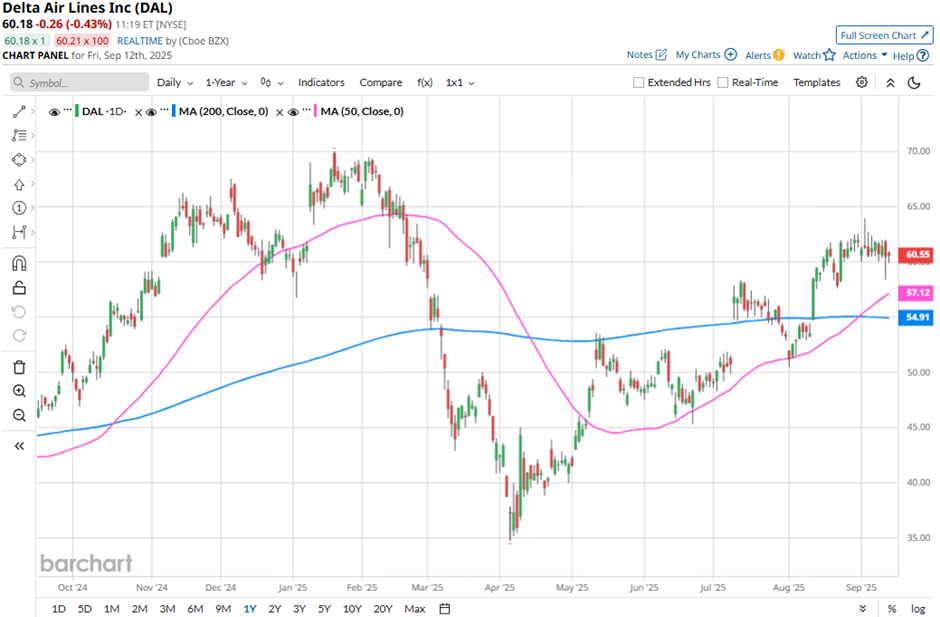
Shares of Delta Air Lines jumped nearly 12% on Jul. 10 after the company reported better-than-expected Q2 2025 adjusted EPS of $2.10 and revenue of $16.7 billion. Despite flat passenger revenue and a 5% drop in domestic unit revenue, Delta issued a full-year profit forecast of $5.25 per share to $6.25 per share and projected Q3 EPS of $1.25 to $1.75, surpassing the consensus at the high end.
The management also cited stabilizing demand, industry capacity cuts to support fares, and strong spending on premium services and co-branded credit cards as drivers of renewed investor confidence.
However, DAL stock has lagged behind its rival United Airlines Holdings, Inc. (UAL). Shares of United Airlines have surged 12.5% on a YTD basis and nearly 120% over the past 52 weeks.
Despite the stock’s underperformance over the past year, analysts remain moderately optimistic about its prospects. DAL stock has a consensus rating of “Strong Buy” from 22 analysts in coverage, and the mean price target of $68.58 is a premium of nearly 14% to current levels.
On the date of publication, Sohini Mondal did not have (either directly or indirectly) positions in any of the securities mentioned in this article. All information and data in this article is solely for informational purposes. For more information please view the Barchart Disclosure Policy here.

/Alphabet%20Inc_%20and%20Google%20logos%20by%20IgorGolovinov%20via%20Shutterstock.jpg)
/Technological%20process%20of%20soldering%20chip%20components%20on%20PCB%20board%20by%20I%20Viewfinder%20via%20Adobe%20Stock.jpeg)