
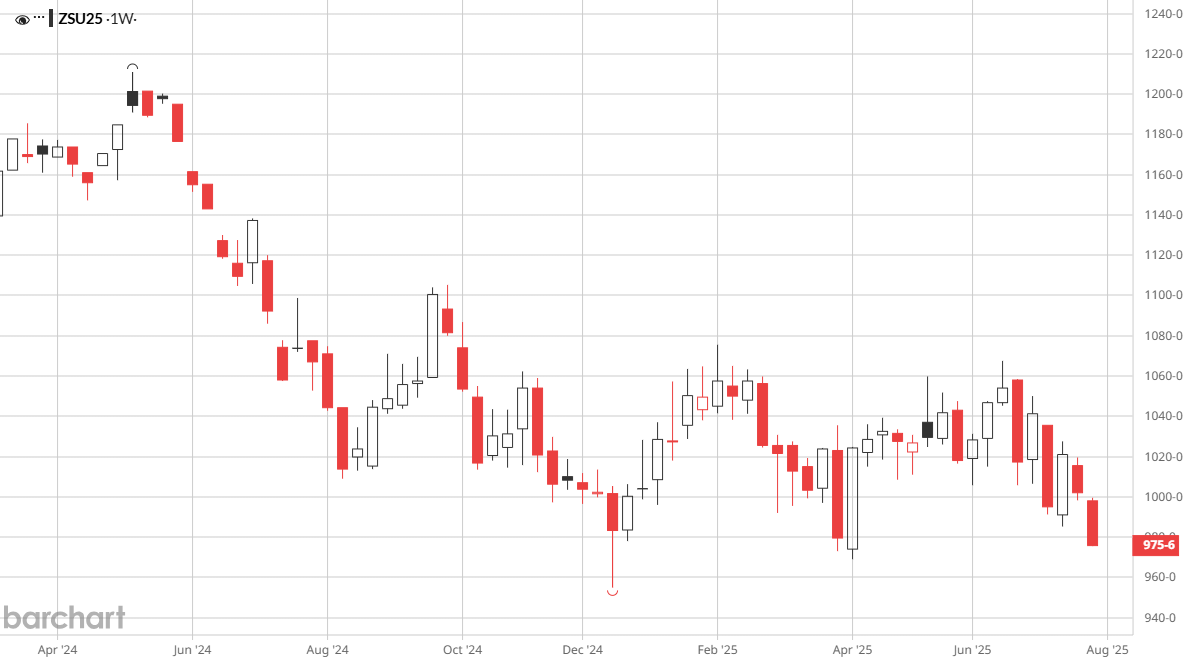
On Monday, soybeans traded down 10 cents to $9.88 3/4 in the August contract, after Argentina announced a permanent reduction in soybean export taxes from 33% to 26% and a reduction in soybean product export taxes from 31% to 24.5%. August soybeans closed at 967 ¾ on Wednesday, down 14 cents. September soybeans closed at 976, down 13 1/2 cents. Weather has been favorable and domestic and global ending stocks are still high; upside might be limited for soybeans in the near-term unless a trade deal with China is completed or positive news develops. For the week ending July 27, soybean conditions improved 2 points to 70% good/excellent. Soybeans now have the best conditions for this week of the year since 2020. Last year at this time, soybean ratings were 67% good/excellent.
Tuesday’s trade discussions between China and the U.S. in Sweden were said to be constructive. However, no deal was made to extend the 90-day tariff truce, set to expire on August 12. Treasury Secretary Scott Bessent said President Trump will make the final call on any extension. If no extension deal is made, tariffs spike back to triple-digit figures.
If you like this article and would like to receive more information on the commodity markets, please use the link to join our email list
China’s soybean exports are expected to be lower during the upcoming U.S. marketing season due to lower feed demand. China has yet to purchase U.S. soybeans for the fourth quarter. Recent trade deals with Japan and the EU have not provided much benefit for soybean prices. The trade deal with Japan includes $8 billion in U.S. Ag purchases, including soybeans, however, Japan is already a top export destination.
Soybean Oil
Also on Tuesday, India made a rare move, buying a record 150,000 metric tons of soybean oil from China. India purchased Chinese soybean oil at a discount compared to South America because of China’s supply glut. China’s soybean imports hit a record in May. Reportedly, some southern Chinese crushing plants have started shutting down due to storage constraints and negative crush margins.
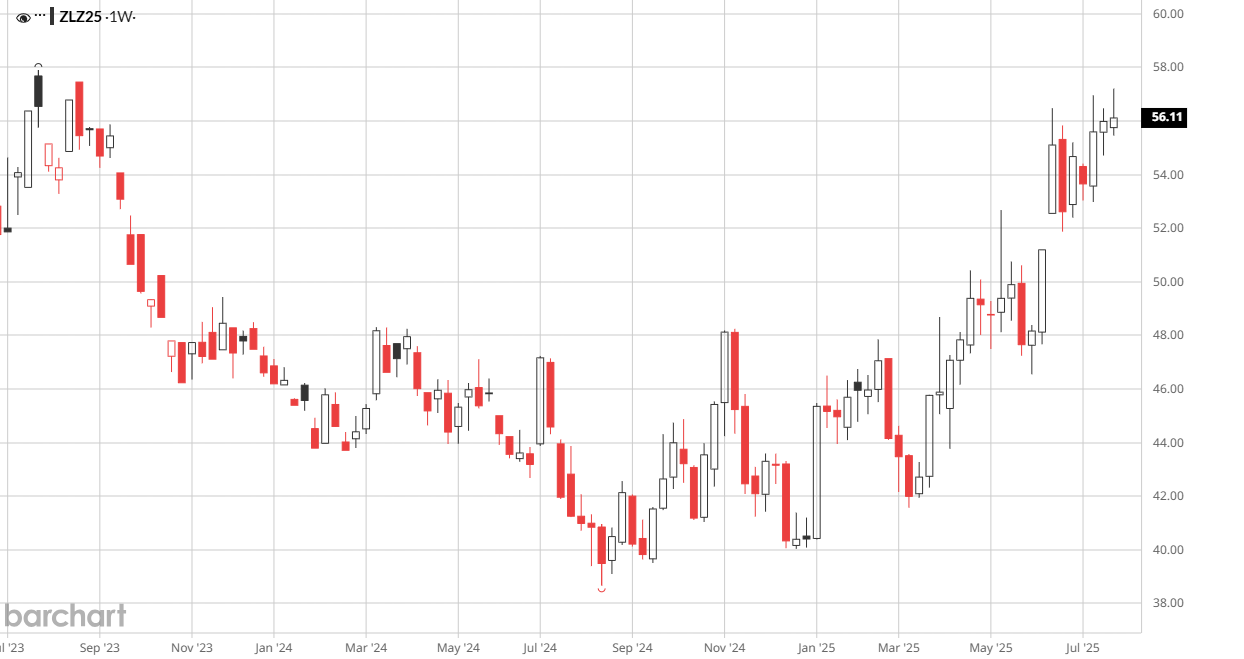
December soybean oil is in an uptrend after making a 3-month low at $46.55 at in mid-June. The oil share continues to rise from 50.40% on July 22, to above 51%. The oil share can continue to climb and could see 55%. On the July WASDE report, soybean crush for 2025/26 was raised 50 million bushels to 2.54 billion. The USDA’s adjustment higher follows the EPA’s proposal to raise the mandated blending levels in the Renewable Fuels Standard to 5.61 billion gallons in 2026 and 5.86 billion gallons for 2027. The EPA’s proposal also included a rule that would limit foreign biofuels and feedstocks to 50% of the value of the Renewable Identification Numbers relative to domestic biofuels and feedstocks. Without any new policy direction by the EPA, bullish sentiment has been able to persist without interruption. Malaysian palm oil has shown weakness this week, making U.S. soybean oil more attractive despite the dollar’s recent strength. Diesel and crude oil are offering some support, now trading $70/barrel after trading $2 higher on Monday and Tuesday and a $1 higher on Wednesday.
Soybean oil has risen 9 of the last 15 years from September 30 to November 10, for an average gain of 8.86%. The best year during that period was 2022 which saw a gain of 22.82% or 17.30 cents. Speculative positioning continues to lean net long. Friday’s Commitment of Traders’ report showed managed money added 12,105 contracts, bringing their net long position to 55,326 contracts. I’m expecting December soybean oil to break the contract highs at $57.20.
Soybean seasonal charts show some strength after the summer is over. Soybeans have an average return of 6.78% from October 12 to December 30 over the last 5 years, with the best year being 2020, which delivered a 24.87% return or 45.40 cents during that period.
SOYBEAN OIL
BUY DECEMBER'25 60 CALL 2.055 OR $1,233/CONTRACT
This trade expires 11/21/25, 114 Days
SOYBEAN OIL
BUY MARCH'26 60 CALL 2.925 OR $1,755/CONTRACT
This trade expires 2/20/256, 205 days
SOYBEANS
CALL FOR ACTIVE TRADE RECCOMMENDATIONS
SOYBEAN MEAL
CALL FOR ACTIVE TRADE RECCOMMENDATIONS
The maximum loss on the calls is the premium paid/cost of the trade. The maximum gain is unlimited.
BULLISH
SOYBEAN OIL
COTTON
GOLD
NATURAL GAS

If you’re ready to start trading, click the link below to open an account with Walsh Trading, Inc.
Hans Schmit, Walsh Trading
Direct 312-765-7311 Toll Free 800-993-5449
hschmit@walshtrading.com www.walshtrading.com
Walsh Trading, Inc. is registered as a Guaranteed Introducing Broker with the Commodity Futures Trading Commission and an NFA Member.
Futures and options trading involves substantial risk and is not suitable for all investors. Therefore, individuals should carefully consider their financial condition in deciding whether to trade. Option traders should be aware that the exercise of a long option will result in a futures position. The valuation of futures and options may fluctuate, and as a result, clients may lose more than their original investment. The information contained on this site is the opinion of the writer or was obtained from sources cited within the commentary. The impact on market prices due to seasonal or market cycles and current news events may already be reflected in market prices. PAST PERFORMANCE IS NOT NECESSARILY INDICATIVE OF FUTURE RESULTS.
All information, communications, publications, and reports, including this specific material, used and distributed by Walsh Trading, Inc. (“WTI”) shall be construed as a solicitation for entering into a derivatives transaction. WTI does not distribute research reports, employ research analysts, or maintain a research department as defined in CFTC Regulation 1.71.

/AI%20(artificial%20intelligence)/AI%20engineer%20working%20on%20laptop%20by%20ART%20STOCK%20CREATIVE%20via%20Shutterstock.jpg)
/Micron%20Technology%20Inc_billboard-by%20Poetra_RH%20via%20Shutterstock.jpg)
/Qualcomm%2C%20Inc_%20logo%20on%20phone-by%20viewimage%20via%20Shutterstock.jpg)
/Advanced%20Micro%20Devices%20Inc_%20logo%20and%20chart%20data-by%20Poetra_%20RH%20via%20Shutterstock.jpg)