




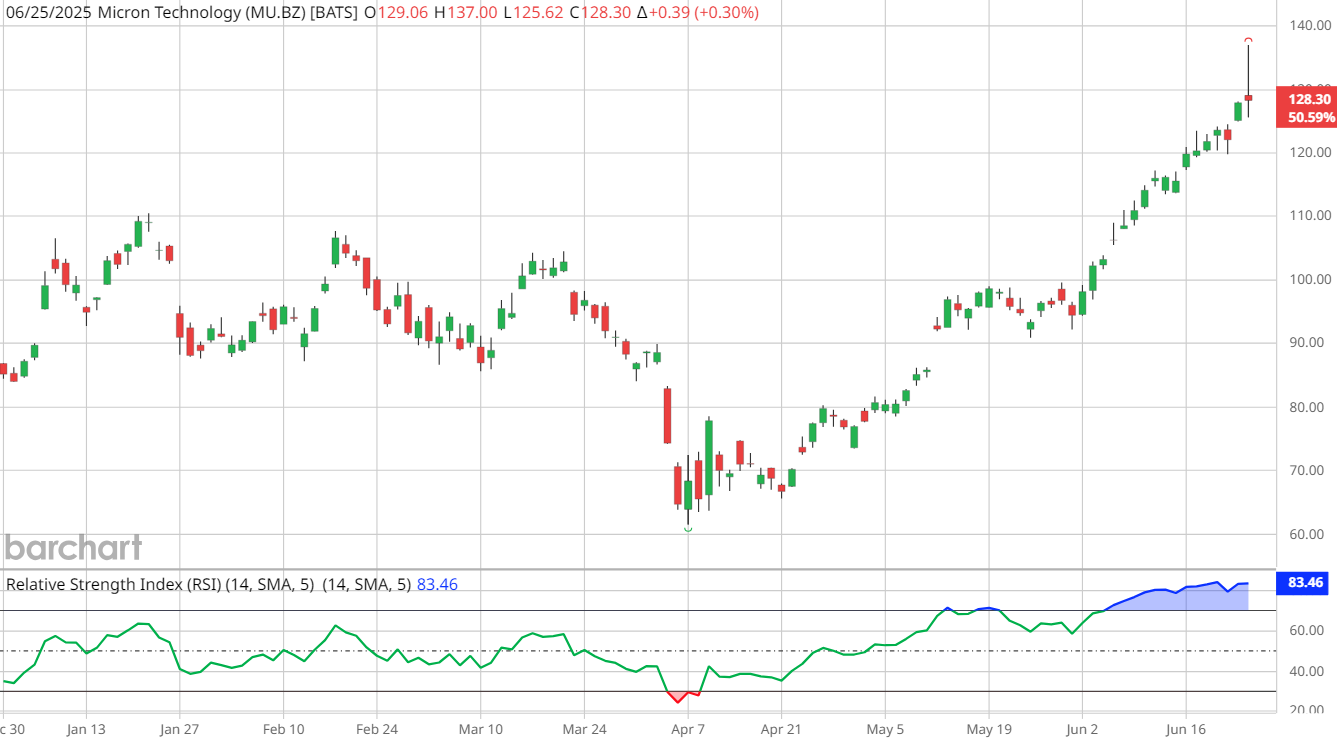
Micron Technology (MU) popped higher in after-hours trading following its exceptional fiscal third-quarter 2025 results - but the stock has quickly pared the bulk of its late gains, and is up just 0.5%. Heading into tonight’s report, MU stock had surged more than 36% over the past month, and the 14-day Relative Strength Index (RSI) of 83 was deep in overbought territory. That means the shares could be vulnerable to a short-term technical reversal, despite the strong earnings.
Inside MU’s Q3 Earnings
Looking at the results, Micron reported record revenue of $9.3 billion, marking a substantial 37% year-over-year increase. This impressive growth was primarily driven by surging demand for artificial intelligence (AI)-related memory products, and was particularly evident in the company's data center segment, where revenue more than doubled compared to the previous year.
The company's DRAM segment, accounting for 76% of total revenue, reached an all-time high of $7.1 billion, representing a 51% year-over-year increase. High-bandwidth memory (HBM) revenue grew nearly 50% sequentially, while NAND flash revenue showed more modest growth, contributing $2.2 billion to the total. Micron's adjusted earnings per share (EPS) of $1.91 significantly exceeded analysts’ expectations of $1.60, while gross margins expanded to 39%, demonstrating improved operational efficiency.
The Compute and Networking Business Unit showed remarkable strength with $5.1 billion in revenue, up 97% year-over-year, primarily driven by robust data center demand for AI applications.
What’s Next for Micron?
Looking ahead, Micron provided strong guidance for its fiscal fourth quarter, projecting revenue between $10.4-11.0 billion and adjusted earnings per share of $2.35-2.65, well above consensus estimates. The company's strategic positioning in the AI memory market appears particularly strong, with HBM now shipping to four high-volume customers and development underway for next-generation HBM4 chips targeted for 2026 production.
Management expressed confidence in the company's outlook, citing tight DRAM inventories and improving NAND inventory levels as positive indicators for continued market momentum. However, some analysts have noted potential risks from tariff-related inventory stockpiling that could impact future quarters. Despite these concerns, Micron's strong free cash flow generation of $1.95 billion demonstrates its ability to fund continued investments in advanced memory technologies while maintaining operational efficiency.
This article was generated with the support of AI and reviewed by an editor. On the date of publication, the editor did not have (either directly or indirectly) positions in any of the securities mentioned in this article. All information and data in this article is solely for informational purposes. For more information please view the Barchart Disclosure Policy here.
/Oracle%20Corp_%20logo%20on%20phone%20and%20stock%20data-by%20Rokas%20Tenys%20via%20Shutterstock.jpg)
/Palantir%20by%20rblfmr%20via%20Shutterstock.jpg)

/Phone%20and%20computer%20internet%20network%20by%20Pinkypills%20via%20iStock.jpg)
/A%20Palantir%20sign%20displayed%20on%20an%20office%20building%20by%20Poetra_RH%20via%20Shutterstock.jpg)