Dual Edge Research publishes two powerful newsletters that work great individually — and even better together. The Bull Strangle Newsletter focuses on stocks and options, combining stock ownership with premium-selling strategies to generate consistent income and market-beating returns. The Smart Spreads Newsletter specializes in seasonal commodity futures spreads, offering a diversified approach with low correlation to equities. Together, they deliver a complete investment perspective — one focused on income, the other on diversification — all under one simple subscription.
Introduction
When most option sellers screen for stocks, they focus on the obvious metrics—implied volatility, option premiums, technical trends, or earnings dates. Those are all important. But after analyzing hundreds of stock characteristics across thousands of option-selling opportunities, I discovered another factor that consistently influences trade quality: market capitalization.
As part of developing my stock ranking system, I evaluated a wide range of metrics to determine which characteristics were most closely associated with higher returns, better win rates, and fewer large losses. Market capitalization proved to be one of the factors worth incorporating into the screening process.
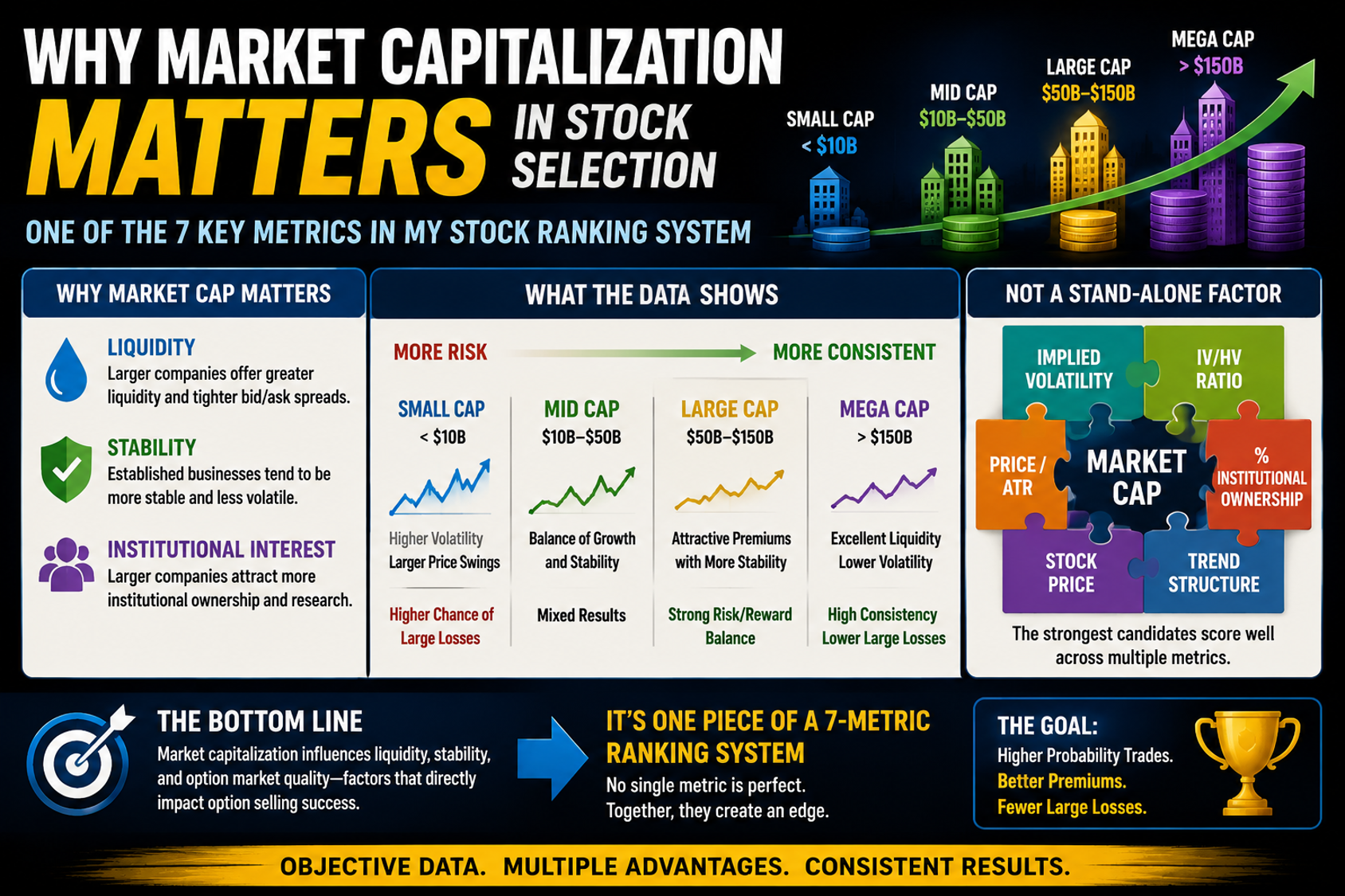
Why Market Capitalization Matters
Market capitalization is simply the total value of a company's outstanding shares. It generally falls into four categories:
- Small Cap: Under $10 billion
- Mid Cap: $10–50 billion
- Large Cap: $50–150 billion
- Mega Cap: Over $150 billion
While market capitalization doesn't predict a stock's direction, it often reflects important characteristics such as liquidity, institutional ownership, business stability, and the depth of the options market. These factors can directly impact the consistency of an option-selling strategy.
What I Found
One of the objectives of my research wasn't to identify a single "best" category, but rather to determine whether market capitalization helped distinguish stronger candidates from weaker ones. The results suggest that it does.
Smaller companies often produce attractive option premiums because they tend to experience larger price swings. Unfortunately, those same price swings also increase the likelihood of significant losses when selling options.
At the opposite end of the spectrum, mega-cap companies generally offer exceptional liquidity, narrower bid/ask spreads, and more stable price behavior. Although option premiums can sometimes be lower, the consistency of these stocks often makes them attractive candidates for systematic option-selling strategies.
Large-cap companies frequently provide an appealing balance between premium generation and price stability, making them a productive hunting ground for many trades.
Market Cap Is Only One Piece of the Puzzle
One of the biggest lessons from this research is that no single metric should drive your decision. A company may have an ideal market capitalization but still be a poor option-selling candidate because implied volatility is too low, institutional ownership is weak, the stock is extended technically, or option liquidity is poor.
Likewise, an outstanding setup in another category may justify considering a smaller-cap company if the remaining characteristics are favorable. This is why I don't use market capitalization as a stand-alone filter. Instead, it contributes to an overall ranking system where multiple factors work together to identify higher-quality opportunities.
Building a Better Ranking System
Over the past several months, I've shared several of the metrics that form my stock ranking system. Each contributes a different piece of information:
- Price relative to Average True Range (ATR)
- Implied Volatility versus Historical Volatility (IV/HV)
- Institutional ownership
- Market capitalization
- Stock price
- Trend structure
- Implied Volatility
None of these metrics is perfect by itself. However, when combined into a structured ranking system, they help identify stocks that historically have exhibited stronger performance characteristics while avoiding many lower-quality candidates. The objective isn't to predict which stock will move higher over the next month. Instead, it's to improve the probability of selecting stocks that provide attractive option premiums while reducing the likelihood of outsized losses.
The Bigger Picture
Successful option selling isn't about finding one magical indicator. It's about stacking multiple small advantages in your favor. Each metric may provide only a modest edge on its own. But when several favorable characteristics occur together, the probability of success can improve meaningfully. Market capitalization is one of those characteristics. It doesn't replace sound risk management or disciplined trade selection, but it does provide another objective way to evaluate potential candidates before placing a trade.
As my research has progressed, one conclusion has become increasingly clear: the strongest option-selling candidates rarely stand out because of one metric—they stand out because they score well across several. That's exactly the philosophy behind the ranking system I've been building, and it's the reason market capitalization has earned its place as one of the metrics I evaluate every week before selecting new positions.
Want to build a more complete trading toolkit?
The Bull Strangle Newsletter focuses on stocks and options, combining stock ownership with disciplined option-selling techniques designed to generate consistent income while managing risk.
The Smart Spreads Newsletter focuses on seasonal commodity spreads, a historically proven approach that seeks opportunities across agricultural, energy, metal, and financial futures markets.
Each strategy is designed to stand on its own, but together they provide a diversified approach that can perform across a wide range of market environments. For traders looking to deepen their education, The Bull Strangle Strategy and Trading Commodity Spreads, both available on Amazon.
Visit BullStrangle.com to subscribe for just $1 for the first month.
For a video overview of the Bull Strangle Newsletter
For a video overview of the Smart Spreads Newsletter
Darren Carlat
Dual Edge Research
(214) 636-3133
DualEdgeResearch@gamil.com
Disclaimer
This information is for informational purposes only and should not be considered as investment advice. Past performance is not indicative of future results, and all investments carry inherent risk. Consult with a financial advisor before making any investment decisions.


/Micron%20Technology%20Inc_%20logo%20on%20building-by%20vzphotos%20vis%20iStock.jpg)
/A%20hand%20holding%20a%20phone%20with%20the%20Reddit%20logo_%20Mamun_Sheikh%20via%20Shutterstock_.jpg)