Trade concerns fell squarely on the tech sector today, as the U.S. added dozens of companies from China, Taiwan, and more to its export control list. Along with the threat that major Chinese customers can no longer buy U.S. tech, Microsoft (MSFT) fell 1.31% today on news that it will undertake a major strategic shift in its data center expansion plans, with TD Cowen reporting that the hyperscaler is canceling projects totaling 2 gigawatts of capacity across the U.S. and Europe.
"In our view, the pullback on new capacity leasing by Microsoft was largely driven by the decision to not support incremental Open AI training workloads," wrote TD Cowen analyst Michael Elias in a note. "However, we continue to believe the lease cancellations and deferrals of capacity points to data center oversupply relative to its current demand forecast.”
While competitors Google (GOOG) (GOOGL) and Meta (META) are moving to acquire the vacated data center capacity, Microsoft's strategic realignment has exacerbated the trade anxieties rippling across the artificial intelligence (AI) subsector, impacting related stocks including NVIDIA (NVDA) and other AI infrastructure companies. As a result, quite a few data center and AI stocks fell this Wednesday. Here’s a look at three notable decliners on the day.
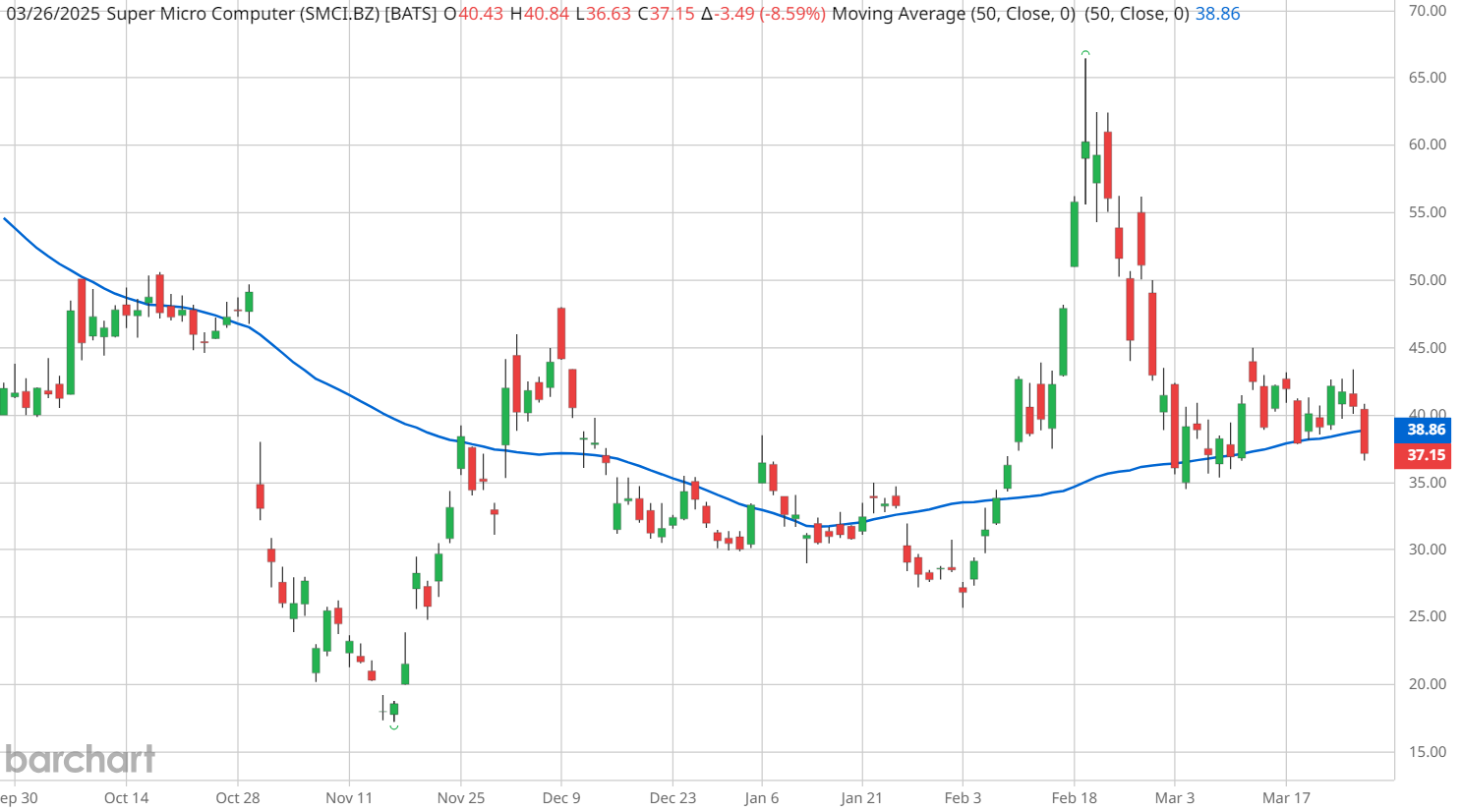
#1. Super Micro Computer (SMCI), down -8.86%
Super Micro Computer (SMCI) has been under heavy pressure even ahead of today’s slump, contributing to a substantial 63.8% fall from a year ago. The AI server company has recently resolved its accounting issues and maintained Nasdaq compliance, which is a positive development, but faces intensifying competition from established players like Dell (DELL) and Hewlett Packard Enterprise (HPE) in the AI server market.
SMCI’s recent struggles can be attributed to multiple factors, including concerns about potential trade tariffs on Chinese goods and a notable Goldman Sachs downgrade to "Sell" with a $32 price target. Despite these challenges, SMCI maintains ambitious growth projections, targeting $40 billion in revenue by fiscal 2026, though analysts are increasingly skeptical about Super Micro’s ability to achieve these goals.
While the stock has experienced significant volatility, it's worth noting that SMCI still maintains a positive year-to-date performance of 21.5%, suggesting that some investors remain optimistic about the company's long-term prospects in the growing AI infrastructure market.
#2. Marvell Technology (MRVL), down -6.85%
Marvell Technology (MRVL) has pulled back sharply in recent months, and is now down by 39.5% on a year-to-basis. However, the company's fundamentals remain robust, as its AI chip segment generated over $1.5 billion in revenue in fiscal 2025 and is expected to exceed its $2.5 billion AI revenue guidance. A key highlight is Marvell's strategic five-year partnership with Amazon (AMZN) for custom AI processors and networking chips. This high-profile deal strengthens Marvell’s position in the custom AI chip market where it currently holds a 13% market share.
The company's fabless business model provides some protection against trade tariff impacts, while its diversified focus across data infrastructure, cloud computing, 5G, and IoT markets offers multiple growth avenues. Looking ahead, analysts remain optimistic about Marvell's prospects, projecting significant revenue growth and a 75.8% year-over-year earnings increase to $2.76 per share in fiscal 2026, supported by increasing demand from cloud hyperscalers and AI infrastructure expansion.
#3. Arista Networks (ANET), down -6.07%
Arista Networks (ANET) stock has logged a steep decline of 26.1% year-to-date, despite the company's strong fundamental performance. The cloud networking company continues to demonstrate robust financial health with impressive profitability metrics, including a 42% EBIT margin and projected revenue growth of 18.08% year-over-year to $8.27 billion.
Wall Street analysts maintain a bullish stance on ANET with a consensus “Buy” rating, suggesting confidence in the company's long-term prospects despite recent market volatility. The stock's premium valuation, trading at a forward adjusted price/earnings (P/E) ratio of 34.86 (above the industry average), reflects market expectations for continued growth, particularly in the multi-cloud networking software market where Arista maintains a strong competitive position.
This article was generated with the support of AI and reviewed by an editor. On the date of publication, the editor had a position in: NVDA, MSFT. All information and data in this article is solely for informational purposes. For more information please view the Barchart Disclosure Policy here.
/Oracle%20Corp_%20office%20logo-by%20Mesut%20Dogan%20via%20iStock.jpg)
/NVIDIA%20Corp%20logo%20outside%20building-by%20BING-JHEN_HONG%20via%20iStock.jpg)
/Uber%20Technologies%20Inc%20logo%20outside%20offices-by%20Sundry%20Photography%20via%20iStock.jpg)
/Space%20Technology%20by%20Rini_%20com%20via%20Shutterstock.jpg)