




Howdy market watchers!
March is here! Did we really have a 75-degree temperature swing in just one week’s time? The welcome sunshine was such a contrast, it is difficult to believe the polar plunge was just a week ago.
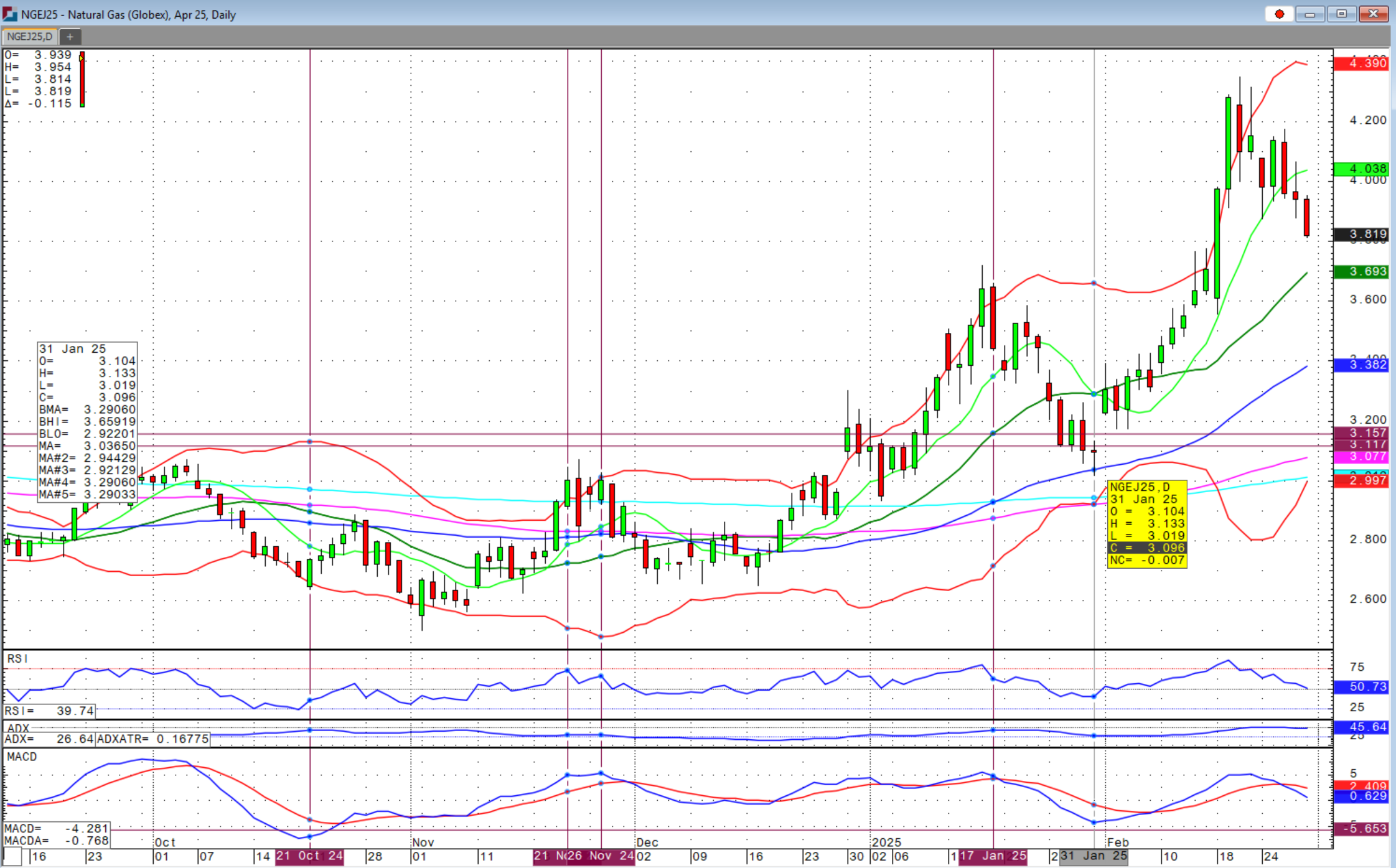
Natural gas again told that tale with this week’s high near $4.20 followed by a low near $3.80 on Friday and closing only slightly off that level. I expect we could see further selling next week with weekly natural gas withdrawals less than expected and the near-term temperature outlook normal-to-above normal for much of the US.
The Southern Plains are in great need of moisture and let’s hope these weekend and early week chances materialize. Wheat is coming out of dormancy with these temperature changes.
There was a lot of market moving news this week, but by far the most extraordinary was the Oval Office argument between President Trump, VP Vance and Ukrainian President Zelensky that devolved to playing out over live TV. I heard several aged Washington reporters say they have never seen such a thing happen in public at the White House between leaders of two countries. It was unbelievable to say the least and resulted in Zelensky departing the White House early and the joint press conference and State dinner to follow being cancelled. Recall, this meeting was supposed to memorialize the “deal” for the US to gain control/ownership over Ukrainian minerals that would also tie us in to protecting them and that country.
Suffice it to say, there is currently no deal as the Russia/Ukraine war reaches its 3rd year. Amid tariffs, inflation and weakening consumer confidence, the markets did not need another level of uncertainty, but that’s what this meeting ended up contributing.
With Friday being the end of the month, several markets were already under selling pressure that accelerated as news of the dispute bragged headlines. The early session gains in the Dow Jones, S&P 500 and NASDAQ evaporated, turning negative for awhile, but ultimately bouncing back strongly to push even higher than earlier highs.
If only ag markets could have done the same. The entire ag complex was in the red to finish Friday’s session with all contracts from grains to livestock closing near or at the lows of the session. It was a disappointing end to February, to say the least.
The cattle complex also found early session strength only to succumb to broader based selling from equity markets, which led to further acceleration into the close. Feeder contracts, with the exception of front-month March, put in a key reversal chart action on Friday, higher high and lower low, after failing to make highs above the recent January 29th high. Back month feeder contracts that have recently experienced a stronger rally versus front months also came under heavier selling pressure Friday.
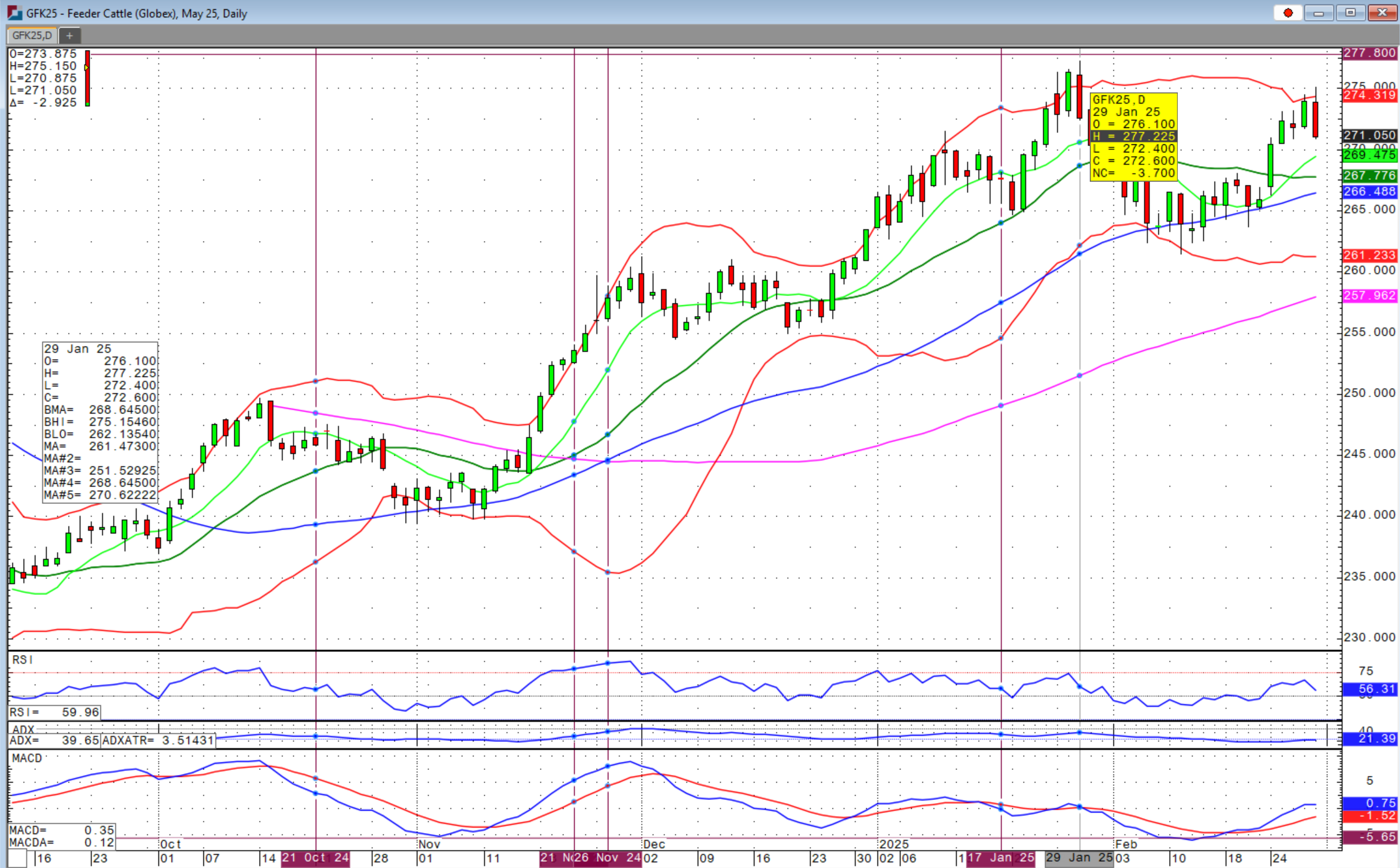
Fed cattle futures led the weakness with recent consolidation that was putting in a rounding bottom of support gave it all back on Friday selling off to the 100-day moving average on April Fats. Friday was also the final trade date of February Live Cattle futures and could explain some of the weakness. Cash fed cattle trade this week was slow to develop and topped out at $198 in Nebraska with several trades at $197 in southern states. I believe we could see some stability in fat cattle futures next week, but getting increasingly concerned about feeders after it was not able to make a new high and last week’s new record net long position of managed money in feeder futures.
This week’s Commitment of Traders Report showed some selling of those longs and we will likely see that more liquidated in next week’s report.
A major concern I have and shared in this week’s Sidwell Insurance and Strategies meetings, is the risk of immigrant deportations impacting meat packing plants. I recently found that 56.1 percent of labor in US meat packing plants is foreign-born. Even if they are all legal immigrants, they could have family members that are not that and these families stick together. The other concern I have, even if an unintended consequence, is the potential for the availability of USDA inspectors to get caught up in DOGE cuts, be it an administrative change, early retirements or otherwise. Both of these potential issues could slow the processing of cattle numbers and back up the supply chain making it a buyers’ market. I hope that such things never materialize, but beware and aware that such headlines could lead to long liquidation in these contracts despite otherwise bullish fundamentals.
President Trump reiterated this week that the 25 percent tariffs on Canada and Mexico that were delayed from last month would in fact go into effect on Tuesday, March 4th. He has also said that the 10 percent tariffs already in effect on China would be doubled and increase another 10 percent on the same date. This didn’t help market stability and pushed the VIX to the 20.00 level again on Friday.
This added to the insult for grains after the USDA Outlook Forum on Thursday morning released forecasts largely in line with expectations amid weaker export numbers this week. As expected, US corn acres increased by 3.0 million acres above last year while ending stocks came in at 1.965 billion bushels, more than expected. Soybean acres came in at 84.0 million acres while ending stocks came in at 320 million bushels, tighter than expected. The smaller soybean ending stocks number was perhaps the biggest surprise versus trade guesses. US wheat acres came in at 47.0 million acres, the same as last year, while ending stocks came in at 826 million bushels.
Corn yields were pegged at 181.0 bushels per acre (bpa) as has been the case in the past three seasons, yet final yields have been meaningfully below these levels with the exception of last year at 179.3 bpa. It is a tall order to reach. Similarly, soybean yields were pegged at 52.5 bpa with actual yields unable to reach that level only coming close at 51.9 bpa in 2016/17 and 51.7 bpa in 2021/22. Wheat yields were pegged at 50.1 bpa, also a tall order, although yields did outperform last year exceeding expectations and reaching 51.2 bpa.
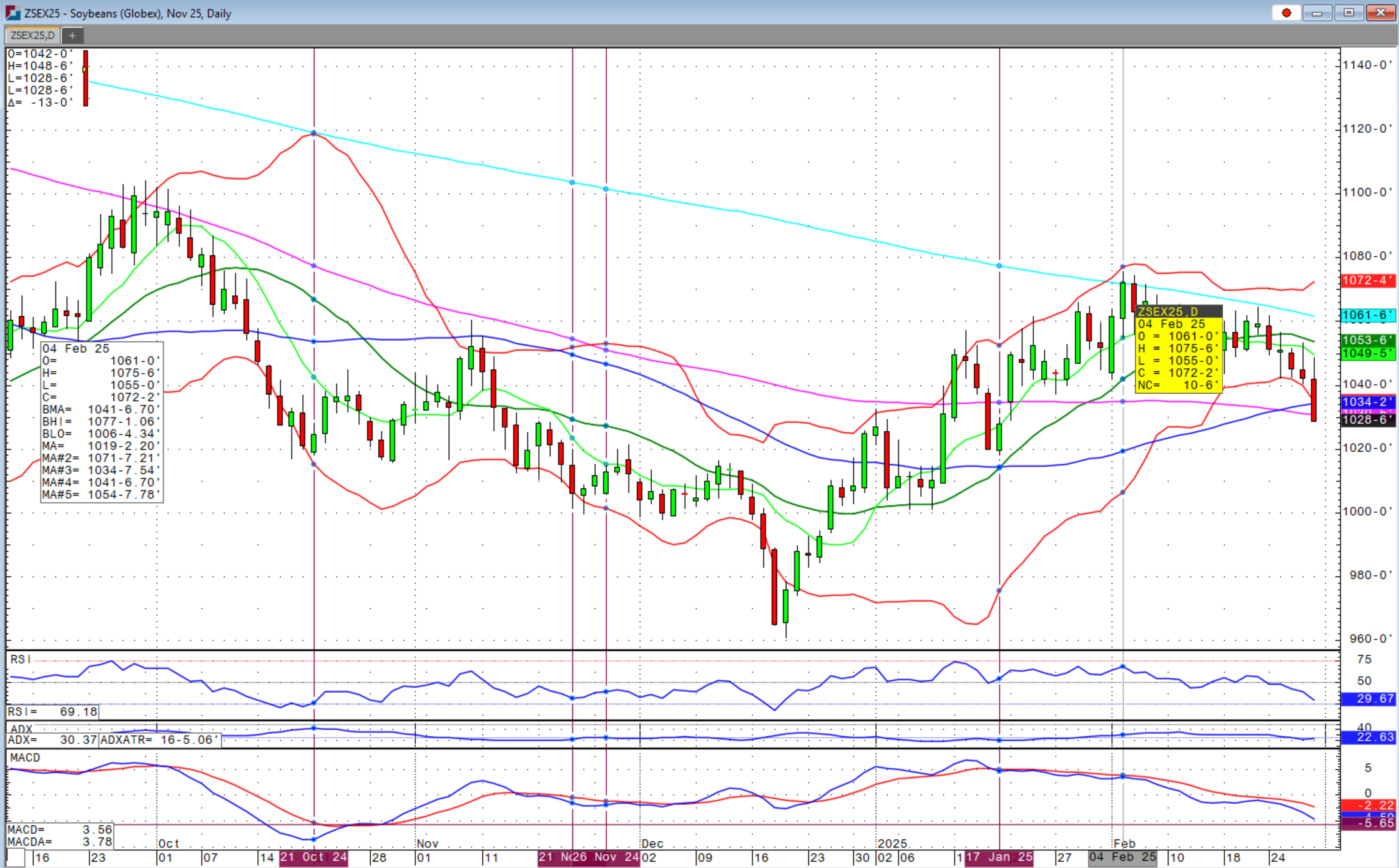
The combination of these factors brought the Outlook Forum’s average farm gate prices to $4.20 for corn, $10.00 for soybeans and $5.50 for wheat. These prices are far from impressive and close to breakeven levels for corn and wheat. The historical soybean-to-corn price ratio of 2.5:1 would suggest that soybean prices need to rally or corn prices need to decline further in order to buy acres from corn. We could see some of this action in the weeks ahead.
With new crop December corn’s close Friday at $4.55, November beans would need to be $11.38 to hold that ratio versus this week’s bean close near $10.30. Alternatively, if soybeans are $10.30, the ratio holds with corn at $4.12. Even USDA’s farm gate prices don’t hold this ratio, but that is reflecting end of season versus pre-season planning.
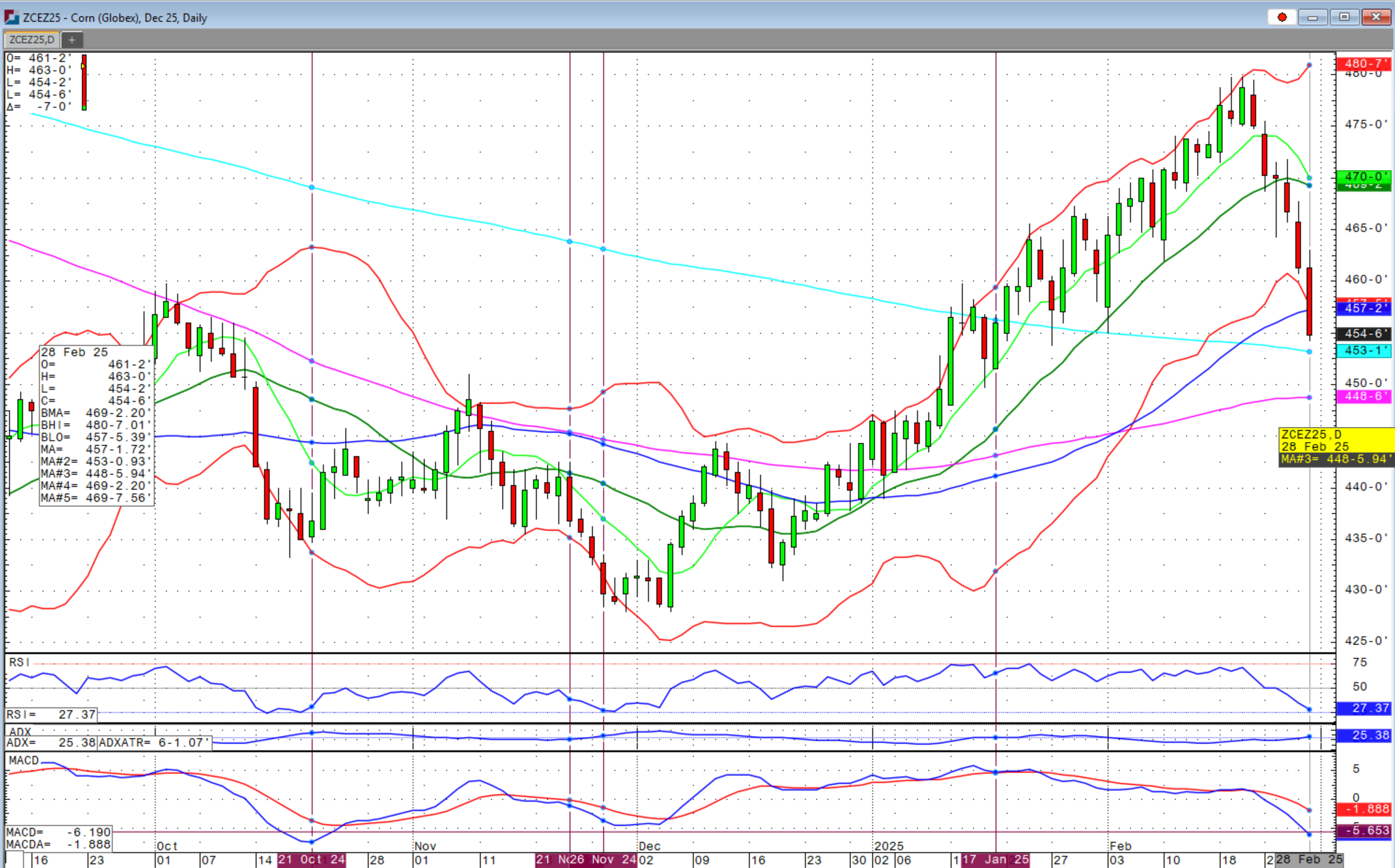
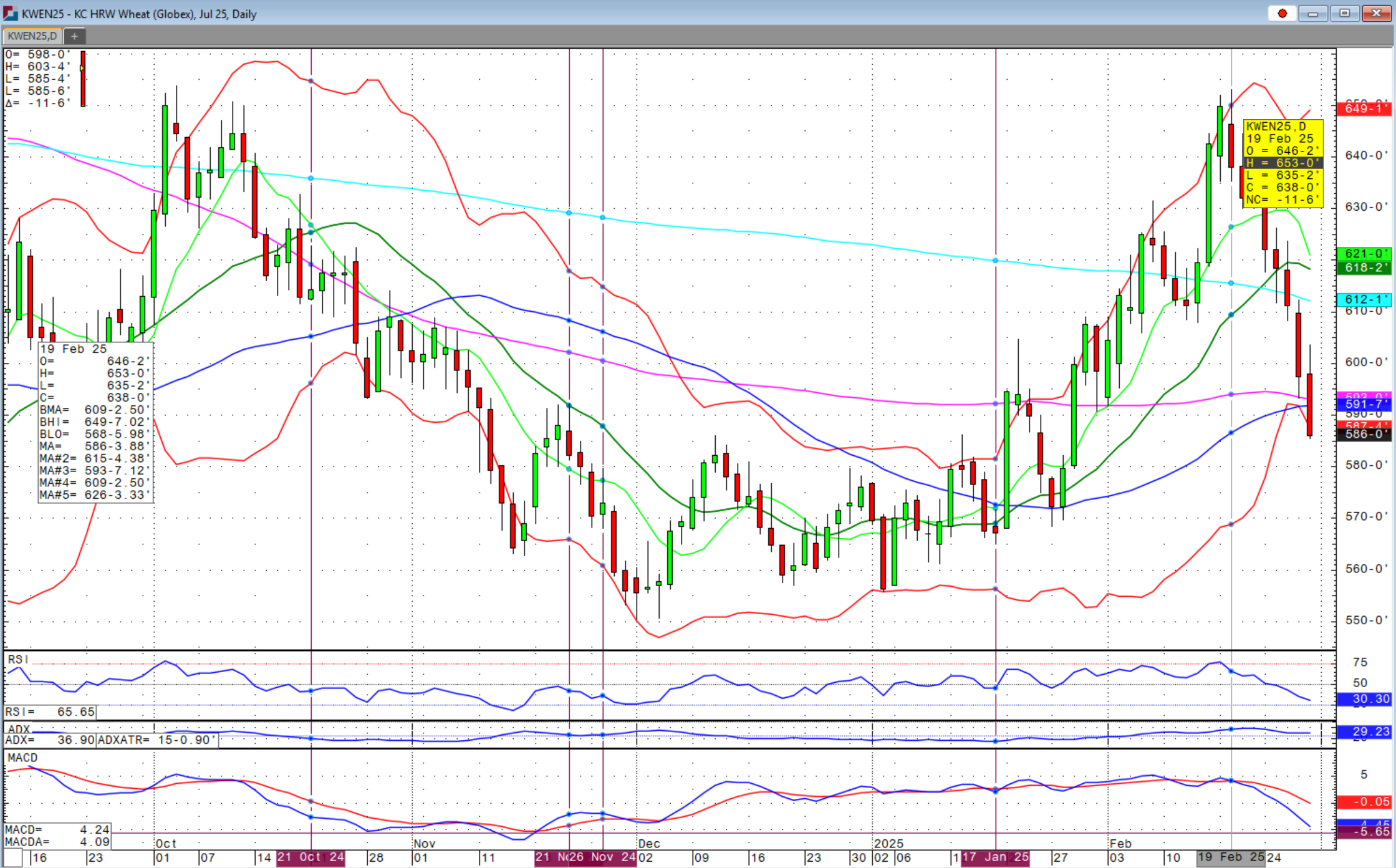
The next major report after the March WASDE and Crop Production updates will be the March 31st Planting Intentions and Grain Stocks reports. The market has some work to do next week to convince the bulls that the recent selling is overdone with stronger demand and enough supply issues remaining to justify a rebound. From the looks of the charts, we desperately need to see this early next week.
The US dollar index rebounded this week and closed Friday near the downward sloping trendline that has caught most of the highs since January 13th.
The Federal Reserve’s preferred inflation reading, the PCE, for January was released Friday and came in at 2.6 percent year-on-year, which was in line with expectations. While this is welcome news, the concern that tariffs could add inflationary price pressures mean that the inflation fight is far from over. I feel that a lot of people think that interest rates are going to see a lot of cuts this year, but barring a major economic downturn, the expectation should be for rates to remain near or at these levels with the outside possibility of an increase depending how these tariff threats evolve.
I do believe there is a chance that the proposed tariffs on Mexico and Canada do not go into effect next week or perhaps at lower levels or get another extension. Such news would be bullish for all commodity markets. Let’s hope that cooler heads prevail next week and that a compromise surfaces. However, it doesn’t seem we yet know what the ‘ask’ is from Trump to avoid tariffs. Time will tell and it is really anyone’s guess how this next week will evolve.
Bottomline, know your breakeven level, add your targeted profit margin above your breakeven level and put in orders at those levels for hedges, put options or forward sales. There will be a lot of volatility in these markets given the magnitude of what is being negotiated, but they can and will come and go quickly as we’ve seen just in this past week.
Sidwell Strategies is the one-stop shop to protect cattle with futures, puts, LRP or a combination of all, which is probably the best strategy overall. If you’re ready to trade commodity markets, give me a call at (580) 232-2272 or stop by my office to get your account set up and discuss risk management and marketing solutions to pursue your objectives. Self-trading accounts are also available. It is never too late to start and there is no operation too small to get a risk management and marketing plan in place.
Wishing everyone a successful trading week! Let us know if you'd like to join our daily market price and commentary text messages to stay informed!
Brady Sidwell is a Series 3 Licensed Commodity Futures Broker and Principal of Sidwell Strategies. He can be reached at (580) 232-2272 or at brady@sidwellstrategies.com. Futures and Options trading involves the risk of loss and may not be suitable for all investors. Review full disclaimer at https://www.sidwellstrategies.com/fccp-disclaimer-21951.


/A%20close-up%20of%20an%20AMD%20office%20by%20gehapromo%20via%20Adobe%20Stock.jpeg)
/Space/Rocket%20launching%20into%20space%20by%20BEST%20BACKGROUNDS%20via%20Shutterstock.jpg)
/Applied%20Materials%20Inc_%20campus%20sign-by%20Sundry%20Photography%20via%20iStock.jpg)
/Micron%20Technology%20Inc_%20logo%20on%20building-by%20vzphotos%20vis%20iStock.jpg)