/Apple%20watch%20on%20wrist%20by%20fancycrave1%20via%20Pixabay.jpg)
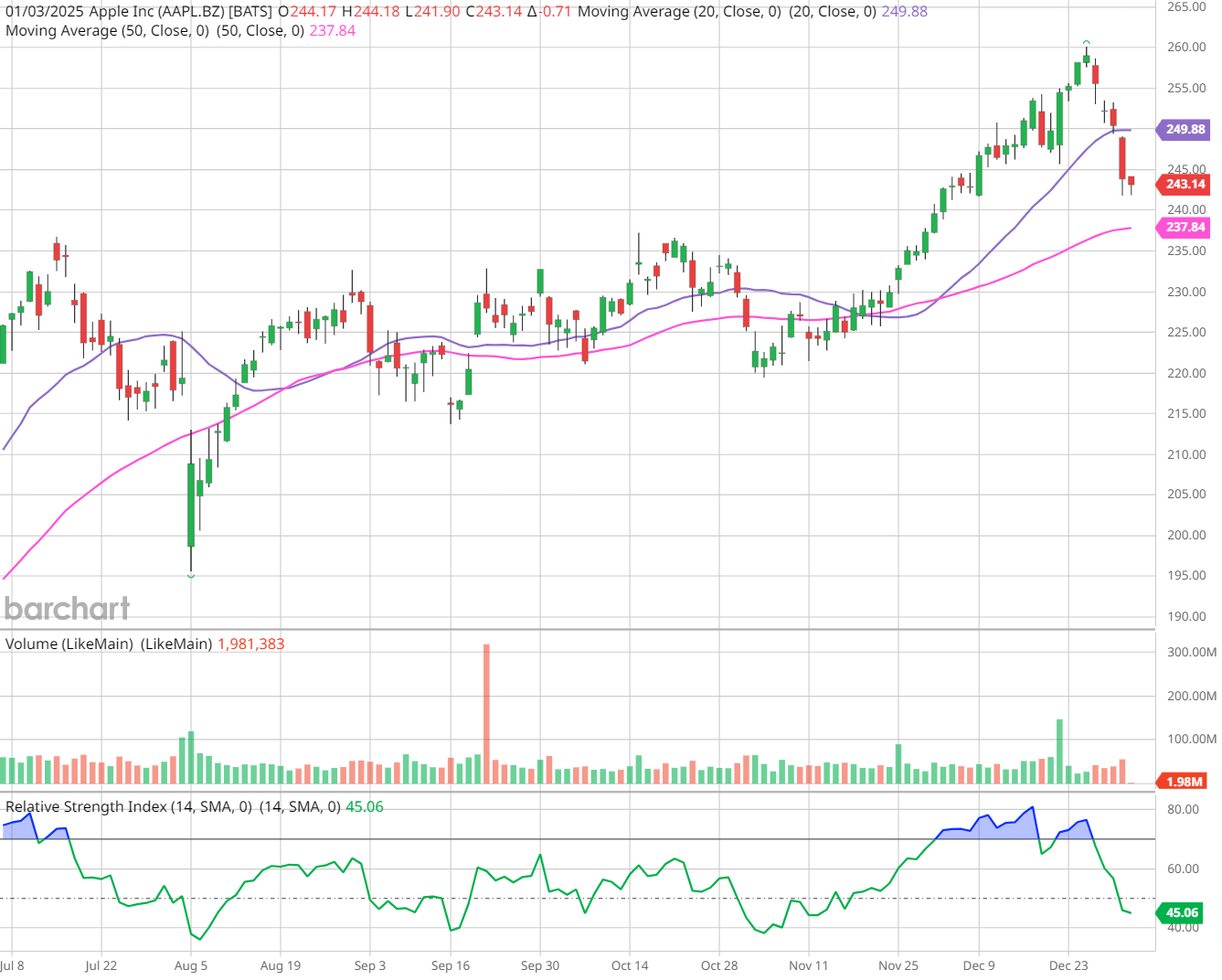
After a remarkably strong run right up to its Dec. 26 record high of $260.10, Apple (AAPL) stock has pulled back by a significant 6%. The tech giant’s price action during this time has been characterized by increased volatility, as evidenced by the wider price range.
AAPL’s 14-day Relative Strength Index (RSI) is currently at 45, indicating a neutral momentum, but leaning towards oversold conditions. Apple stock is also now below the 20-day simple moving average (SMA) of $249.88, suggesting a potential bearish trend in the short term.
However, AAPL remains above the 50-day SMA of $237.84, which could provide support. The 30-day rolling VWAP at $245 is also a critical level to watch, as it may act as a resistance point.
So, with a market capitalization of approximately $3.69 trillion, is the biggest company in the world still a good stock to buy near new highs?
The new highs in AAPL have been driven in part by optimism over an expected growth phase for the tech giant, fueled by advancements in artificial intelligence (AI), which are anticipated to power a multi-year iPhone upgrade cycle. Analysts have raised their price targets, suggesting a "golden era of growth" for Apple.
However, macroeconomic challenges, such as potential tariffs and interest rate uncertainties, pose risks to Apple's growth trajectory. In the Chinese market, Apple faces significant hurdles in the form of increased competition from domestic brands like Huawei, which are proving to be serious challengers to the iPhone. In response, Apple has launched promotional campaigns to boost sales and regain market share.
Despite these challenges, Apple's historical success and innovation continue to bolster positive investor sentiment. Going forward, the company's ability to maintain its market position amid rising competition will be crucial for sustaining its stock value.
And AAPL stock definitely isn’t cheap. Apple's forward adjusted price-to-earnings (P/E) ratio stands at 32.98, while its price-to-sales (P/S) ratio is 8.89 - both indicating a premium valuation.
To stack up the market behemoth against a rival that’s close to its own size, AAPL has a one-year return of 34.05%, and five-year earnings growth of 127.27%. In comparison, semiconductor specialist Nvidia (NVDA) has a one-year return of 188.16% and five-year earnings growth of 686.67%. Consensus analyst ratings show that NVDA has a higher average recommendation of “Strong Buy” compared to AAPL's “Moderate Buy,” indicating stronger analyst confidence in NVDA.
Overall, AAPL still appears to be a resilient long-term bet, even as the stock pulls back from all-time highs. However, for investors with limited funds to spread across multi-trillion dollar tech companies, NVDA might be a slightly more attractive option than AAPL right now due to its higher growth rates and stronger analyst ratings, despite AAPL's larger market cap and stable growth.
This article was generated with the support of AI and reviewed by an editor. On the date of publication, the editor had a position in: AAPL , NVDA . All information and data in this article is solely for informational purposes. For more information please view the Barchart Disclosure Policy here.
/Broadcom%20Inc%20HQ%20photo-by%20Sundry%20Photogrpahy%20via%20iStock.jpg)
/Super%20Micro%20Computer%20Inc%20logo%20on%20building-by%20Poetra_RH%20via%20Shutterstock.jpg)
/Intel%20Corp_%20Santa%20Clara%20campus-by%20jejim%20via%20Shutterstock.jpg)