




Dual Edge Research publishes two powerful newsletters that work great individually — and even better together. The Bull Strangle Newsletter focuses on stocks and options, combining stock ownership with premium-selling strategies to generate consistent income and market-beating returns. The Smart Spreads Newsletter specializes in seasonal commodity futures spreads, offering a diversified approach with low correlation to equities. Together, they deliver a complete investment perspective — one focused on income, the other on diversification — all under one simple subscription.
Introduction
In the previous article, we explored how institutional ownership became one of the strongest predictors in my Bull Strangle stock selection research. Stocks with greater institutional participation consistently produced higher average returns, higher win rates, and fewer large losses. That answered an important question:
- Who is buying the stock?
The next question proved just as important:
- How much does this stock normally move relative to its price?
For an option income strategy, that distinction matters. A two-dollar daily move means something very different for a twenty-dollar stock than it does for a two-hundred-dollar stock. Looking only at Average True Range doesn't capture that difference. That's why one of the most valuable metrics to emerge from my research wasn't ATR alone—it was Price divided by Average True Range, or Price / ATR.
Understanding Price / ATR
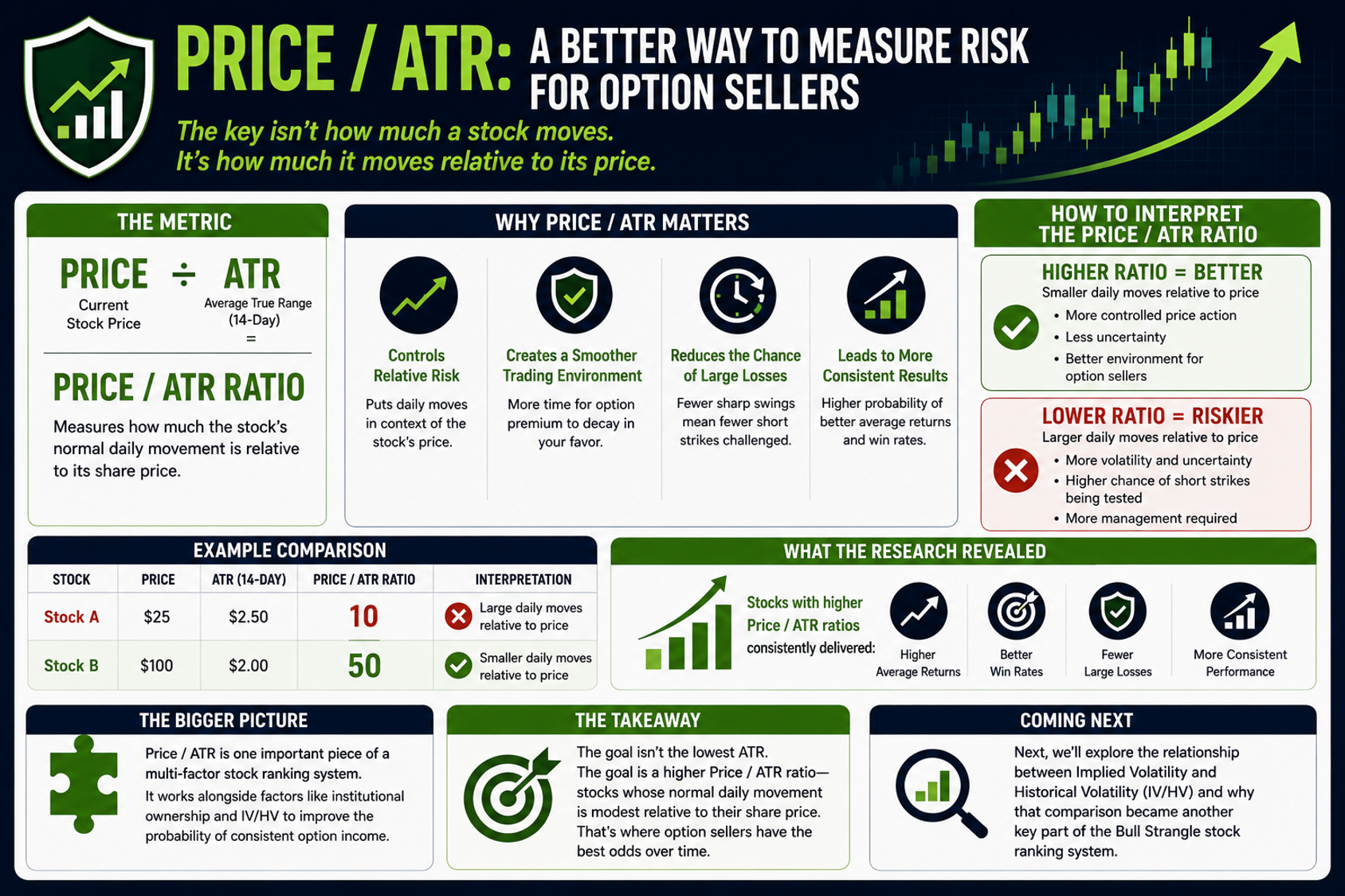
Average True Range measures a stock's typical daily price movement over a specified period, usually fourteen trading days. Unlike implied volatility, ATR is expressed in dollars rather than percentages. If a stock has an ATR of $2.00, it has recently moved about two dollars per day on average. By itself, however, ATR provides only part of the story. A $2 ATR represents a very different level of risk for a $20 stock than it does for a $200 stock.
Dividing the stock price by ATR provides a much more meaningful measure of how large those daily moves are relative to the stock's value. A higher Price / ATR ratio indicates that the stock's normal daily movement is relatively small compared to its share price. That generally creates a more favorable environment for option sellers.
Why Price / ATR Matters
Every option seller benefits from controlled price movement. Large percentage swings increase uncertainty, make short strikes more likely to be challenged, and often require additional position management. The objective isn't to eliminate volatility. Without volatility, there would be little option premium to collect.
Instead, the goal is to identify stocks that generate attractive premiums without exposing the position to unnecessary day-to-day price swings. Price / ATR helps identify those opportunities by placing ATR in its proper context. Rather than asking, "How much does this stock move each day?" the more useful question becomes:
- "How much does this stock move relative to its share price?"
That distinction proved surprisingly important throughout the research.
What the Research Revealed
As I analyzed hundreds of completed Bull Strangle trades, one pattern appeared repeatedly. Stocks with higher Price / ATR ratios consistently produced stronger results. These stocks generally demonstrated:
- Higher average returns
- Better win rates
- Fewer large losses
- More consistent overall performance
No single indicator guarantees success. Markets remain unpredictable, and individual trades will always produce unexpected outcomes. However, across a large sample of completed trades, Price/ATR consistently emerged as one of the strongest statistical differentiators.
Why It Works
Higher Price / ATR ratios indicate that a stock's normal daily movement is relatively modest compared to its price. That typically creates a more stable trading environment, in which option premiums have more time to decay before short strikes are threatened.
Conversely, lower Price / ATR ratios indicate larger percentage swings. Those stocks may still generate attractive option premiums, but they also tend to introduce greater uncertainty and require more trade management. The objective isn't to find stocks with the lowest ATR. It's to identify stocks whose daily movement is appropriately small relative to their share price. That simple adjustment made the metric substantially more useful.
Building a Better Ranking System
One of the biggest lessons from this research has been that successful stock selection rarely depends on a single indicator. Instead, better results come from combining several independent characteristics, each contributing a modest statistical advantage. Institutional ownership became an important factor. Price / ATR became another.
Neither guarantees success on its own. Together, however, they increase the likelihood of identifying stocks better suited to a disciplined option-selling strategy. This philosophy ultimately led to the Bull Strangle stock ranking system, where multiple independent metrics work together before a trade is ever selected. The objective isn't to predict the future. It's to stack the odds in your favor consistently.
Coming Next
Price/ATR measures how much a stock typically moves relative to its price. The next question is equally important:
- How does the market's expectation of future volatility compare with what the stock has actually been doing?
In the next article, we'll examine the relationship between Implied Volatility and Historical Volatility (IV/HV) and explore why that comparison became another key component of the Bull Strangle stock ranking system. Like Price / ATR, it provided insights that were both practical and, in several cases, unexpected.
Want to build a more complete trading toolkit?
The Bull Strangle Newsletter focuses on stocks and options, combining stock ownership with disciplined option-selling techniques designed to generate consistent income while managing risk.
The Smart Spreads Newsletter focuses on seasonal commodity spreads, a historically proven approach that seeks opportunities across agricultural, energy, metal, and financial futures markets.
Each strategy is designed to stand on its own, but together they provide a diversified approach that can perform across a wide range of market environments. For traders looking to deepen their education, The Bull Strangle Strategy and Trading Commodity Spreads, both available on Amazon.
Visit BullStrangle.com to subscribe for just $1 for the first month.
For a video overview of the Bull Strangle Newsletter
For a video overview of the Smart Spreads Newsletter
Darren Carlat
Dual Edge Research
(214) 636-3133
DualEdgeResearch@gamil.com
Disclaimer
This information is for informational purposes only and should not be considered as investment advice. Past performance is not indicative of future results, and all investments carry inherent risk. Consult with a financial advisor before making any investment decisions.


/Renewable%20Energy%20by%20Yuri%20Hoya%20via%20Shutterstock.jpg)


/Micron%20Technology%20Inc_%20logo%20on%20building-by%20vzphotos%20vis%20iStock.jpg)