



Estée Lauder Companies (NYSE:EL) recently cut its dividend, blaming challenges in the "complex prestige beauty landscape," especially in China and Asia's travel retail markets. The announcement in late October didn't go over well with the stock market, sending the company's shares down 11% since then.
With this development, I'll review Estée Lauder's dividend history, the reasons behind the cut, and its long-term sustainability.
Here's the latest on Estée Lauder's dividend
Estée Lauder, which went public in 1995 and began paying quarterly dividends in 1996, has a long history of rewarding shareholders. However, the company experienced a disappointing fiscal 2024, reporting $15.6 billion in net revenue and $390 million in net income -- declines of 2% and 61%, respectively, year over year. This pushed its payout ratio -- the percentage of profits distributed as dividends -- to an unsustainable 243%.
These financial pressures intensified in the first quarter of fiscal 2025. Compounding the strain were one-time costs, including a $159 million litigation settlement tied to talcum-related claims and $106 million in restructuring expenses, which led to a net loss of $156 million for the quarter.
While management had anticipated some restructuring costs, the result weighed on the balance sheet, with net debt surging 30% year over year, reaching $5.5 billion.
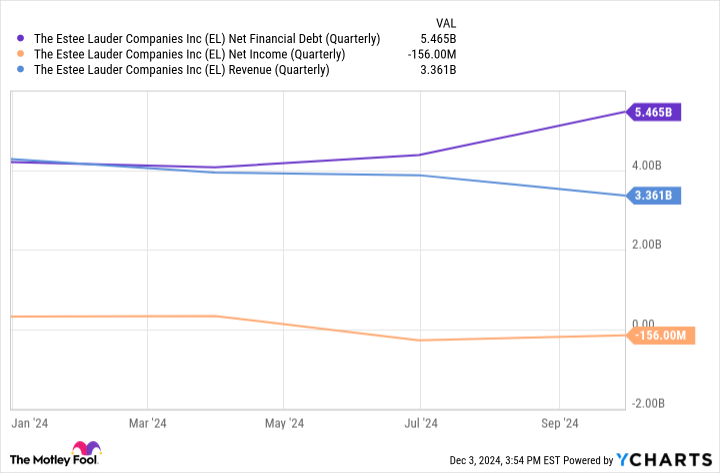
EL Net Financial Debt (Quarterly) data by YCharts.
To address these mounting challenges, Estée Lauder management cut its quarterly per-share dividend from $0.66 to $0.35. Assuming no change to its dividend policy in 2025, Estée Lauder will pay out $1.40 per share, equating to an annual yield of 1.9%.
As a result of the recent missteps, management withdrew its initial earnings-per-share guidance for fiscal 2025, which had been set between $2.52 and $2.76.
Investors hoping for a quick recovery in the stock may want to tread carefully, considering that a recent Hartford Funds study on dividend-paying stocks revealed that companies cutting or eliminating dividends historically underperform those that consistently grow them.
Don’t miss this second chance at a potentially lucrative opportunity
Ever feel like you missed the boat in buying the most successful stocks? Then you’ll want to hear this.
On rare occasions, our expert team of analysts issues a “Double Down” stock recommendation for companies that they think are about to pop. If you’re worried you’ve already missed your chance to invest, now is the best time to buy before it’s too late. And the numbers speak for themselves:
- Nvidia: if you invested $1,000 when we doubled down in 2009, you’d have $376,324!*
- Apple: if you invested $1,000 when we doubled down in 2008, you’d have $46,022!*
- Netflix: if you invested $1,000 when we doubled down in 2004, you’d have $491,327!*
Right now, we’re issuing “Double Down” alerts for three incredible companies, and there may not be another chance like this anytime soon.
*Stock Advisor returns as of December 2, 2024
Collin Brantmeyer has no position in any of the stocks mentioned. The Motley Fool has no position in any of the stocks mentioned. The Motley Fool has a disclosure policy.

/Micron%20Technology%20Inc_%20logo%20on%20building-by%20vzphotos%20vis%20iStock.jpg)



/A%20close-up%20of%20the%20SpaceX%20Falcon%209%20by%20EvgeniyQW%20via%20Adobe%20Stock.jpeg)