


Advanced materials manufacturer Rogers (NYSE:ROG) fell short of the market’s revenue expectations in Q3 CY2024, with sales falling 8.2% year on year to $210.3 million. Next quarter’s revenue guidance of $192.5 million underwhelmed, coming in 9.1% below analysts’ estimates. Its GAAP profit of $0.58 per share was 33.3% above analysts’ consensus estimates.
Is now the time to buy Rogers? Find out by accessing our full research report, it’s free.
Rogers (ROG) Q3 CY2024 Highlights:
- Revenue: $210.3 million vs analyst estimates of $220.1 million (4.5% miss)
- EPS: $0.58 vs analyst estimates of $0.44 (33.3% beat)
- EBITDA: $35.2 million vs analyst estimates of $32.2 million (9.3% beat)
- Revenue Guidance for Q4 CY2024 is $192.5 million at the midpoint, below analyst estimates of $211.8 million
- Gross Margin (GAAP): 35.2%, in line with the same quarter last year
- Operating Margin: 6.9%, down from 12.3% in the same quarter last year
- EBITDA Margin: 16.7%, in line with the same quarter last year
- Free Cash Flow Margin: 12%, down from 15.4% in the same quarter last year
- Market Capitalization: $1.87 billion
"Third-quarter results were mixed with earnings that exceeded our guidance expectations and sales that were below the low end of our outlook,” stated Colin Gouveia, Rogers' President and CEO.
Company Overview
With its silicone foam used in Apollo 11’s mission to the moon, Rogers (NYSE:ROG) produces advanced materials for the telecommunications, automotive, and electronics industries.
Electronic Components
Like many equipment and component manufacturers, electronic components companies are buoyed by secular trends such as connectivity and industrial automation. More specific pockets of strong demand include data centers and telecommunications, which can benefit companies whose optical and transceiver offerings fit those markets. But like the broader industrials sector, these companies are also at the whim of economic cycles. Consumer spending, for example, can greatly impact these companies’ volumes.
Sales Growth
Examining a company’s long-term performance can provide clues about its business quality. Any business can put up a good quarter or two, but the best consistently grow over the long haul. Rogers’s demand was weak over the last five years as its sales fell by 2% annually, a rough starting point for our analysis.
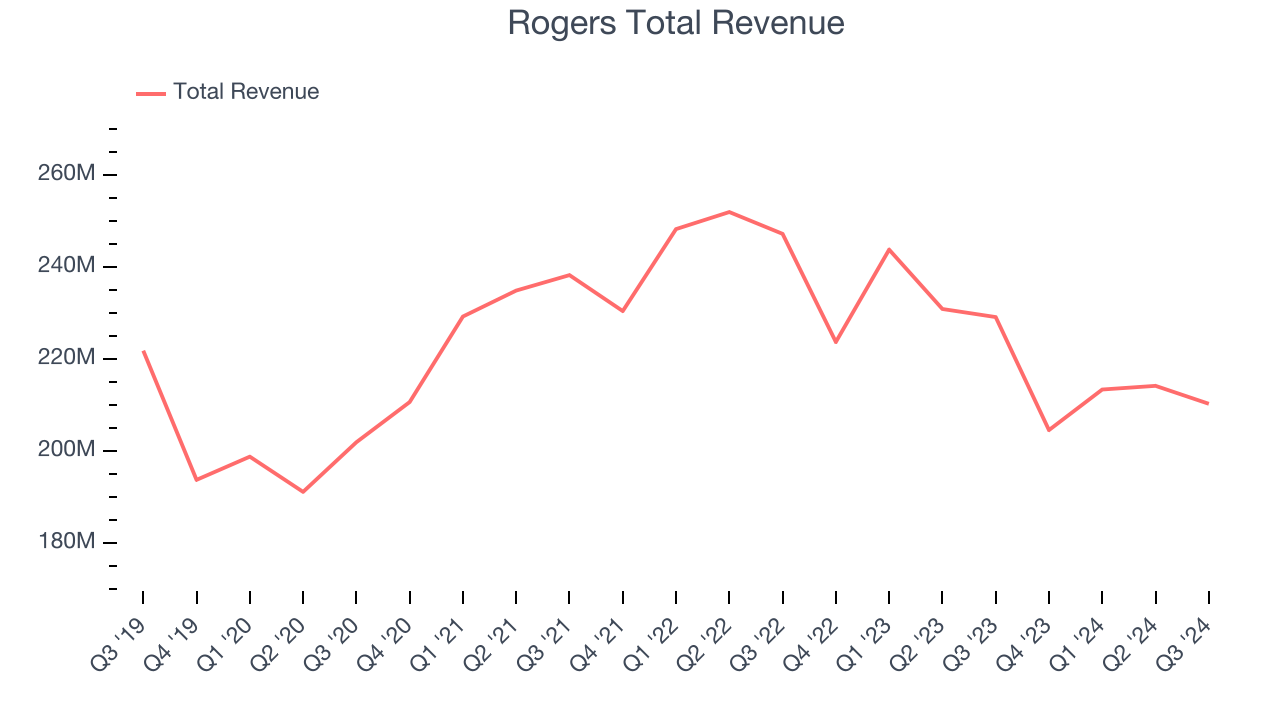
We at StockStory place the most emphasis on long-term growth, but within industrials, a half-decade historical view may miss cycles, industry trends, or a company capitalizing on catalysts such as a new contract win or a successful product line. Rogers’s recent history shows its demand has stayed suppressed as its revenue has declined by 7.2% annually over the last two years. Rogers isn’t alone in its struggles as the Electronic Components industry experienced a cyclical downturn, with many similar businesses seeing lower sales at this time.
This quarter, Rogers missed Wall Street’s estimates and reported a rather uninspiring 8.2% year-on-year revenue decline, generating $210.3 million of revenue. Management is currently guiding for a 5.9% year-on-year decline next quarter.
Looking further ahead, sell-side analysts expect revenue to grow 6.4% over the next 12 months, an acceleration versus the last two years. While this projection indicates the market thinks its newer products and services will catalyze better performance, it is still below average for the sector.
Here at StockStory, we certainly understand the potential of thematic investing. Diverse winners from Microsoft (MSFT) to Alphabet (GOOG), Coca-Cola (KO) to Monster Beverage (MNST) could all have been identified as promising growth stories with a megatrend driving the growth. So, in that spirit, we’ve identified a relatively under-the-radar profitable growth stock benefitting from the rise of AI, available to you FREE via this link.
Operating Margin
Operating margin is a key measure of profitability. Think of it as net income–the bottom line–excluding the impact of taxes and interest on debt, which are less connected to business fundamentals.
Rogers has done a decent job managing its cost base over the last five years. The company has produced an average operating margin of 9.2%, higher than the broader industrials sector.
Looking at the trend in its profitability, Rogers’s annual operating margin decreased by 7.8 percentage points over the last five years. Even though its margin is still high, shareholders will want to see Rogers become more profitable in the future.
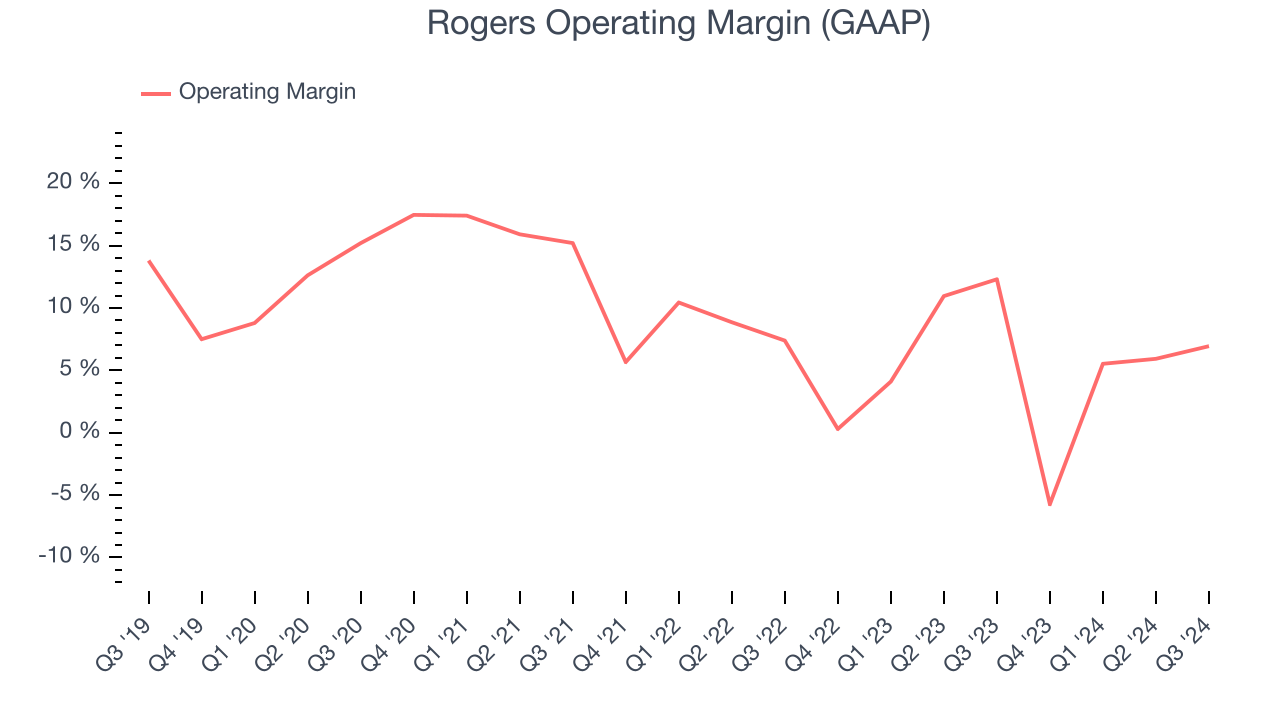
In Q3, Rogers generated an operating profit margin of 6.9%, down 5.4 percentage points year on year. Since Rogers’s operating margin decreased more than its gross margin, we can assume it was recently less efficient because expenses such as marketing, R&D, and administrative overhead increased.
Earnings Per Share
We track the long-term growth in earnings per share (EPS) for the same reason as long-term revenue growth. Compared to revenue, however, EPS highlights whether a company’s growth was profitable.
Sadly for Rogers, its EPS by declined more than its revenue over the last five years, dropping 18.8% annually. This tells us the company struggled because its fixed cost base made it difficult to adjust to shrinking demand.
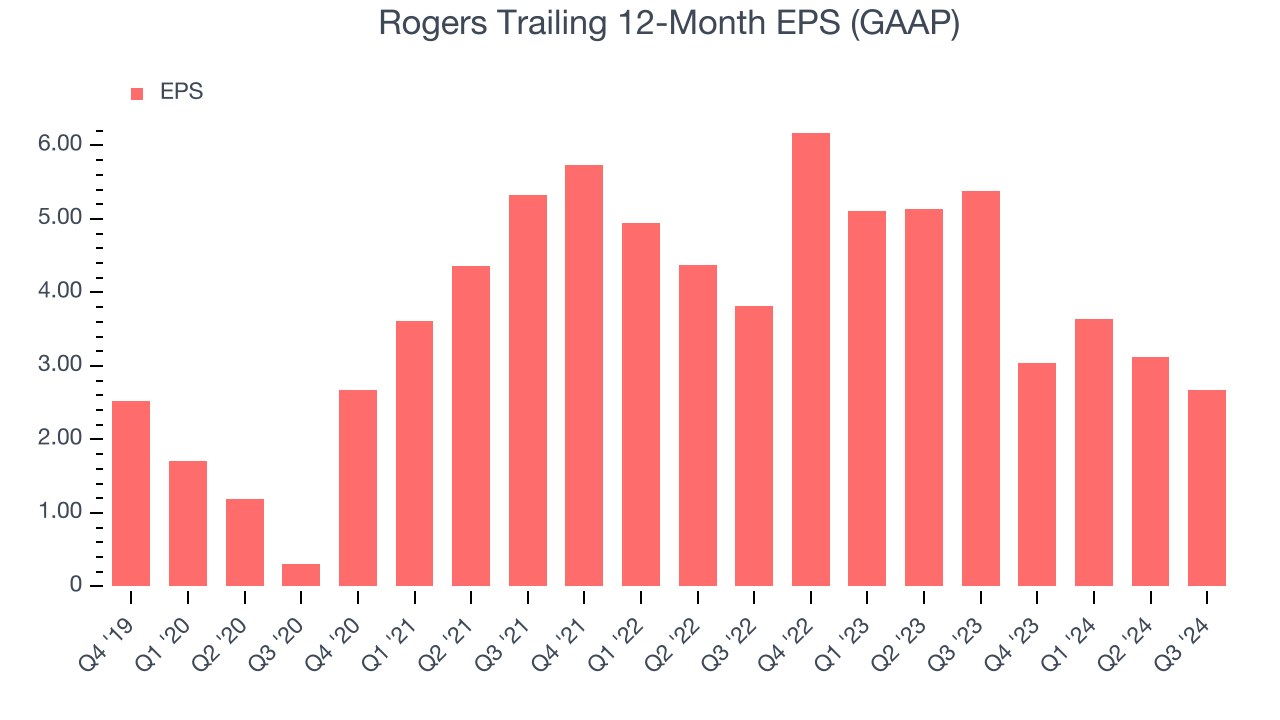
We can take a deeper look into Rogers’s earnings to better understand the drivers of its performance. As we mentioned earlier, Rogers’s operating margin declined by 7.8 percentage points over the last five years. This was the most relevant factor (aside from the revenue impact) behind its lower earnings; taxes and interest expenses can also affect EPS but don’t tell us as much about a company’s fundamentals.
Like with revenue, we analyze EPS over a shorter period to see if we are missing a change in the business. For Rogers, its two-year annual EPS declines of 16.2% show it’s still underperforming. These results were bad no matter how you slice the data.
In Q3, Rogers reported EPS at $0.58, down from $1.02 in the same quarter last year. Despite falling year on year, this print easily cleared analysts’ estimates. We also like to analyze expected EPS growth based on Wall Street analysts’ consensus projections, but there is insufficient data.
Key Takeaways from Rogers’s Q3 Results
We were impressed by how significantly Rogers blew past analysts’ EPS expectations this quarter. We were also excited its EBITDA outperformed Wall Street’s estimates. On the other hand, its revenue guidance for next quarter missed and its revenue fell short of Wall Street’s estimates. Overall, this was a weaker quarter. The stock traded down 4.3% to $95.17 immediately after reporting.
Big picture, is Rogers a buy here and now?We think that the latest quarter is only one piece of the longer-term business quality puzzle. Quality, when combined with valuation, can help determine if the stock is a buy. We cover that in our actionable full research report which you can read here, it’s free.




/A%20Palantir%20sign%20displayed%20on%20an%20office%20building%20by%20Poetra_RH%20via%20Shutterstock.jpg)