Wine company The Duckhorn Portfolio (NYSE:NAPA) reported Q2 CY2024 results beating Wall Street’s revenue expectations, with sales up 7.3% year on year to $107.4 million. Its non-GAAP profit of $0.14 per share was also 40.6% above analysts’ consensus estimates.
Is now the time to buy Duckhorn? Find out by accessing our full research report, it’s free.
Duckhorn (NAPA) Q2 CY2024 Highlights:
- Company being acquired for $11.10 per share
- Revenue: $107.4 million vs analyst estimates of $104.8 million (2.5% beat)
- EPS (non-GAAP): $0.14 vs analyst estimates of $0.10 (40.6% beat)
- Gross Margin (GAAP): 47.8%, down from 54.9% in the same quarter last year
- EBITDA Margin: 37.2%, up from 33.7% in the same quarter last year
- Free Cash Flow was -$1.93 million compared to -$40.39 million in the same quarter last year
- Sales Volumes rose 23.7% year on year (10.6% in the same quarter last year)
- Market Capitalization: $794.1 million
“We are pleased to conclude fiscal 2024 with a solid fourth quarter performance,” said Deirdre Mahlan, President, CEO and Chairperson.
Company Overview
With many of their grapes sourced from the famous Napa Valley region of California, The Duckhorn Portfolio (NYSE:NAPA) is a producer of premium wines and known for its Merlot and other Bordeaux varietals.
Beverages and Alcohol
These companies' performance is influenced by brand strength, marketing strategies, and shifts in consumer preferences. Changing consumption patterns are particularly relevant and can be seen in the explosion of alcoholic craft beer drinks or the steady decline of non-alcoholic sugary sodas. Companies that spend on innovation to meet consumers where they are with regards to trends can reap huge demand benefits while those who ignore trends can see stagnant volumes. Finally, with the advent of the social media, the cost of starting a brand from scratch is much lower, meaning that new entrants can chip away at the market shares of established players.
Sales Growth
Duckhorn is a small consumer staples company, which sometimes brings disadvantages compared to larger competitors benefitting from better brand awareness and economies of scale.
As you can see below, the company’s annualized revenue growth rate of 6.4% over the last three years was mediocre for a consumer staples business.
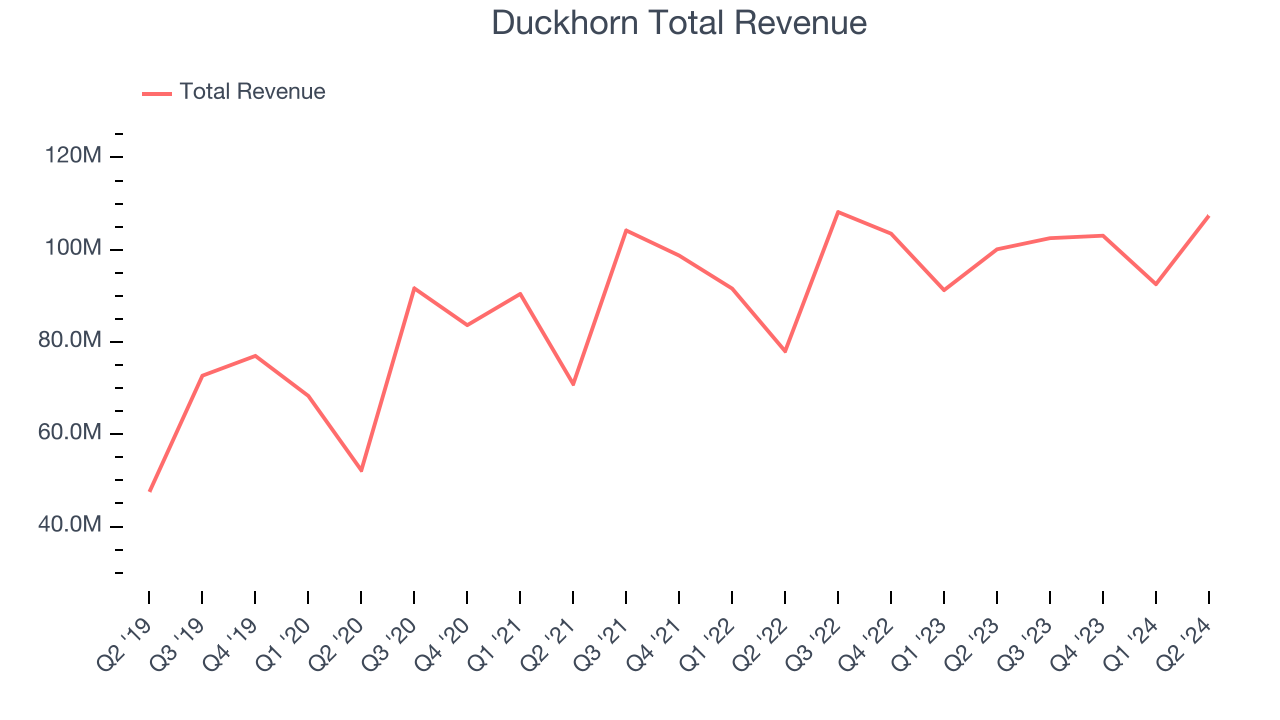
This quarter, Duckhorn reported solid year-on-year revenue growth of 7.3%, and its $107.4 million in revenue outperformed Wall Street’s estimates by 2.5%. Looking ahead, Wall Street expects sales to grow 18.8% over the next 12 months, an acceleration from this quarter.
Unless you’ve been living under a rock, it should be obvious by now that generative AI is going to have a huge impact on how large corporations do business. While Nvidia and AMD are trading close to all-time highs, we prefer a lesser-known (but still profitable) semiconductor stock benefitting from the rise of AI. Click here to access our free report on our favorite semiconductor growth story.
Volume Growth
Revenue growth can be broken down into changes in price and volume (the number of units sold). While both are important, volume is the lifeblood of a successful staples business as there’s a ceiling to what consumers will pay for everyday goods; they can always trade down to non-branded products if the branded versions are too expensive.
Duckhorn’s average quarterly volume growth was a robust 4.5% over the last two years. This is good because meaningful volume growth is hard to come by in the stable consumer staples sector.
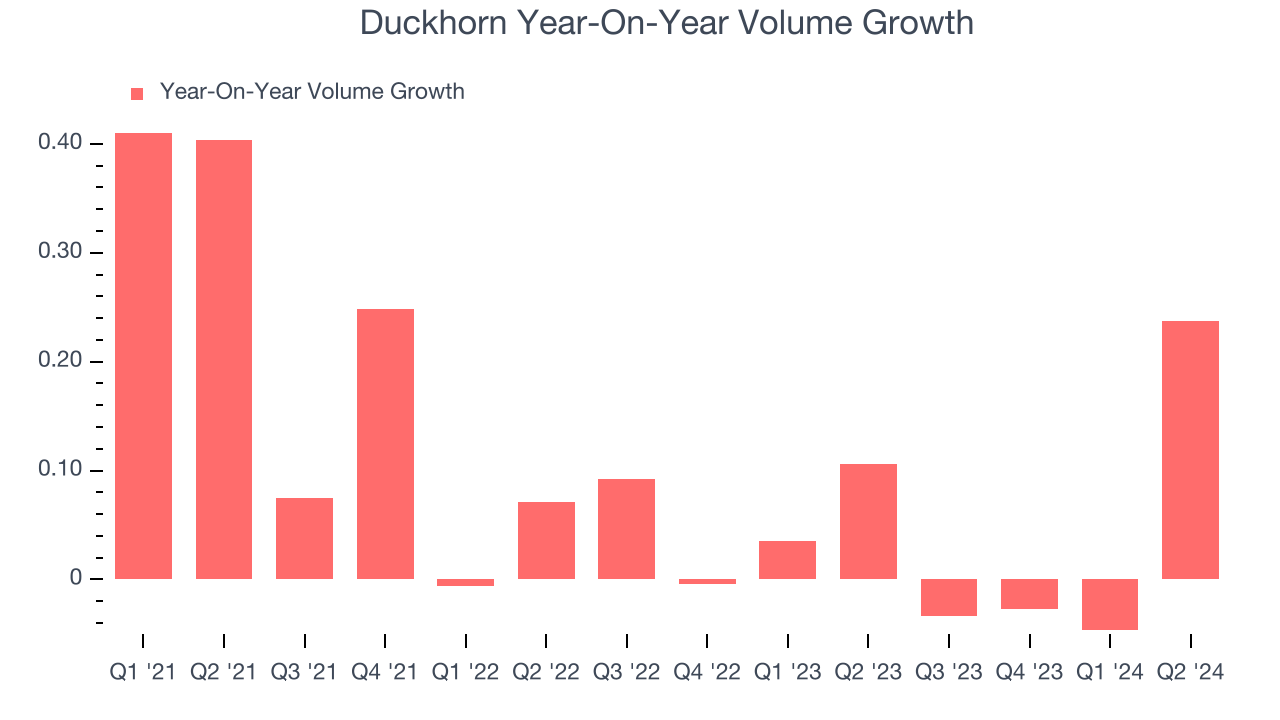
In Duckhorn’s Q2 2024, sales volumes jumped 23.7% year on year. This result was an acceleration from the 10.6% year-on-year increase it posted 12 months ago, certainly a positive signal.
Key Takeaways from Duckhorn’s Q2 Results
Company being acquired for $11.10 per share by Butterfly, a private equity company focused on food and beverage investments. As for the quarter, we were impressed by how significantly Duckhorn blew past analysts’ EPS expectations this quarter. We were also excited its revenue outperformed Wall Street’s estimates. On the other hand, its gross margin missed analysts’ expectations. Overall, this quarter had some key positives. The stock traded up 101% to $10.86 immediately after reporting due to the news of the acquisition.
So should you invest in Duckhorn right now?When making that decision, it’s important to consider its valuation, business qualities, as well as what has happened in the latest quarter. We cover that in our actionable full research report which you can read here, it’s free.


/A%20photo%20of%20a%20Sandisk%20Solid%20State%20Drive%20by%20Top%20Popular%20Vector%20by%20Shutterstock.jpg)