



Chart of the Day
The information and opinions expressed below are based on my analysis of price behavior and chart activity
Sign Up to receive Walsh Trading’s 1st Half of 2026 Market Outlook First Half of 2026 Outlook for the Livestock and Grain markets.
Tuesday, February 17, 2026
If you like this article and would like to receive more information on the commodity markets from Walsh Trading, please use the link to join our daily email list -Click here
April Feeder Cattle (Daily)
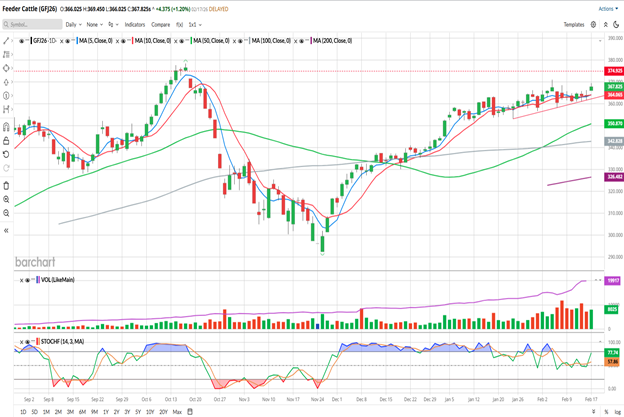
Today, April Feeder Cattle closed at 367.825, up 4.375 from Friday’s settlement. This holiday-shortened week saw prices get an early boost due to very strong cash prices late last week and rumors of more price strength today. Sale Barns across the country remain busy, and many “new-high” records are being set at varying weight classes, on a near-daily basis.
Late last week cash trade for slaughter weight cattle rallied into the $246-249 level, forcing packers even deeper into the red. Current packer margins are estimated to be over -$300/head, now. Earlier today, there was talk of $250 trade into one of the “I” states, but as of this writing, I can’t confirm. That strength is also supporting Feeder Cattle prices, in my estimation.
Today’s close marks the highest closing price in April Feeders since the contract high close of 376.500 on October 16th. There’s still an overhead gap on the chart from that day, at 374.925 and prices need to get above 371.500 to get into the lower part of that gap. You may notice the red dotted line, denoting the gap level, on the chart above. I’ve also drawn a trendline (also red) on the chart, from the January 23rd low to the February 5th low. You may notice that prices got close to that trendline support last week, but did not break it, instead that trendline acted as support during a week when prices barely changed.
The short-term moving averages on the chart above, the 5- and 10-day, made a bullish crossover with today’s trade. Those are blue and red, respectively, and are offering potential support levels at 364.155 and 364.065. I would think that the 364.000 level should be support this week, barring some sort of outside event. The medium-term moving averages, the 50- and 100-day made a bullish crossover earlier this month, on February 2nd. Those averages are green and grey, respectively, and are near 350.875 and 342.825, or so. The 200-day average (purple) is way down near the 326.500 level. All of those moving averages seem to be in a bullish configuration and all of them are inclined toward higher prices, at the moment.
Last week’s trade was also interesting, to me anyhow, because both Monday and Friday of last week were nearly “textbook” Doji’s, or equilibrium days where the opening and closing prices were nearly identical. Last week we saw a mild bearish confirmation on Tuesday, following Monday’s equilibrium trade, but got now follow through to the downside and the trend support held. Today’s trade seems like a bullish confirmation, following Friday’s equilibrium-type trade. We’ll have to stay tuned to see if the bulls have regained technical control. I think they got it back in early-December, when the 5- and 10-day averages made a bullish crossover, but the upward momentum has certainly slowed over the past month or so. Today’s close is also higher than all price points achieved in January, further adding to the bullish fuel.
Stochastics (bottom sub-graph) have dipped down to mid-range over the past two weeks and now appear to be pointing back up toward overbought. There have been a few periods of oversold conditions, looking back over this view, but to my eye, the market has been “more” content to be overbought over the past six-month look. Another day or two of price gains like today and the Stochastics will hit the overbought levels again.
I understand that some cattle producers are “worried” about these high prices. I think the worry stems from a “fear of missing out” type of feeling. And I’ve had many producers tell me that a test of the contract highs could result in some hedging pressure up there, should prices reach the 380.000 level. I also speak with many producers who still recall the way the market topped out in late 2014 and have expressed concerns that price could reverse any day now and they’ll be left holding the proverbial bag.
While anything is possible, especially in today’s age of social media, I think the fundamental situation is still bullish. I’ve said it here before (and I’ll keep saying it) but we have less cattle and more people to feed. Yes, the supply-side numbers are bullish, with herd numbers at some 75-year lows. But the biggest driver, in my opinion, is demand. Beef is still king when it comes to protein and US consumers are showing no signs of lightening up, just yet. Yes, there is some grumbling at the meat counters in supermarkets, but demand remains strong. Packer margin losses are estimated to be over -$300 per head. Their slaughter efficiency, in my opinion, has actually kept retail prices lower than they could be, simply because they’re getting more usable product out of each animal. Dressed, or hanging weights, have improved from about 875 pounds at this time in 2024, up to about 950 pounds today. That’s almost a 10% jump in just two years and I think that is what has kept retail prices, somewhat, in check.
There is a Cattle on Feed report due out this Friday, after the close. Estimates that I’ve seen would project to the “On Feed” number to be 98.5% of last year’s data, with the Placements near 97% and Marketings at 87%. If the numbers do come in like that, I think that would confirm the bullish trend and put even higher prices on the table, so to speak, for next week.
Producers that are worried about downside price risk may do well to consider Long Put or Put Spread positions. April Options expire in 72 days. March Options expire in 37 days and may offer a better value, simply because you’re paying less in time value. An April 360.000 Put (just under last weeks low) settled at 7.325 today, or $3,662.50, before your commissions/fees. If you chose to spread that by selling an April 350.000 Put option, at today’s settlement, your out-of-pocket expense drops to 2.725, plus your commissions/fees. A March 363.000 Put (also just under last weeks low) settled at 3.975 today, or $1,987.50, before your commissions/fees. Like the April example above, if you chose to spread that March long option by selling the 353.000 Put against it, your out-of-pocket expense drops to 2.025, at today’s settlement, or $1,012.50 before your commissions/fees. Given the uptrend that’s been in place for the past 5 years, I think the option strategies offer the producer better value than outright hedges and expensive margin calls. Should the market turn lower, the options should help your bottom line in short order, while you’re getting the chance to decide if a short futures position or outright hedge is good for you and your operation.
Aggressive and well-margined speculators/traders may do well to consider a Long futures position in April Feeders. Look to enter the market on a pullback to 364.000, with a risk/reverse Sell Stop (if you bought 1, sell 2) below last weeks low of 360.700. That would work out to a potential risk of $1,650 per contract, before your commissions/fees. Look to exit that trade on a rally to a new contract high of 378.500. If the upside target is hit, that would work out to a potential profit of $7,250 per contract, before your commissions/fees.
April Feeder Cattle (Weekly)
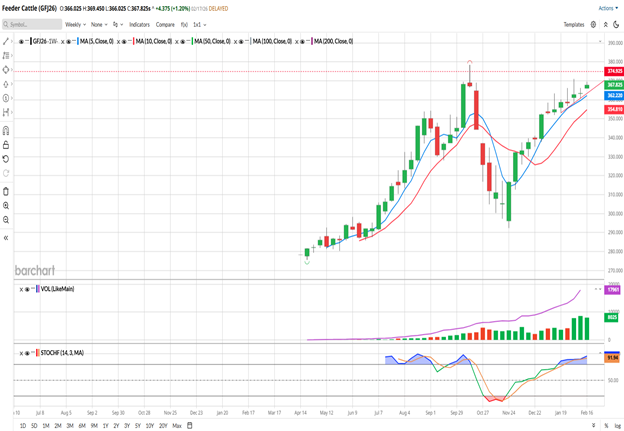
One day into the holiday-shortened week and I’m seeing a bullish confirmation, following last week’s Doji. Only 0.200 separated the open from the close last week, which is almost a textbook Doji print. However, there are still 3 trading days remaining in the week, so anything can still happen.
The only moving averages on the weekly chart are the 5- and 10-week (blue/red) and those have been in a bullish configuration since the week of Christmas. Currently, those averages are at 362.220 and 354.810, respectively. I would expect the 5-week average to remain as support, but if prices drop to the 10-week, that could be a sign of bearish reversal. Much like the first large, red bar in October. Once that 10-week average was broken, prices still had another 54.000 to drop. Recall that prices started to decline then because of an offhand statement by the President, that he would like it if beef prices came down. Keep an eye out for social media posts, because those can change market perception, regardless. There’s also the New World Screwworm that has kept the US/MX border closed to animal imports. While an additional sterile fly dispersal facility has been completed in Texas, the sterile fly production facility in Mexico is still under construction, with completion/production as early as this summer. The US production site is still only in the “planning” stages and is still years away from being operational. There are currently no signs of Screwworm here in the US. However, rumors can put a temporary (I think) bearish spin on the market, as could the border being re-opened to trade.
According to Barchart’s Seasonal Data, Feeder prices tend to rally in February 65% of the time, over the past 15 years. In March, prices tend to stay firm on balance, but it’s about 50/50 since 2010. Average performance in April is negative, about 56% of the time over that period. The Seasonal Charts that I watch, project to a high in late February, with a 5 year pattern to weaken into the first week or so in March, followed by a rally into new highs by late March. I think the fundamental conditions may have shifted enough that the 15 and 30 year seasonal patterns may be irrelevant. I have that opinion about many markets, not just the Cattle.
Sign Up to receive Walsh Trading’s 1st Half of 2026 Market Outlook First Half of 2026 Outlook for the Livestock and Grain markets.
If you like what you’ve read here and would like to see more like this from Walsh Trading, please Click here and sign up for our daily futures market email.
Jefferson Fosse Walsh Trading
Direct 312 957 8248 Toll Free 800 556 9411
jfosse@walshtrading.com www.walshtrading.com
Walsh Trading, Inc. is registered as a Guaranteed Introducing Broker with the Commodity Futures Trading Commission and an NFA Member.
Futures and options trading involves substantial risk and is not suitable for all investors. Therefore, individuals should carefully consider their financial condition in deciding whether to trade. Option traders should be aware that the exercise of a long option will result in a futures position. The valuation of futures and options may fluctuate, and as a result, clients may lose more than their original investment. The information contained on this site is the opinion of the writer or was obtained from sources cited within the commentary. The impact on market prices due to seasonal or market cycles and current news events may already be reflected in market prices. PAST PERFORMANCE IS NOT NECESSARILY INDICATIVE OF FUTURE RESULTS. All information, communications, publications, and reports, including this specific material, used and distributed by Walsh Trading, Inc. (“WTI”) shall be construed as a solicitation for entering into a derivatives transaction. WTI does not distribute research reports, employ research analysts, or maintain a research department as defined in CFTC Regulation 1.71.




/McDonald's%20Corp%20arches%20by-%20TonyBaggett%20via%20iStock.jpg)