Editor's note: Any and all references to time frames longer than one trading day are for purposes of market context only, and not recommendations of any holding time frame. Daily rebalancing ETFs are not meant to be held unmonitored for long periods. If you don't have the resources, time or inclination to constantly monitor and manage your positions, leveraged and inverse ETFs are not for you.
Investing in the fund involves a high degree of risk. SPCX recently commenced its initial public offering and may experience heightened volatility. Unlike traditional ETFs, or even other leveraged and/or inverse ETFs, this leveraged single-stock ETF tracks the price of a single stock rather than an index, eliminating the benefits of diversification. Leveraged ETFs pursue daily leveraged investment objectives, which means they are riskier than alternatives which do not use leverage. They seek daily goals and should not be expected to track the underlying stock’s performance over periods longer than one day. They are not suitable for all investors and should be utilized only by investors who understand leverage risk and who actively manage their investments. The Fund will lose money if the underlying stock’s performance is flat, and it is possible that the Fund will lose money even if the underlying stock’s performance increases, over a period longer than a single day. Investing in the Fund is not equivalent to investing directly in SPCX.
SpaceX (Ticker: SPCX) began trading on the Nasdaq on June 12 after raising $75 billion in the largest IPO* in history, easily surpassing Saudi Aramco’s $29.4 billion listing in 2019. The stock opened at a valuation of roughly $1.75 trillion.1
SpaceX is not your typical pre-revenue IPO. The S-1 revealed 2025 revenue of $18.67 billion, with Starlink, its satellite internet unit, contributing $11.4 billion of that total, up 50% year over year. Starlink reported $1.2 billion in Q1 2026 operating profit and 10.3 million active subscribers as of the filing date.2 Starlink’s constellation now includes more than 10,000 operational satellites, roughly 65% of all active satellites in orbit.3
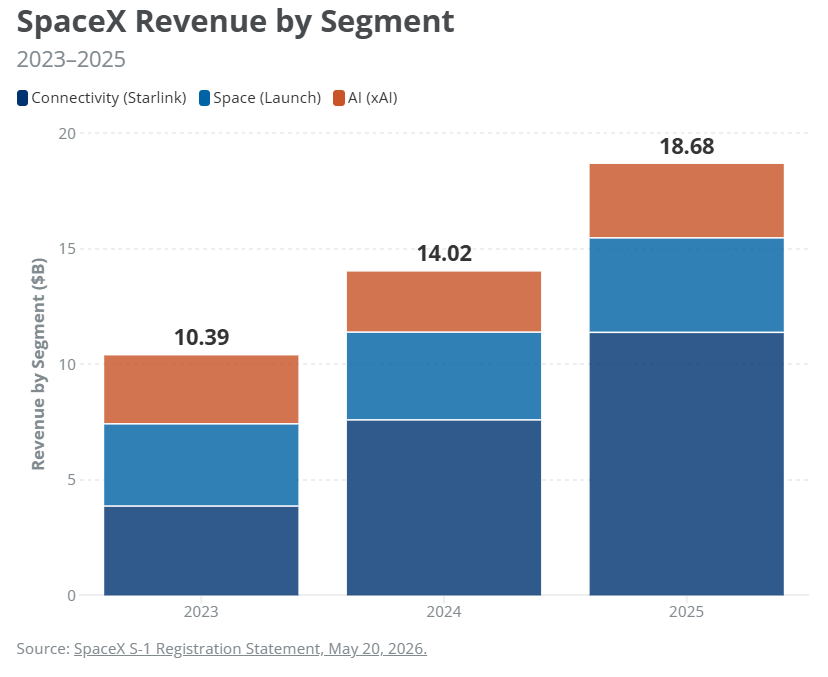
The rocket-launching business logged 167 Falcon 9 missions in 2025 with 100% payload delivery success, and individual boosters have now flown more than 30 times each.4 On May 22, SpaceX flew Starship V3 in the twelfth Starship test from a new launch pad at Starbase, deploying 22 Starlink simulators and completing a controlled splashdown in the Indian Ocean.5 Five days later, the U.S. Space Force awarded SpaceX a $2.29 billion contract to build the Space Data Network Backbone on its Starshield platform.6
The revenue catalysts don’t end there. SpaceX holds more than $22 billion in cumulative federal contracts across NASA, the Department of Defense, and the Space Force, including the $4.04 billion Artemis lunar lander program.7
The numbers are impressive. The question is whether they justify a $1.75 trillion price tag. At roughly 94 times 2025 revenue, the valuation leaves little room for stumbles, and there are places where the story gets more complicated.
Why Bulls Are Lining Up for SpaceX
The strongest bullish argument for SpaceX at this market cap* is probably Starlink. A satellite broadband business generating $11.4 billion in revenue at a reported 63% EBITDA margin is rare in any sector.8 Subscriber growth has been accelerating, from 4.6 million at the end of 2024 to 9 million by December 2025 to 10.3 million by February 2026.3 Maritime, aviation, and direct-to-cell services are opening new verticals that did not exist two years ago.
The launch business reinforces the moat. SpaceX handles roughly 85% of U.S. orbital launches and more than 60% of global commercial launches by mass.4 Reusable boosters at over 30 flights each have driven per-launch costs below $3 million on the booster alone, a structural advantage that competitors have not yet matched.4
Government revenue adds another layer of support. The $2.29 billion Starshield contract, the $5.9 billion NSSL Phase 3 Lane 2 award, and the Artemis HLS program represent committed, multi-year revenue streams that are largely independent of consumer or enterprise demand cycles.67
The xAI merger in February 2026 adds an AI infrastructure dimension. The combined entity gives public investors exposure to launch, satellite broadband, defense, and AI under a single ticker.1
What Could Take the Air Out
The valuation is the first and most obvious risk. At $1.75 trillion, SpaceX would immediately rank among the ten most valuable companies in the world.1 That multiple requires sustained execution across every business line simultaneously.
The S-1 shows a 2025 net loss of $4.9 billion, driven primarily by $20 billion in xAI-related capital expenditures* that accounted for 60% of total capex.2 That’s a big bet on AI. If the market decides the AI drag outweighs the Starlink engine, the stock could reprice quickly.
Governance is another potential risk. Elon Musk holds 85.1% voting control through a dual-class share structure. He also runs Tesla (Ticker: TSLA), xAI, X, The Boring Company, and Neuralink. The S-1 discloses $530 million in legal exposure attributable to Musk personally.9 For public-market investors accustomed to independent boards, the governance structure is an intriguing feature for some and a risk for others.
Execution risk on Starship is another concern. The test flight on May 22 was mostly successful, but the Super Heavy booster failed its boostback burn and crash-landed in the Gulf of Mexico.5 Starship V3 is still in testing. The propellant transfer demonstration needed for NASA’s Artemis lunar missions has not yet occurred.10
Competition is also accelerating. Blue Origin’s New Glenn is operational, Rocket Lab’s Neutron targets a 2026 maiden flight, and both are pursuing reusable architectures.11 SpaceX’s lead is measured in thousands of flights, but the gap may narrow over time.
Trading the Bullish View on SpaceX with LOFF
The recently launched Direxion Daily SpaceX Bull 2X ETF (Ticker: LOFF) is a daily 2X leveraged bull fund targeting daily investment results, before fees and expenses, of 200% of the performance of the common shares of SPCX. It is designed for active traders who want precision leveraged exposure to SpaceX. LOFF is built for short-term, daily objective trades.
The Trade Ahead
Now that SpaceX is a public company, investors will be keeping a close eye on catalysts like Starlink subscriber rates, Starship test flights, government contract awards, xAI milestones, and quarterly financials that will be visible for the first time. A key question is whether the $1.75 trillion valuation is too much. LOFF gives traders a vehicle for expressing a bullish short-term view on the newly minted stock.
Sources:
1 Reuters via Investing.com, “Exclusive: SpaceX accelerates IPO timeline, targets June 12 listing on Nasdaq, sources say.” https://www.investing.com/news/stock-market-news/exclusivespacex-accelerates-ipo-timeline-targets-june-11-pricing-on-nasdaq-4693540
2 StockTwits, “SpaceX IPO Takes Off: Firm Highlights Starlink’s $1.2B Q1 Profit And 10.3M Subscribers In Filing.” https://stocktwits.com/news-articles/markets/equity/spacex-ipo-takes-off-firm-highlights-starlink-1.2-billion-q1-profit-10.3-million-subscribers/cZXxBC0Ren8
3 The Global Statistics, “Starlink Internet Statistics 2026,” accessed June 2, 2026. https://www.theglobalstatistics.com/starlink-internet-statistics/
4 SpaceXNow, “Statistics,” accessed June 2, 2026. https://spacexnow.com/stats
5 SpaceX, “Starship’s Twelfth Flight Test.” https://www.spacex.com/launches/starship-flight-12
6 SpaceNews, “SpaceX wins $2.29 billion Space Force contract for military data network.” https://spacenews.com/spacex-wins-2-29-billion-space-force-contract-for-military-data-network/
7 Fed-Spend, “SpaceX Government Contracts: $22 Billion in Federal Awards from NASA, DOD, and the Space Force.” https://fed-spend.com/blog/spacex-government-contracts-nasa-dod-space-force
8 TradingKey, “$11.4 Billion Revenue Vs. 1.75 Trillion Valuation: Can Starlink Support SpaceX IPO?” https://www.tradingkey.com/analysis/stocks/us-stocks/261779128-starlink-spacexipo-rocket-launch-tradingkey
9 LinkedIn (cf0), “SpaceX (SPCX): IPO Analysis, Valuation, And Competitive Landscape.” https://www.linkedin.com/pulse/copy-spacex-spcx-ipo-analysis-valuation-competitive-landscape-cf0-gwn5f
10 CNBC, "SpaceX completes 11th Starship test before debuting upgraded prototype.” https://www.cnbc.com/2025/10/14/spacex-completes-11th-starship-test-before-debuting-upgraded-prototype.html
11 SpaceNexus, “SpaceX vs Blue Origin vs Rocket Lab: Launch Provider Comparison 2026.” https://spacenexus.us/blog/spacex-blue-origin-rocket-lab-comparison-2026
*Definitions and Index Descriptions
An investor should carefully consider a Fund’s investment objective, risks, charges, and expenses before investing. A Fund’s prospectus and summary prospectus contain this and other information about the Direxion Shares. To obtain a Fund’s prospectus and summary prospectus call 866-476-7523 or visit our website at direxion.com. A Fund’s prospectus and summary prospectus should be read carefully before investing.
The Fund’s ability to achieve its daily leveraged investment objective depends, in part, on the availability of swaps, options, and other financial instruments that provide exposure to SpaceX. These instruments may be limited, illiquid, costly, or unavailable, particularly at the time of or shortly after SpaceX’s or during periods of significant volatility or market demand. Exchange position limits, margin requirements, counterparty risk limits, limited public float, limited trading history, or other market, regulatory, or operational constraints may also restrict the Fund’s ability to obtain or maintain its desired 2X exposure. As a result, the Fund may be unable to achieve exposure equal to 200% of the daily performance of SPCX, may be unable to rebalance effectively, or may be required to hold more cash or use less efficient instruments. These constraints may increase costs significantly and thereby increase tracking error, cause the Fund to return substantially less than 200% the daily performance of SPCX, or prevent the Fund from achieving its investment objective. Additionally, shares of the Fund trading on the NYSE Arca, Inc. may experience larger bid-ask spreads and increased premium/discounts, especially on SpaceX’s IPO date as well as the days following the IPO. The gain or loss that an investor experiences is very likely to be different than Fund’s stated investment objective due to intra-day investment risk. On the IPO date and the days following the IPO, investors should expect significant volatility in Share price and heightened risk of the Fund’s return being substantially less than 200% the daily performance of SPCX because of the risks stated above. An investor can lose the full principal value of his/her investment in the Fund within a single day if SPCX loses more than 50% in one day.
Direxion Shares Risks – An investment in the Fund involves risk, including the possible loss of principal. The Fund is non-diversified and includes risks associated with the Fund concentrating its investments in a particular security, industry, sector, or geographic region which can result in increased volatility. The Fund's investments in derivatives such as futures contracts and swaps may pose risks in addition to, and greater than, those associated with directly investing in securities or other investments, including imperfect correlations with underlying investments or the Fund's other portfolio holdings, higher price volatility and lack of availability. As a result, the value of an investment in the Fund may change quickly and without warning.
Leverage Risk – The Fund obtains investment exposure in excess of its net assets by utilizing leverage and may lose more money in market conditions that are adverse to its investment objective than a fund that does not utilize leverage. A total loss may occur in a single day. Leverage will also have the effect of magnifying any differences in the Fund’s correlation with SPCX and may increase the volatility of the Fund.
Daily Correlation Risk - A number of factors may affect the Fund’s ability to achieve a high degree of correlation with SPCX and therefore achieve its daily leveraged investment objective. The Fund’s exposure to SPCX is impacted by SPCX’s movement. Because of this, it is unlikely that the Fund will be perfectly exposed to SPCX at the end of each day. The possibility of the Fund being materially over- or under-exposed to SPCX increases on days when SPCX is volatile near the close of the trading day.
SpaceX Investing Risk — Investing in SpaceX involves a high degree of risk. SpaceX operates in a rapidly changing and highly competitive industry. Returns depend in part on SpaceX’s ability to successfully design, manufacture, launch, and operate space launch vehicles, spacecraft, and satellite systems while controlling costs and achieving operational reliability; among other risks.
Space and Space Exploration Industry Risk — The space and space exploration industry encompasses the building and integration of items to go into space, including spacecraft, satellites, payloads and products to be used in space or which are related to space. The space industry has seen dramatic increase in investment over a short period of time.
Communication Services Sector Risk — The communication services sector may be dominated by a small number of companies which may lead to additional volatility in the sector. Communication services companies are particularly vulnerable to the potential obsolescence of products and services due to technological advances and the innovation of competitors.
Additional risks of the Fund include Recent Initial Public Offering and Derivatives Capacity Constraints Risk. Effects of Compounding and Market Volatility Risk, Derivatives Risk, Counterparty Risk, Rebalancing Risk, Intra-Day Investment Risk, Concentration Risk, Market Risk, Non-Affiliation Risk, Security Volatility Risk and Cash Transaction Risk. Please see the summary and full prospectuses for a more complete description of these and other risks of the Fund.
Distributor: ALPS Distributors, Inc.


/A%20photo%20of%20a%20Sandisk%20Solid%20State%20Drive%20by%20Top%20Popular%20Vector%20by%20Shutterstock.jpg)