Dual Edge Research publishes two powerful newsletters that work great individually — and even better together. The Bull Strangle Newsletter focuses on stocks and options, combining stock ownership with premium-selling strategies to generate consistent income and market-beating returns. The Smart Spreads Newsletter specializes in seasonal commodity futures spreads, offering a diversified approach with low correlation to equities. Together, they deliver a complete investment perspective — one focused on income, the other on diversification — all under one simple subscription.
Introduction
In last week's article, I introduced the stock ranking system developed through ongoing Bull Strangle research. The objective of the project is simple: identify characteristics that consistently appear in stocks that produce favorable outcomes for option-selling strategies. Among all the metrics evaluated so far, one factor has repeatedly emerged as one of the strongest indicators of stock quality: institutional ownership. While many investors focus primarily on earnings growth, analyst ratings, or recent price performance, institutional ownership provides a different perspective. It offers insight into who owns the stock and, perhaps more importantly, who is willing to commit significant capital to it. The research suggests that this matters more than many investors realize.
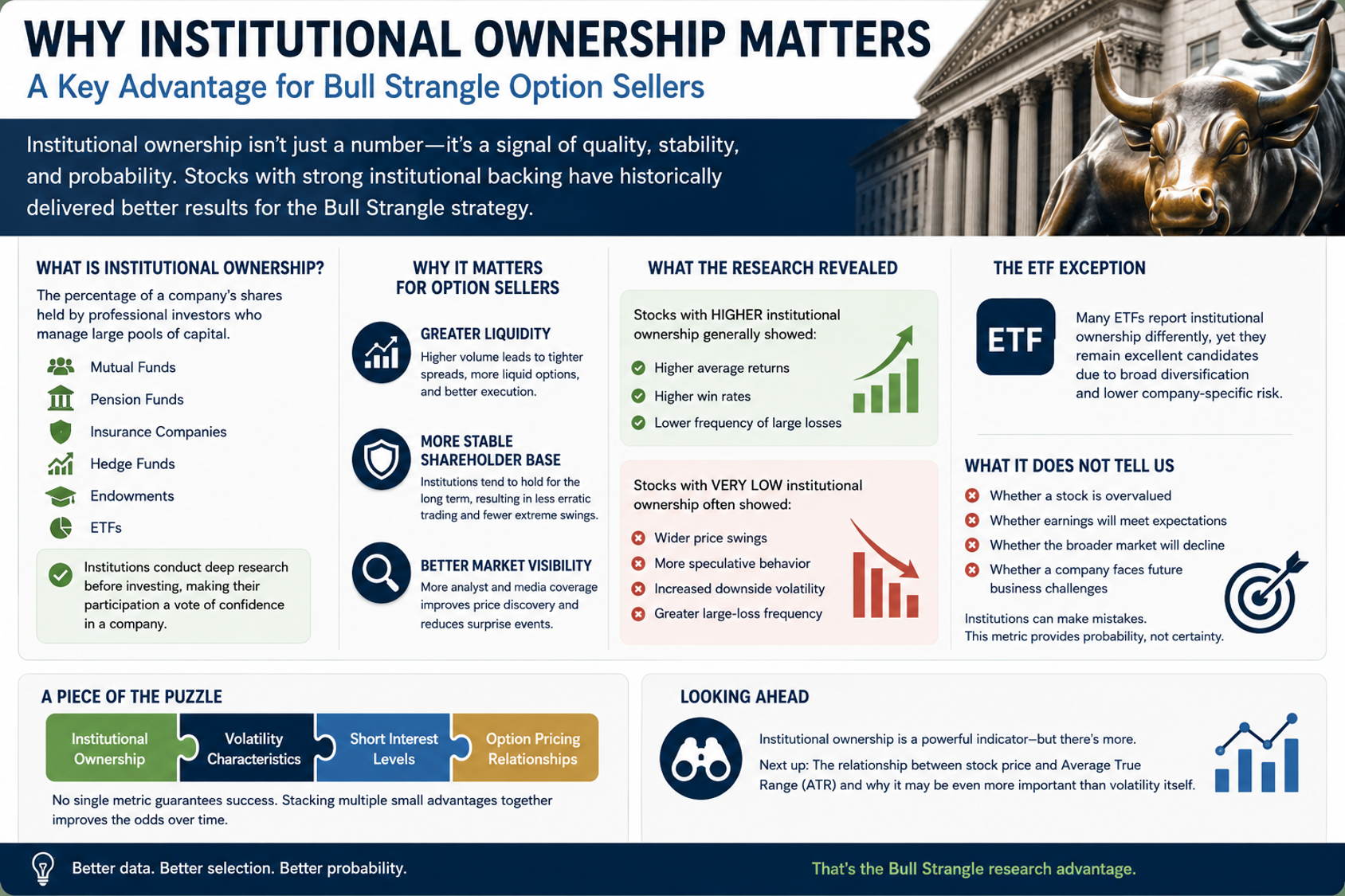
What Is Institutional Ownership?
Institutional ownership represents the percentage of a company's outstanding shares held by professional investors, such as:
- Mutual funds
- Pension funds
- Insurance companies
- Hedge funds
- Endowments
- Exchange-traded funds
These organizations often manage billions of dollars and employ teams of analysts dedicated to researching potential investments. Unlike individual investors, institutions typically perform extensive due diligence before establishing meaningful positions. They analyze financial statements, evaluate management teams, study industry trends, and assess long-term business prospects. While institutions are certainly not infallible, their participation often serves as a vote of confidence in a company's quality and stability.
Why Option Sellers Should Care
For the Bull Strangle strategy, the objective is not necessarily to identify the fastest-growing stocks or the next market superstar. Instead, the goal is to find stocks that can support a repeatable income-generating process. Stocks with substantial institutional ownership often exhibit several characteristics that align well with that objective.
Greater Liquidity
Large institutional participation generally attracts higher trading volume. Higher volume typically leads to:
- Tighter bid-ask spreads
- More liquid option markets
- Better execution quality
For option sellers, even small improvements in execution can have a meaningful impact on hundreds of trades.
More Stable Shareholder Bases
Institutional investors often maintain positions for months or years rather than days or weeks. As a result, stocks with heavy institutional ownership frequently experience less erratic trading activity than stocks dominated by speculative retail participation. While no stock is immune to volatility, institutional sponsorship can help reduce the frequency of extreme price swings that create challenges for option sellers.
Better Market Visibility
Analysts, investment banks, and financial media often follow companies that attract institutional interest. This increased visibility tends to improve price discovery and reduce the likelihood of dramatic surprises caused by limited market attention. Again, the objective is not to eliminate risk. It is to reduce unnecessary risk whenever possible.
What the Research Revealed
As part of the ongoing Bull Strangle research project, stocks were grouped by their level of institutional ownership and evaluated for subsequent trading performance. The results showed a clear pattern. Stocks with higher institutional ownership generally produced:
- Higher average returns
- Higher win rates
- Lower frequencies of large losses
The improvement was not perfectly linear, and institutional ownership alone does not guarantee success. However, the trend was consistent enough to become a permanent component of the stock ranking system. Perhaps more importantly, stocks with very low institutional ownership frequently exhibited characteristics that were less desirable for an income-oriented strategy. These stocks often displayed:
- Wider price swings
- More speculative behavior
- Increased downside volatility
- Greater large-loss frequency
While some generated impressive gains, the overall risk profile was less attractive.
The ETF Exception
One interesting discovery during the research involved exchange-traded funds. Many ETFs report institutional ownership figures that differ significantly from traditional operating companies. In some cases, ownership data may appear unusually low or may not be reported consistently across data providers. Yet many ETFs remain excellent candidates for option-selling strategies because they offer broad diversification and reduced company-specific risk. For this reason, institutional ownership should be viewed as one tool rather than a universal rule. Context always matters.
What Institutional Ownership Does Not Tell Us
Like any metric, institutional ownership has limitations. It does not tell us:
- Whether a stock is overvalued
- Whether earnings will meet expectations
- Whether the broader market will decline
- Whether a company faces future business challenges
Institutions can make mistakes just like individual investors. The value of the metric comes from probability rather than certainty. The research suggests that stocks attracting substantial institutional participation have historically provided a more favorable environment for the Bull Strangle strategy. That does not mean every trade will succeed. It simply means the odds appear to improve.
A Piece of the Puzzle
One of the most important lessons from this research is that no single metric drives results on its own. Institutional ownership is powerful, but it works best when combined with other factors such as volatility characteristics, short-interest levels, and option-pricing relationships. The objective is not to find one perfect indicator. The objective is to stack multiple small advantages together. When several favorable characteristics appear in the same stock, the probability of a successful outcome may improve substantially. That philosophy forms the foundation of the Bull Strangle ranking system.
Looking Ahead
Institutional ownership has proven to be one of the most valuable metrics identified so far, but it is only one part of the selection process. In the next article, we'll examine another factor that has demonstrated surprising predictive value: the relationship between stock price and Average True Range (ATR). While many investors focus on volatility itself, the research suggests that how volatility relates to stock price may be even more important.
Want to build a more complete trading toolkit?
The Bull Strangle Newsletter focuses on stocks and options, combining stock ownership with disciplined option-selling techniques designed to generate consistent income while managing risk.
The Smart Spreads Newsletter focuses on seasonal commodity spreads, a historically proven approach that seeks opportunities across agricultural, energy, metal, and financial futures markets.
Each strategy is designed to stand on its own, but together they provide a diversified approach that can perform across a wide range of market environments. For traders looking to deepen their education, The Bull Strangle Strategy and Trading Commodity Spreads, both available on Amazon.
Visit BullStrangle.com to subscribe for just $1 for the first month.
For a video overview of the Bull Strangle Newsletter
For a video overview of the Smart Spreads Newsletter
Darren Carlat
Dual Edge Research
(214) 636-3133
DualEdgeResearch@gamil.com
Disclaimer
This information is for informational purposes only and should not be considered as investment advice. Past performance is not indicative of future results, and all investments carry inherent risk. Consult with a financial advisor before making any investment decisions.


/A%20close-up%20of%20a%20SpaceX%20sign%20by%20Sundry%20Photography%20via%20Adobe%20Stock.jpeg)

/AI%20(artificial%20intelligence)/AI%20chip%20by%203Dsss%20via%20Shutterstock.jpg)