
Howdy market watchers!
It’s the weekend before the supposed arctic blast, which inevitably coincides with the Enid Farm Show! As long as the ice stays away, these conditions can actually be supportive for foot traffic and it has been great to see everyone.
It has been an exhilarating journey since moving back ‘home to the farm’ after working in Asia for 10 years. Building supply chain, risk management and merchandising businesses to support local agriculture producers has been challenging yet very rewarding. Our industry is steeped in tradition, but requires greater competitiveness, technology and capital than ever before. Diversification of risk and thought has never been more important, especially for younger producers. The good news is that options and outlets are expanding and available for a wide range of specialty crops and high-quality commodity crops.
Sidwell Strategies and Enterprise Grain has the contacts and infrastructure in place to make these unique program options available for you. Join our meeting at Enid Brewing Company on January 25th at 5:30 PM to learn more.
It was a week of anxious trade ahead of Friday’s much anticipated USDA Crop Production and WASDE reports as well as US winter wheat seedings acreage update. There were indeed several surprises as we usually see from these government updates.
Firstly, US corn yields for this past year’s crop were raised to 177.3 bushels per acre (bpa) up from 174.9 bpa, which was also the average trade guess. While harvested acres came in slightly lower than expected, it was not enough to offset the higher yield estimate that in turn increased total production to 15.342 billion bushels from 15.234 billion bushels while a slight decline to 15.226 billion bushels was expected.
US soybean yields were also increased to 50.6 bpa from 49.9 bpa. Harvested acres were lower than expected, but still increased total production to 4.165 billion bushels from the previous USDA estimates at 4.129 billion bushels, which was basically the average of trade guesses. These production increases upped 2023/24 US grain ending stocks to 2.162 billion bushels from 2.131 billion bushels and soybean ending stocks to 280 million bushels from 245 million bushels.
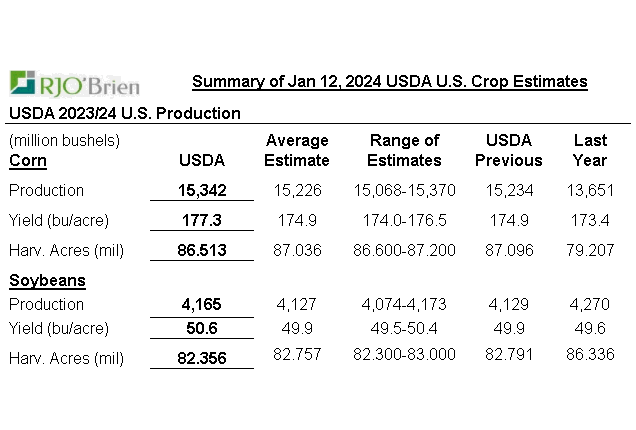
The December 1st US Grain stocks came in higher than expected for corn (119 million bushels), beans (25 million bushels) and wheat (23 million bushels).
USDA’s production estimates for South American row crops was of significant interest after the recent drought and heat that has seen private forecasts cut for Brazil’s crop. Soybean production was pegged at 157.0 million metric tons (MMT), up 1.0 MMT from average trade guesses and 4.0 MMT lower than USDA’s previous forecast. CONAB, the USDA of Brazil, released their estimates of soybean production in the country at 155 MMT, 5.0 MMT below December estimates. Brazil corn production came in at 127.0 MMT, 2.0 MMT lower than previous numbers, but 1.8 MMT higher than average trade guesses.
Argentina’s soybean production was increased 2.0 MMT versus previous USDA estimates and 1.1 MMT above trade guesses. Argentine corn production was unchanged at 55.0 MMT from prior estimates and only 0.2 MMT above trade guesses. World ending stocks for soybeans increased only slightly by 0.4 MMT to 114.6 MMT although a decrease to 111.9 MMT was expected.
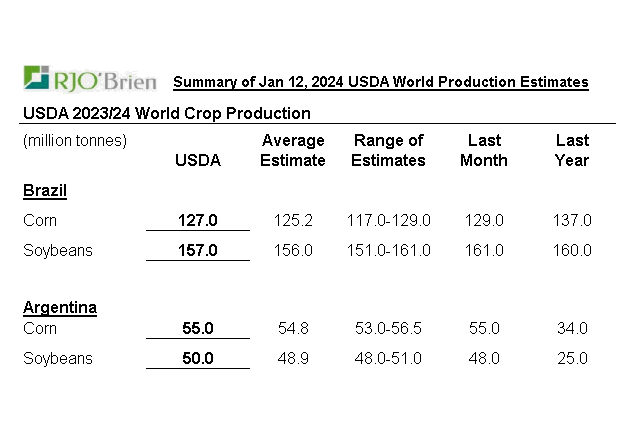
World ending stocks for corn were increased by 10.0 MMT to 325.2 MMT while the trade was expecting a slight decline. Soybean and corn futures tumbled on the report’s 11 AM release and stayed under pressure for most of the session. However, 30-45 minutes after the release, row crop markets started climbing back and managed to close 21.25 cents and 6 cents off session lows for soybeans and corn, respectively.
Another major surprise in the week ending reports came from the US winter wheat acres. Total, all wheat class planted acres came in at 34.425 million acres, 2.274 million acres lower than last year and more importantly, 1.361 million acres below average trade guesses. The biggest drop was in hard red winter wheat acres of 1.113 million acres below trade guesses and nearly 1.7 million acres less than last year’s plantings. Soft red winter wheat acres were 217,000 below expectations and 500,000 less than last year. White wheat acres were also lower than last year.
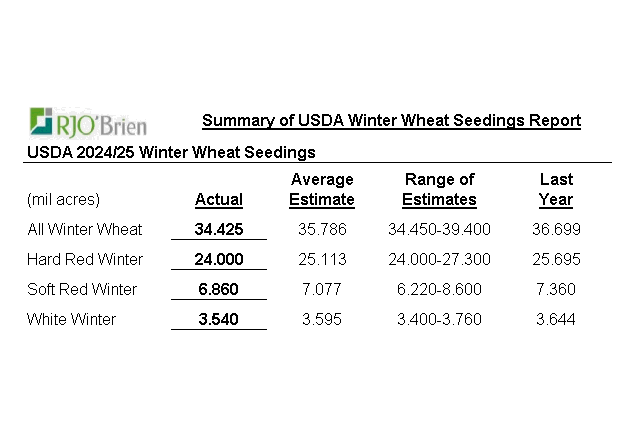
Global ending stocks of wheat came in slightly larger than expected at 260.0 MMT versus 258.3 MMT anticipated from increases in Russian and Ukrainian production and exports and Australia and Canadian exports despite a slight decline in EU exports. The wheat market managed to stay firm on the release, turning positive for a short while before selling off under pressure from soybeans and corn. However, just as row crop markets fought back, the wheat market found it’s stride with Kansas City wheat nearly closing positive and Chicago wheat fighting 9 cents off session lows.
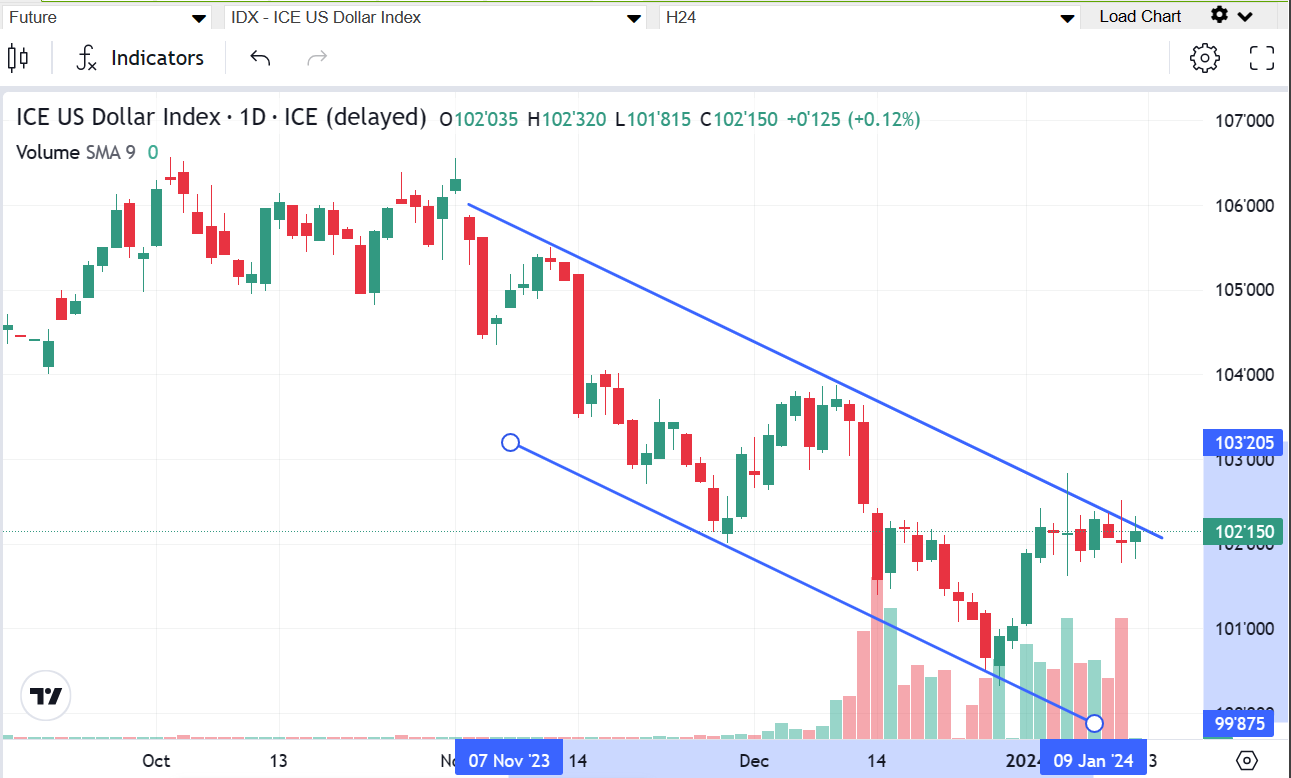
With the US dollar trading sideways this week, closing the week below the trendline, waiting for the next Federal Reserve’s FOMC decision on January 31st, we could see further weakness support exports. Thursday’s US CPI report did however show consumer prices rising 0.3 percent in December, higher than the expected 0.2 percent. This brought the annual increase to 3.4 percent versus 3.2 percent expected.
Core CPI, excluding volatile food and energy prices, also increased more than expected on the month and year ago levels. Rising “shelter” costs accounted for more than half the core CPI increase while wages increased 0.2 percent over the prior month adjusted for inflation.
Taiwan’s presidential election took place on Saturday with the Democratic party winning that supports the island country’s sovereignty. This will keep tensions high with China. Have these larger crop numbers been priced into the market with Friday’s recovery off the lows? It is a good possibility.
Frigid weather moving across US wheat production areas could spark buying on winterkill concerns. Corn and soybean markets are also oversold with gaps above on the chart that I suspect will be filled in the coming weeks. If you’re selling any of these grains down here, I would consider re-owning them on the futures market.
The cattle market is also likely to react to the coming winter weather that will slow the pace of gain in feedyards. That boost is needed for the markets in the near-term as I have growing concern that softer meat prices are slowing down packer interest in continued support of higher fed cattle prices. This in turn is intensifying the standoff between packers and feedyards. With large numbers of cattle on feed and heavier cattle in feedyards as owners hold out for better prices, we’re threatening a situation where there are more market-ready cattle than the market, through the packers, are willing to purchase. This translates to a market where the inventory is not current, but oversupplied in the immediate-term that would suggest lower prices.
Once we get past this winter weather, that is a concern I have for the feeder cattle market until demand and supply realign. Feeder cattle contracts closed above the 50-day moving average for a 3rd consecutive session on Friday while Live cattle contracts remained below their 50-day moving averages. If we get a lot of frozen precipitation in major feeding states, this feeder market could explode higher. However, if it is only cold temperatures and limited precipitation, such expectations could be overdone.
My advice is to protect the feeder market on weather premium surges, especially if you’re getting back near where you purchased them. I believe there is more upside to come in this market, but not convinced yet that it is now until the supply of marketable cattle get more current with demand and beef, as in meat, prices stabilize.
Markets will be closed Monday for Martin Luther King, Jr. Day.
Sidwell Strategies is the one-stop shop to protect cattle with futures, puts, LRP or a combination of all, which is probably the best strategy overall. If you’re ready to trade commodity markets, give me a call at (580) 232-2272 or stop by my office to get your account set up and discuss risk management and marketing solutions to pursue your objectives. Self-trading accounts are also available. It is never too late to start and there is no operation too small to get a risk management and marketing plan in place.
Wishing everyone a successful trading week! Let us know if you'd like to join our daily market price and commentary text messages to stay informed!
Brady Sidwell is a Series 3 Licensed Commodity Futures Broker and Principal of Sidwell Strategies. He can be reached at (580) 232-2272 or at brady@sidwellstrategies.com. Futures and Options trading involves the risk of loss and may not be suitable for all investors. Review full disclaimer at http://www.sidwellstrategies.com/disclaimer.
On the date of publication, Brady Sidwell did not have (either directly or indirectly) positions in any of the securities mentioned in this article. All information and data in this article is solely for informational purposes. For more information please view the Barchart Disclosure Policy here.

/Super%20Micro%20Computer%20Inc%20logo%20on%20building-by%20Poetra_RH%20via%20Shutterstock.jpg)