The expeditious if not aggressive rollout of artificial intelligence (AI) has had its fair share of consequences—both positive and negative—in just a few years.
On one hand, the global memory chip shortage has resulted in new members of the trillion-dollar market cap club while rewarding shareholders with once-in-a-generation gains. On the other hand, AI-assisted hacking and malware deployments have created a situation wherein demand for cybersecurity is not only unprecedented, it is absolutely critical.
According to Harvard Business Review, “the average AI-enabled data breach now costs organizations $4.88 million; a figure that does not account for reputational damage, regulatory penalties, or the cascading operational failures that follow.”
But for investors, there’s a silver lining. With cyberattacks on the rise, demand for enterprise security firms is increasing. That has provided an enormous, sustainable tailwind for one exchange-traded fund (ETF) in particular.
AI-Assisted Cyberattacks (and Budgets to Combat Them) Are on the Rise
The advent of AI has caused a measurable increase in the rate, scale, and sophistication of cyberattacks and data breaches.
A 2026 study conducted by International Business Machines (NYSE: IBM) found a 44% year-over-year (YOY) increase in the exploitation of public-facing software or system applications, 300,000 AI chatbot credentials observed for sale on the dark web, and a 49% YOY Increase in active ransomware groups.
Harvard Business Review has warned that AI-enabled cyberattacks are becoming more autonomous and adaptive, with systems capable of probing defenses, identifying weaknesses and changing tactics in real time without human direction. The report also noted that 77% of organizations lack the foundational data and AI security practices needed to safeguard critical technology infrastructure.
Fortunately, businesses, governments, and other institutions aren’t resting on their laurels. According to industry consultancy firm Grand View Research, the global cybersecurity market, which was valued at nearly $272 billion in 2025, is expected to reach more than $663 billion by 2033. That is good for a compound annual growth rate (CAGR) of 11.9% and a total addressable market that is more than 144% larger than it was last year.
The global cybersecurity services market, specifically, is poised to grow by a CAGR of 14.8% through 2033, with Grand View Research citing that “advances in AI, the Internet of Things, and machine learning have led to increased adoption of web and mobile applications, creating a more complex IT infrastructure that is increasingly vulnerable to cyberattacks.”
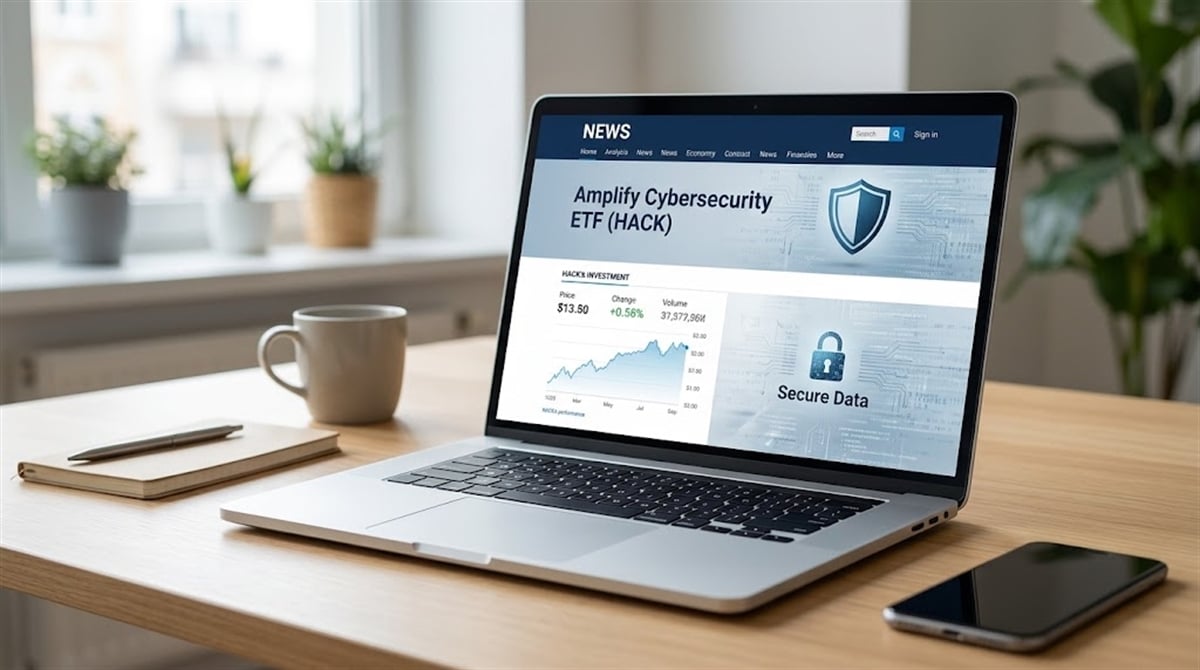
That bodes particularly well for the Amplify Cybersecurity ETF (NYSEARCA: HACK) and its portfolio of top-tier cybersecurity firms.
A Basket of Booming Cybersecurity Stocks
Considering that forecasted growth alongside the increasing rate of malware, phishing, ransomware, and zero-day exploit threats, it’s no surprise that the Amplify Cybersecurity ETF (NYSEARCA: HACK) has been surging higher this year.
Since its year-to-date (YTD) low on February 23, the fund has gained more than 49%, recently hitting its all-time high, as its basket of best-in-class cybersecurity firms continues to reward shareholders.
That success is largely attributable to the fact that the fund aims to track the Nasdaq ISE Cyber Security Select Index. In doing so, it includes companies that develop, implement, or provide cybersecurity hardware, software, and services. The index’s constituents are companies that derive at least 90% of their revenue from cyber defense.
Prior to this year, the ETF’s performance was lackluster, with HACK only having gained around 20% for the five years prior to its aforementioned YTD low. But given the rise of data breaches, AI-assisted cyberthreats, and swelling corporate budget lines aimed at combatting those risks, the companies in the Amplify Cybersecurity ETF have been outperforming this year.
The fund’s holdings include the who’s who of enterprise security providers, with its top five allocations being:
CrowdStrike (NASDAQ: CRWD): up around 60% YTD
Broadcom (NASDAQ: AVGO): up around 40% YTD
Palo Alto Networks (NASDAQ: PANW): up over 50% YTD
Cisco Systems (NASDAQ: CSCO): up more than 65% YTD
Fortinet (NASDAQ: FTNT): up nearly 85% YTD
Together, those five positions account for more than 36% of the ETF’s portfolio. On the whole, more than 87% of the fund’s holdings are domiciled in the United States, with the remaining companies located in Israel and Japan.
Amplify’s ETF Is the Ultimate Cybersecurity Portfolio HACK
The passively managed fund carries an expense ratio of 0.60%, which puts it on par with the average fees charged by thematic ETFs.
That figure is, to some extent, offset by a dividend that yields six cents per share annually.
With average daily volume of around 127,000 shares and $2.60 billion in assets under management, trading can be light.
But for investors looking to add exposure to the cybersecurity trend, the ETF receives a Moderate Buy rating based on 531 ratings by analysts who cover more than 96% of the companies in HACK’s portfolio.
The smart money is treating the fund accordingly, with inflows from institutional buyers surpassing outflows by a margin of around $171 million to just over $75 million, respectively, over the past 12 months. Meanwhile, short interest is infinitesimal at just 0.19% of the float, or a mere 48,136 shares out of the 24.85 million shares outstanding.
Where Should You Invest $1,000 Right Now?
Before you make your next trade, you'll want to hear this.
MarketBeat keeps track of Wall Street's top-rated and best performing research analysts and the stocks they recommend to their clients on a daily basis.
Our team has identified the five stocks that top analysts are quietly whispering to their clients to buy now before the broader market catches on... and none of the big name stocks were on the list.
They believe these five stocks are the five best companies for investors to buy now...
The article "As AI Data Breaches Become More Common, This Cybersecurity ETF Is Surging" first appeared on MarketBeat.

/Micron%20Technology%20Inc_%20logo%20on%20building-by%20vzphotos%20vis%20iStock.jpg)
/A%20hand%20holding%20a%20phone%20with%20the%20Reddit%20logo_%20Mamun_Sheikh%20via%20Shutterstock_.jpg)
/Alphabet%20(Google)%20Image%20by%20Markus%20Mainka%20via%20Shutterstock.jpg)