




Wrapping up Q1 earnings, we look at the numbers and key takeaways for the general industrial machinery stocks, including Otis (NYSE:OTIS) and its peers.
Automation that increases efficiency and connected equipment that collects analyzable data have been trending, creating new demand for general industrial machinery companies. Those who innovate and create digitized solutions can spur sales and speed up replacement cycles, but all general industrial machinery companies are still at the whim of economic cycles. Consumer spending and interest rates, for example, can greatly impact the industrial production that drives demand for these companies’ offerings.
The 13 general industrial machinery stocks we track reported a strong Q1. As a group, revenues beat analysts’ consensus estimates by 3.1% while next quarter’s revenue guidance was 0.6% above.
Thankfully, share prices of the companies have been resilient as they are up 6.4% on average since the latest earnings results.
Otis (NYSE:OTIS)
Credited with inventing the first hydraulic passenger elevator, Otis Worldwide (NYSE:OTIS) is an elevator and escalator manufacturing, installation and service company.
Otis reported revenues of $3.57 billion, up 6.4% year on year. This print exceeded analysts’ expectations by 1.7%. Despite the top-line beat, it was still a mixed quarter for the company with a solid beat of analysts’ revenue estimates but a slight miss of analysts’ organic revenue estimates.
"Otis delivered a solid quarter, with net sales up 6%. All Service lines of business grew, led by repair which grew 16% at actual currency and 10% organically. Orders and backlog strengthened: modernization orders were up 11% and backlog was up 30% at constant currency. New Equipment orders grew 1% and backlog grew 3% at constant currency. Otis delivered operating cash flow of $413 million and adjusted free cash flow of $272 million, up significantly from a year ago," said Chair, CEO & President Judy Marks.
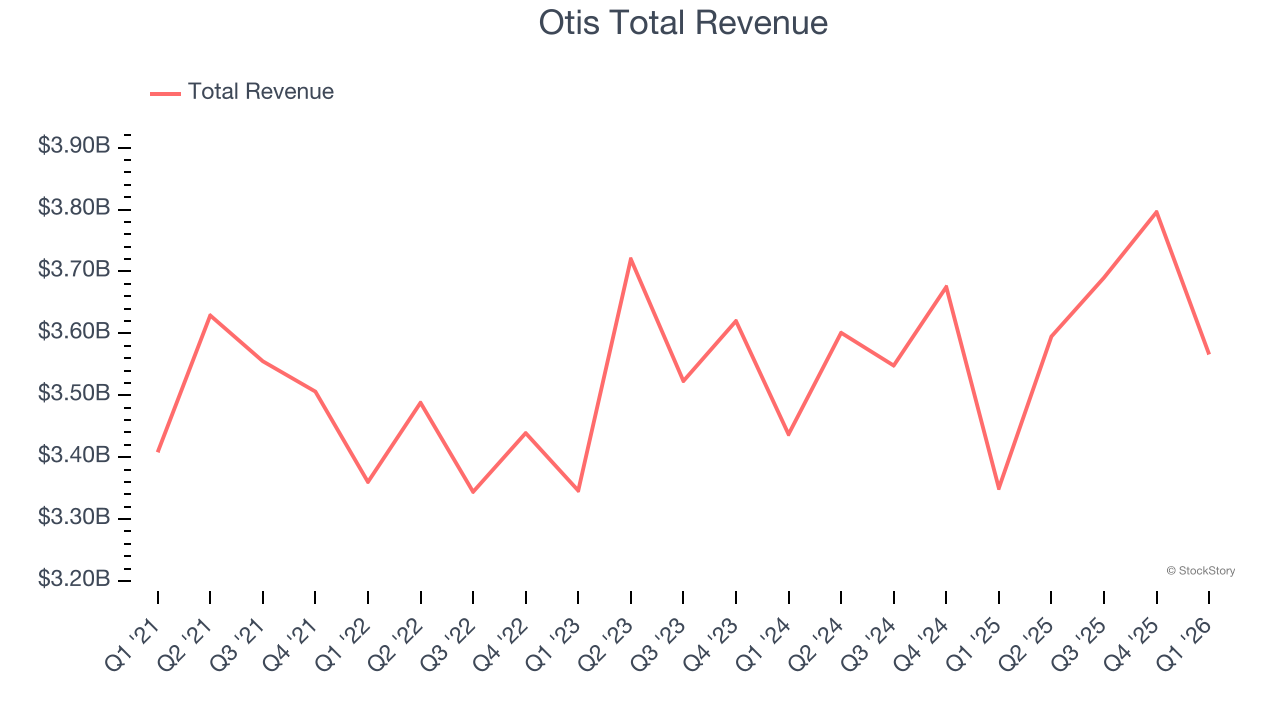
Unsurprisingly, the stock is down 9.9% since reporting and currently trades at $71.09.
Is now the time to buy Otis? Access our full analysis of the earnings results here, it’s free.
Best Q1: Albany (NYSE:AIN)
Founded in 1895, Albany (NYSE:AIN) is a global textiles and materials processing company, specializing in machine clothing for paper mills and engineered composite structures for aerospace and other industries.
Albany reported revenues of $311.3 million, up 7.8% year on year, outperforming analysts’ expectations by 10.8%. The business had a stunning quarter with an impressive beat of analysts’ EBITDA estimates.
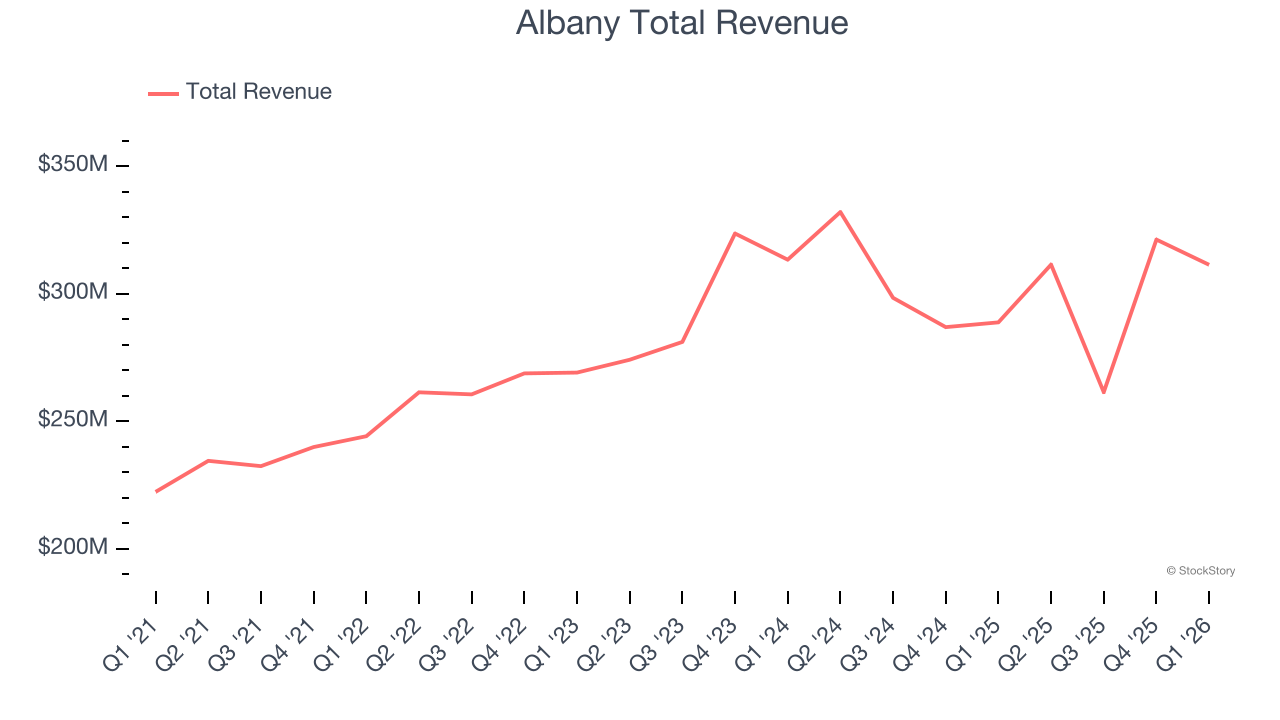
The market seems happy with the results as the stock is up 11.5% since reporting. It currently trades at $64.71.
Is now the time to buy Albany? Access our full analysis of the earnings results here, it’s free.
Weakest Q1: Icahn Enterprises (NASDAQ:IEP)
Founded in 1987, Icahn Enterprises (NASDAQ: IEP) is a diversified holding company primarily engaged in investment and asset management across various sectors.
Icahn Enterprises reported revenues of $2.24 billion, up 19.8% year on year, falling short of analysts’ expectations by 4.1%. It was a disappointing quarter as it posted a significant miss of analysts’ revenue and adjusted operating income estimates.
Icahn Enterprises delivered the weakest performance against analyst estimates in the group. As expected, the stock is down 10% since the results and currently trades at $7.50.
Read our full analysis of Icahn Enterprises’s results here.
L.B. Foster (NASDAQ:FSTR)
Founded with a $2,500 loan, L.B. Foster (NASDAQ:FSTR) is a provider of products and services for the transportation and energy infrastructure sectors, including rail products, construction materials, and coating solutions.
L.B. Foster reported revenues of $121.1 million, up 23.9% year on year. This result beat analysts’ expectations by 16.2%. Overall, it was a stunning quarter as it also recorded a beat of analysts’ EPS and EBITDA estimates.
L.B. Foster achieved the biggest analyst estimate beat and highest full-year guidance raise among its peers. The stock is up 31.5% since reporting and currently trades at $40.39.
Read our full, actionable report on L.B. Foster here, it’s free.
Luxfer (NYSE:LXFR)
With its magnesium alloys used in the construction of the famous Spirit of St. Louis aircraft, Luxfer (NYSE:LXFR) offers specialized materials, components, and gas containment devices to various industries.
Luxfer reported revenues of $83.9 million, down 13.5% year on year. This number missed analysts’ expectations by 0.7%. Aside from that, it was an exceptional quarter as it put up a beat of analysts’ EPS and EBITDA estimates.
Luxfer had the slowest revenue growth among its peers. The stock is up 28.8% since reporting and currently trades at $17.12.
Read our full, actionable report on Luxfer here, it’s free.
Market Update
Late in 2025 into early 2026, there was hand-wringing around artificial intelligence. For software companies, the fear was that AI would erode pricing power and compress margins as new tools made it easier to replicate what once required expensive enterprise platforms. Crypto investors had their own version of the same anxiety: if AI agents could trade, allocate capital, and manage wallets autonomously, what exactly was the long-term value of today’s crypto infrastructure?
These concerns triggered a noticeable rotation away from these sectors and into safer havens. But markets rarely dwell on one narrative for long. Spring 2026 came, and the focus shifted abruptly from technological disruption to geopolitical risk. The US’ conflict with Iran became the dominant driver of market psychology, and when geopolitics takes center stage, the script changes quickly. Investors stop debating growth rates and start worrying about oil supply, inflation, and global stability.
Want to invest in winners with rock-solid fundamentals? Check out our Top 5 Quality Compounder Stocks and add them to your watchlist. These companies are poised for growth regardless of the political or macroeconomic climate.
StockStory’s analyst team — all seasoned professional investors — uses quantitative analysis and automation to deliver market-beating insights faster and with higher quality.


/An%20Intel%20sign%20out%20front%20of%20a%20corporate%20office%20by%20wolterke%20via%20Adobe%20Stock.jpeg)
/Alibaba%20by%20testing%20via%20Shutterstock.jpg)
/Alphabet%20(Google)%20Image%20by%20Markus%20Mainka%20via%20Shutterstock.jpg)