
Dual Edge Research publishes two powerful newsletters that work great individually — and even better together. The Bull Strangle Newsletter focuses on stocks and options, combining stock ownership with premium-selling strategies to generate consistent income and market-beating returns. The Smart Spreads Newsletter specializes in seasonal commodity futures spreads, offering a diversified approach with low correlation to equities. Together, they deliver a complete investment perspective — one focused on income, the other on diversification — all under one simple subscription.
Introduction
The Biggest Surprise From 15 Years of Seasonal Spread Research: Direction Matters
In last week’s article, we reviewed the commodity markets that demonstrated the strongest long-term seasonal consistency after screening roughly 500,000 spread combinations across 15 years of historical data. Several markets stood out immediately:
- Natural gas SELL structures
- Heating oil BUY structures
- VIX SELL structures
- Gasoil BUY structures
- Corn SELL structures
But one of the most important findings from the research was not about the markets themselves. It was about direction.
The same spread structure often produced dramatically different results depending on whether it was traded as a BUY spread or a SELL spread. That finding reshaped how I think about seasonal spread selection.
The Common Misunderstanding About Seasonal Spreads
Many traders approach seasonal spreads with a very simple assumption:
- “If the spread tends to rise seasonally, buy it. If it tends to fall, sell it.”
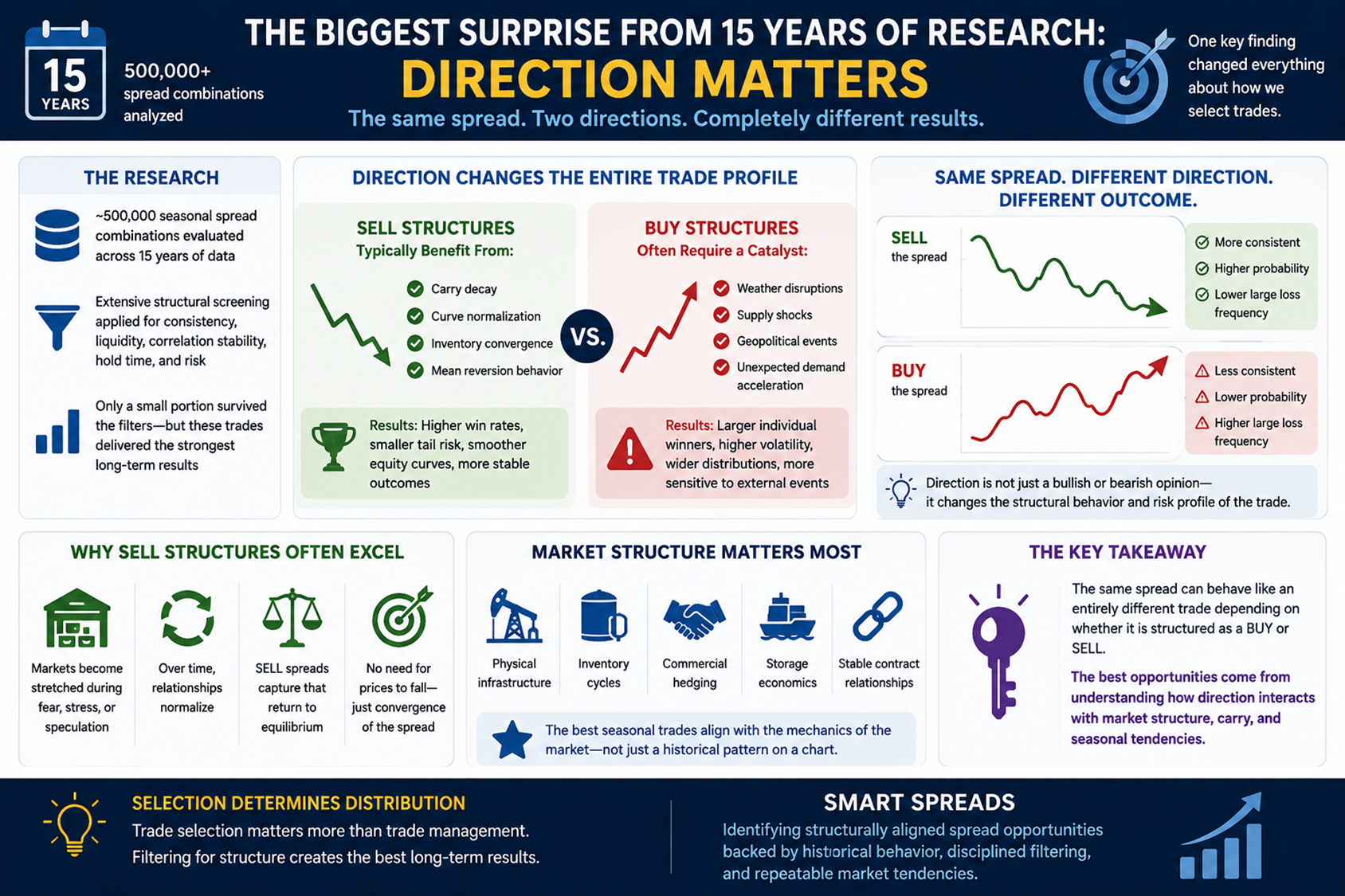
But the research suggested something much more important. Direction is not simply a bullish or bearish opinion. Direction changes the entire structural behavior of the trade. In many cases, the difference between BUY and SELL structures is completely altered:
- Win rate
- Drawdown behavior
- Large-loss frequency
- Profit consistency
- Volatility exposure
Two trades using identical contracts could produce entirely different distribution profiles depending on which side of the spread was traded.
Why SELL Structures Frequently Outperformed
One of the clearest patterns in the research was the persistent strength of SELL-side structures across multiple commodity sectors. Natural gas was the clearest example.
Across thousands of trades, SELL structures consistently outperformed because they naturally aligned with several recurring market forces:
- Carry decay
- Inventory normalization
- Curve compression
- Mean reversion behavior
This distinction is critical. Many commodity curves naturally spend time in stretched states during periods of fear, weather stress, supply concerns, or speculative enthusiasm. Over time, those distortions often normalize.
SELL structures frequently benefit from that normalization process. That does not mean prices themselves must fall. The relationship between contracts moves back toward equilibrium.
This is one reason why seasonal spread trading differs dramatically from outright futures trading. The objective is often to capture structural convergence rather than to predict price direction.
Why BUY Structures Often Need a Catalyst
BUY structures behaved differently. The strongest BUY-side trades typically required some form of external acceleration to sustain directional expansion. Those catalysts often included:
- Weather disruptions
- Geopolitical events
- Supply shocks
- Unexpected demand increases
- Refinery disruptions
Heating oil provided one of the strongest examples. Its BUY-side structures demonstrated exceptional historical performance because seasonal tightening in distillate markets repeatedly created directional expansion opportunities.
But unlike SELL structures, these trades often depended on conditions continuing to strengthen rather than normalize. That distinction matters because it changes the probability profile of the trade.
SELL structures frequently benefited from markets calming down. BUY structures often required markets to become more extreme.
The Distribution Profiles Were Completely Different
Perhaps the most important takeaway from the research was how dramatically direction changed the distribution profile of trades. SELL structures often produced:
- Higher win rates
- Smaller tail-risk frequency
- Smoother equity curves
- More stable average outcomes
BUY structures are often produced:
- Larger individual winners
- Higher volatility
- Wider outcome distributions
- Greater sensitivity to external events
Neither is inherently superior. But they are not interchangeable. Understanding that distinction helps explain why two traders using similar seasonal charts can experience completely different results.
One trader may be aligned with structural normalization. The other may be dependent on continuation and expansion. Those are fundamentally different risk profiles.
The Market Structure Matters More Than the Seasonal Chart
One of the broader lessons from the research was that seasonal charts alone are not enough. A strong historical pattern does not automatically create a strong trade. The underlying market structure matters enormously. The best long-term trades are typically aligned with:
- Carry relationships
- Commercial hedging behavior
- Inventory cycles
- Storage economics
- Stable contract relationships
This is why energy markets repeatedly dominate the research. Energy spreads are heavily influenced by physical infrastructure and inventory flows, which create recurring structural tendencies throughout the futures curve. The market mechanics themselves reinforce the seasonal behavior.
Selection Determines Distribution
After reviewing hundreds of thousands of spread combinations, one conclusion became increasingly obvious:
Trade management matters, but trade selection matters more.
The structural characteristics of the spread largely determine:
- The likely win rate
- The volatility profile
- The probability of large losses
- The persistence of the seasonal tendency
This is why extensive filtering dramatically improved results. Most seasonal spreads failed basic structural requirements. Only a relatively small percentage demonstrated the combination of persistence, liquidity, stability, and favorable risk distribution necessary for long-term consistency.
Final Thoughts
The biggest surprise from the research was not simply which markets performed best. It was how dramatically structure and direction influenced outcomes. The same spread can behave like an entirely different trade depending on whether it is positioned as a BUY or SELL structure.
That insight changes how seasonal spreads should be evaluated. The best opportunities are rarely about predicting prices. They are about identifying where market structure, carry behavior, and seasonal tendencies align to create favorable long-term distributions.
That philosophy remains central to the Smart Spreads newsletter, where the focus is not on chasing headlines but on identifying structurally aligned spread opportunities backed by historical behavior, disciplined filtering, and repeatable market tendencies.
More Information
Now you can get two powerful newsletters — for one simple price!
- For stocks and options, the Bull Strangle Newsletter shows you how to combine stock ownership with dual option selling — a disciplined strategy that has consistently outperformed the S&P 500.
- For commodity futures, the Smart Spreads Newsletter focuses on seasonal commodity spreads — a proven, low-correlation approach that thrives in all types of markets.
Each newsletter is designed to deliver consistent income on its own — but when used together, they create a complete, diversified trading approach that works in any market environment.
Visit BullStrangle.com to subscribe for just $1 for the first month.
For a video overview of the Bull Strangle Newsletter
For a video overview of the Smart Spreads Newsletter
Darren Carlat
Dual Edge Research
(214) 636-3133
DualEdgeResearch@gail.com
Disclaimer
This information is for informational purposes only and should not be considered as investment advice. Past performance is not indicative of future results, and all investments carry inherent risk. Consult with a financial advisor before making any investment decisions.

/Intuit%20Inc%20logo-by%20Mojahid%20Mottakin%20via%20Shutterstock.jpg)
/A%20photo%20of%20a%20Sandisk%20Solid%20State%20Drive%20by%20Top%20Popular%20Vector%20by%20Shutterstock.jpg)
/Abbott%20Laboratories%20vials%20and%20Logo-by%20Melniov%20Dmitriy%20via%20Shutterstock.jpg)