Dual Edge Research publishes two powerful newsletters that work great individually — and even better together. The Bull Strangle Newsletter focuses on stocks and options, combining stock ownership with premium-selling strategies to generate consistent income and market-beating returns. The Smart Spreads Newsletter specializes in seasonal commodity futures spreads, offering a diversified approach with low correlation to equities. Together, they deliver a complete investment perspective — one focused on income, the other on diversification — all under one simple subscription.
Introduction
This week’s Bull Strangle watch list highlights two very different setups that share one important characteristic: improving technical structure. Delta Air Lines (DAL) and the iShares Bitcoin Trust ETF (IBIT) come from completely different sectors, but both are showing signs of stabilization following periods of elevated volatility and trend disruption. That distinction matters in the Bull Strangle framework. The goal is not to chase the fastest-moving stocks or the most exciting headlines. The objective is to identify situations where price structure, trend alignment, and option premiums combine to create a favorable distribution for option sellers.
Delta Air Lines (DAL): Trend Continuation with Controlled Pullback
Delta Air Lines has quietly rebuilt a constructive technical foundation following the sharp March-April decline that briefly pushed shares below several key moving averages. Since bottoming near the mid-$50s, DAL has established a steady pattern of higher highs and higher lows, supported by a rising trendline that continues to define the recovery. More recently, the stock has shifted into a consolidation phase after rallying into resistance near the $74-$76 area. Importantly, the pullback has remained controlled. DAL continues to hold above the 20-day, 50-day, 100-day, and 200-day moving averages, suggesting the broader uptrend remains intact.
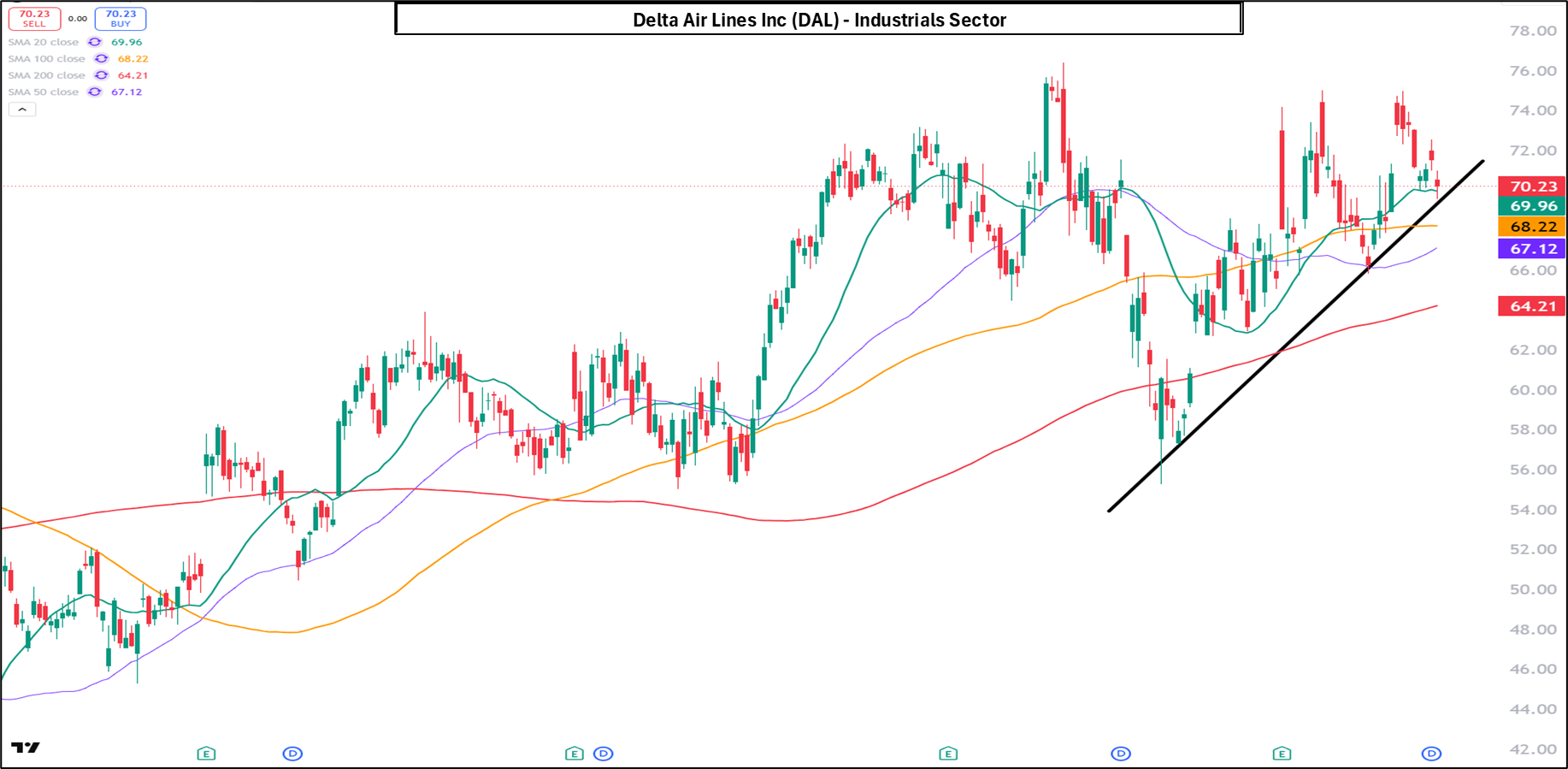
From a Bull Strangle perspective, this type of orderly pause is often more attractive than an extended momentum breakout. The recent pullback toward the rising 20-day moving average near $70 provides a more stable technical reference point while still maintaining bullish longer-term structure. As long as DAL continues holding above the rising trendline and the broader $68-$70 support zone, the technical backdrop remains constructive. A move back above the recent highs near $75 would likely signal renewed momentum, while a break below the 50-day moving average would suggest the trend is beginning to weaken.
IBIT: Recovery Phase Following a Long Corrective Trend
IBIT represents a different type of opportunity. While DAL is working through a consolidation within an existing uptrend, IBIT appears to be transitioning out of a prolonged corrective phase.
For much of the past several months, the ETF traded within a persistent downtrend as sellers repeatedly defended the descending trendline that capped rallies from October through early April. During that stretch, IBIT remained below its major moving averages while crypto-related volatility pressured momentum. That technical picture has improved considerably in recent weeks.
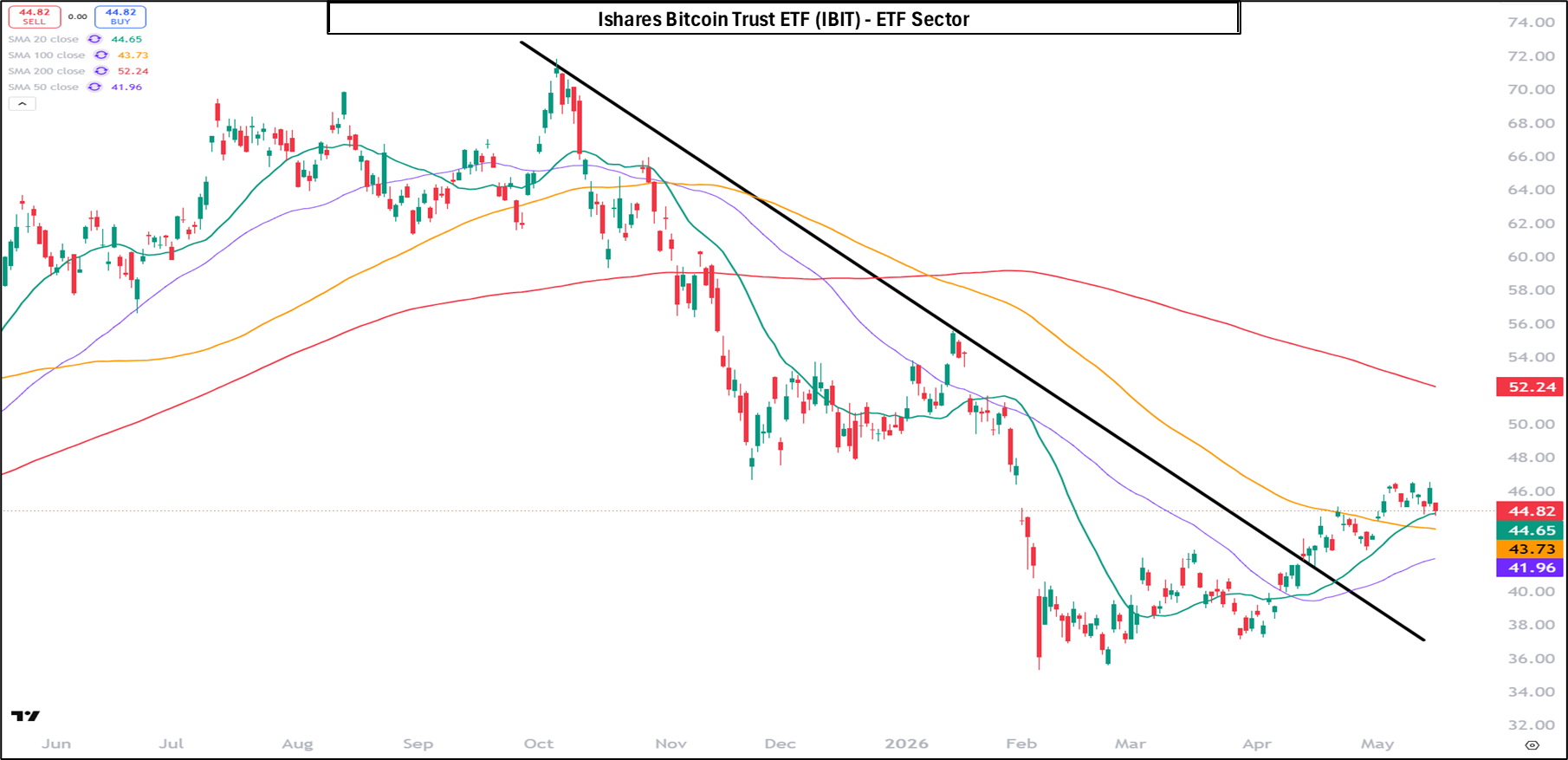
IBIT successfully broke above the long-term downtrend line in April and has since reclaimed the 20-day, 50-day, and 100-day moving averages. The ETF has also started forming higher lows, suggesting improving intermediate-term momentum. The recent consolidation near the mid-$40s appears constructive so far, with the 20-day moving average continuing to act as short-term support. Holding above the breakout zone near $43-$44 keeps the current recovery structure intact, while a move above recent highs near $46 could support a broader continuation move. Of course, IBIT also carries significantly higher volatility than a stock like DAL. That elevated premium environment can create attractive option-selling opportunities, but it also requires greater respect for position sizing and strike selection.
Why These Setups Matter
The Bull Strangle approach is not about predicting the next major market move. It is about identifying stocks and ETFs where trend structure, support levels, and option pricing create a favorable balance between premium generation and risk control. This week’s watch list reflects that philosophy well:
- DAL represents a steadier trend-continuation setup with improving structure and controlled volatility.
- IBIT offers a higher-volatility recovery setup where momentum is improving following a prolonged correction.
Different structures. Different volatility profiles. Different risks. But in both cases, the focus remains the same: allowing structure and probability—not emotion or excitement—to drive trade selection. For traders using stock-backed option-selling strategies, those distinctions often matter far more than the headline itself.
More Information
To learn how this approach is applied in a structured, repeatable way, The Bull Strangle Strategy provides a complete framework for combining stock ownership with option income.
Now you can get two powerful newsletters for one simple price!
- For stocks and options, the Bull Strangle Newsletter shows you how to combine stock ownership with dual option selling — a disciplined strategy that has consistently outperformed the S&P 500.
- For commodity futures, the Smart Spreads Newsletter focuses on seasonal commodity spreads — a proven, low-correlation approach that thrives in all types of markets.
Each newsletter is designed to deliver consistent income on its own — but when used together, they create a complete, diversified trading approach that works in any market environment.
Visit BullStrangle.com to subscribe for just $1 for the first month.
For a video overview of the Bull Strangle Newsletter
For a video overview of the Smart Spreads Newsletter
Darren Carlat
Dual Edge Research
(214) 636-3133
DualEdgeResearch@gamil.com
Disclaimer
This information is for informational purposes only and should not be considered as investment advice. Past performance is not indicative of future results, and all investments carry inherent risk. Consult with a financial advisor before making any investment decisions.

/Micron%20Technology%20Inc_%20logo%20on%20building-by%20vzphotos%20vis%20iStock.jpg)