




Most traders spend too much time reacting to news and too little time trying to understand what price is already saying. Markets are not random all the time. They move in cycles, and those cycles are often driven by shifts in sentiment, from pessimism to optimism, and then back again. This is where Elliott Wave can be very useful.
For me, Elliott Wave is not just a pattern tool. It is a way to read sentiment through price structure. When traders become too optimistic, price often starts showing signs of exhaustion. When fear becomes too extreme, markets often get close to a turning point. That is why Elliott Wave is not only about labeling waves. It is about understanding where the market may be within a cycle.
The basic idea is simple. Trending markets usually move in five waves, while corrections usually unfold in three waves or some variation of that corrective structure. If you can recognize whether the market is in a strong directional phase or just in a pause, you already have a big advantage over traders who are simply chasing candles.
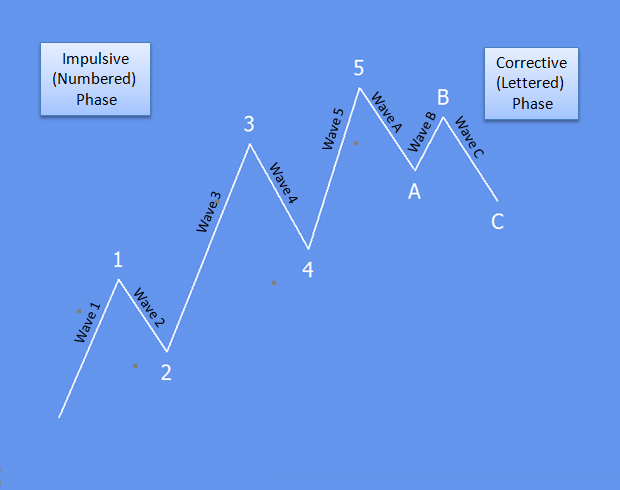
This matters because sentiment can shift long before headlines catch up. By the time the media becomes very bullish, price is often already late in the move. The same happens in panic. When fear is everywhere and people think a market is finished, a correction may already be close to its end. Elliott Wave helps put this into context.
One of the biggest mistakes traders make is that they focus only on outcome. They ask whether the market will go up or down. A better question is this: what kind of structure is price building right now? If the move is sharp, clean, and directional, it may be impulsive. If it is slow, overlapping, and choppy, it is more likely corrective. That difference can completely change how you approach a trade.
This is why I always say that market structure comes first. Once you understand the structure, you can begin to judge whether the market is likely continuing in trend, pausing before the next leg, or preparing for a larger reversal. That is much more useful than reacting emotionally to every move.
Elliott Wave also works because markets are fractal. The same type of behavior can appear on a weekly chart, a daily chart, or even intraday. Human behavior does not really change, only the scale does. Greed and fear are still there, whether you are looking at a long term stock trend or a short term move in forex.
That does not mean Elliott Wave is perfect. It is not. Markets can surprise you, and sometimes the count is wrong. But that does not make the method useless. It simply means that the trader has to remain flexible and let price confirm the view. Elliott Wave should never be used as a rigid prediction tool. It should be used as a framework for reading probability.
The real value is that it teaches patience and discipline. It forces you to wait for clear structures instead of jumping into random price action. It also helps you identify when sentiment is becoming too stretched, and when a market may be closer to a pause or reversal than most traders realize.
At the end of the day, markets move because people move them. Sentiment changes, expectations shift, and those changes leave footprints on the chart. Elliott Wave is simply one of the best ways I know to read those footprints.
Thank you for reading, if you wish to dive deep in this topic - we have dedicated course and chatroom available at your time - https://wavetraders.com/elliott-wave-plans/
By Grega

/Advanced%20Micro%20Devices%20Inc_%20logo%20on%20phone%20and%20website-by%20T_Schneider%20via%20Shutterstock.jpg)
/Intel%20Corp_%20badge%20holder-by%20hasrul_rais%20via%20Shutterstock.jpg)
/Palantir%20by%20Hiroshi-Mori-Stock%20via%20Shutterstock.jpg)
/Dell%20Technologies%20by%20Poetra_RH%20via%20Shutterstock.jpg)
/AI%20(artificial%20intelligence)/AI%20engineer%20working%20on%20laptop%20by%20ART%20STOCK%20CREATIVE%20via%20Shutterstock.jpg)