Intervention, Rate Divides, and a Market on Edge
Japanese yen futures (JPY/USD) as traded on the CME are quoted as the value of one Japanese yen in U.S. dollar terms. This is the inverse of the commonly quoted USDJPY spot rate seen in the media and on most financial platforms. A rising JPY/USD futures price means the yen is strengthening against the dollar, while a falling price means the yen is weakening. Readers accustomed to watching USDJPY should simply invert their directional bias when reading this analysis. For example, the $160 level on the USDJPY spot is 1/160 = 0.00625 on JPY futures.
Sentiment in the yen has been dominated by two forces in the past month: escalating intervention risk from Japanese authorities and a visibly shifting rate outlook at the Bank of Japan.
On April 28, the BOJ held its policy rate steady at 0.75% for a third consecutive meeting, but the result was far from routine. The vote came in at 6 to 3, with board members Hajime Takata, Naoki Tamura, and Junko Nakagawa all dissenting in favor of an immediate hike to 1.0%. This marked the most divided BOJ vote since Governor Kazuo Ueda took the helm in April 2023, and the language in the forward guidance was notably rewritten to state that the BOJ will continue to raise the policy interest rate. Alongside the decision, the BOJ slashed its FY2026 GDP growth forecast to 0.5% from 1.0% and dramatically raised its core CPI forecast to 2.8% from 1.9%, citing higher crude oil prices driven by the ongoing Middle East conflict and second-round inflation effects. Overnight swap markets moved to price in a 74% probability of a June hike following the announcement.
Finance Minister Satsuki Katayama added to the pressure on yen bears by confirming she had directly discussed FX with U.S. Treasury Secretary Scott Bessent, raising the specter of coordinated action. Verbal warnings from Vice Finance Minister Mimura to market participants were pointed, with Mimura telling yen bears to take heed before any further official action. These warnings came as the yen had weakened past the politically sensitive $160 level (0.00625 on JPY futures), drawing the line in the sand that authorities had been flagging for weeks.
The Middle East conflict continues to amplify both inflation and safe-haven dynamics simultaneously, creating a uniquely complex environment for the yen. Japan's heavy reliance on Gulf energy imports means elevated crude prices are a direct headwind for the Japanese economy, while signs of ceasefire progress between the United States and Iran have intermittently weighed on risk-off yen demand. The ceasefire technically remains in place, but the situation is far from resolved. Ongoing U.S. military activity in the Strait of Hormuz under what the Pentagon has dubbed "Project Freedom," combined with Iranian warnings that the blockade constitutes a ceasefire violation, has kept geopolitical risk premium elevated and continues to cloud the macro outlook for the yen.
What the Market Has Done
- Yen futures have been broadly sideways since November, with no sustained directional trend establishing itself despite significant macro volatility.
- Beginning in early March, sellers stepped down their offers and gradually held prices down at 0.006395 (daily level 2), compressing the market lower toward 0.00625 (daily level 3), which is the $160 level in USDJPY spot, a zone well known to market participants as a level where the BOJ has historically intervened to defend the yen.
- On April 30, a large single-day bid materialized, encompassing the entirety of the prior month's range in a single candle. This move is confirmed to have been driven by Ministry of Finance FX intervention, with Japan's MoF reportedly deploying approximately 5.48 trillion yen (roughly $35 billion USD) in yen-buying operations, marking the first such action since July 2024.
- The yen surged as much as 3% on April 30 alone, according to LSEG data, before partially giving back gains over subsequent sessions as the intervention lacked sustained policy follow-through, consistent with the pattern observed during the July 2024 episode.
- In the past week, price has settled into a chop around the 2026 VWAP, which is confluent with the 0.006395 daily level 2 area. Buyers and sellers are actively battling for control at this level, with no clear directional conviction as the market digests intervention risk, BOJ policy uncertainty, and Middle East developments simultaneously.
What to Expect in the Coming Weeks
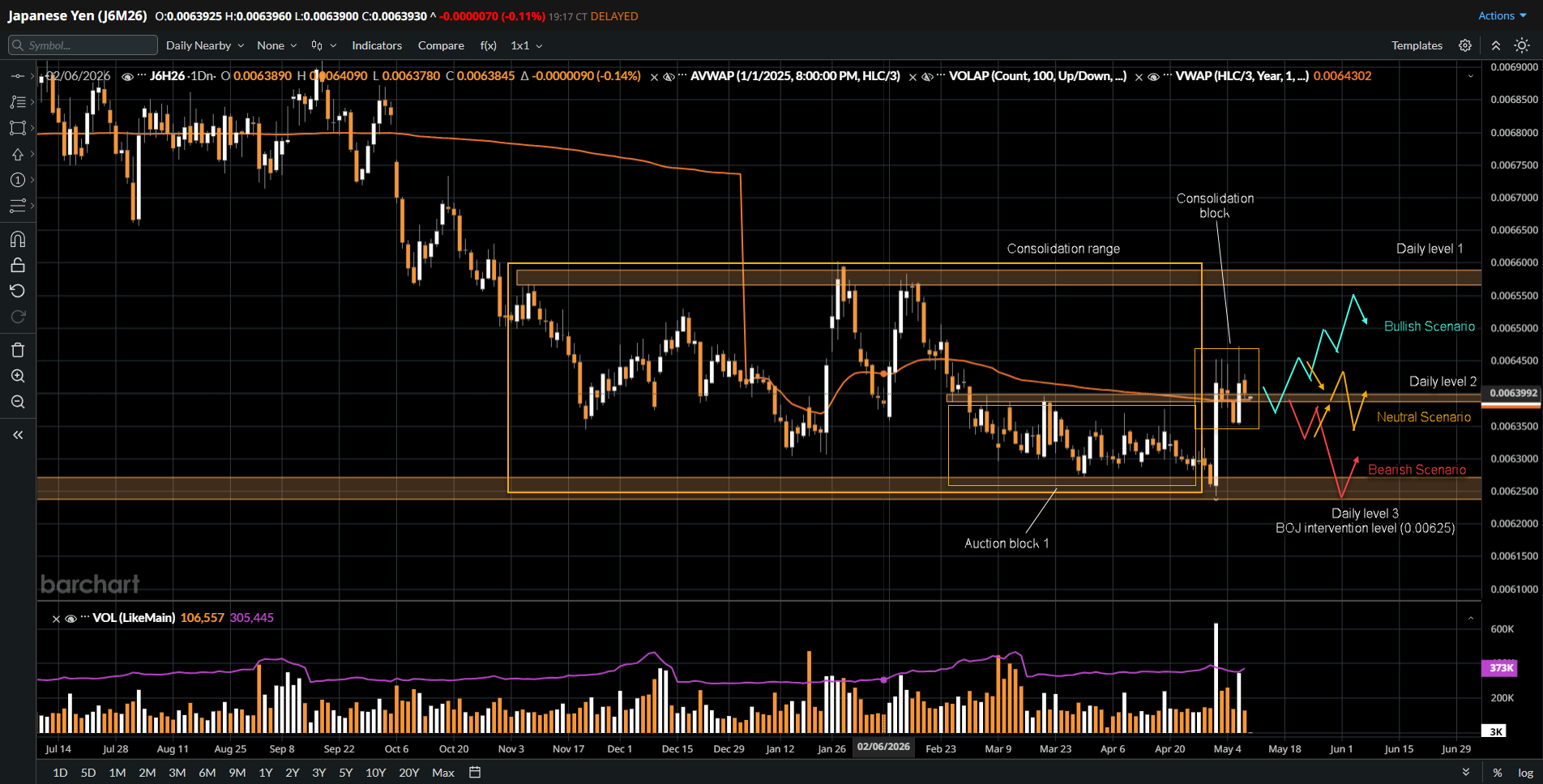
The key level to watch remains 0.006395 (daily level 2).
What to Expect in the Coming Weeks
The key level to watch remains 0.006395 (daily level 2).
Bullish Scenario
- If buyers are able to hold above 0.006395 and build acceptance, and eventually break above 0.00645, expect an initial push toward 0.0065 followed by a continuation into the 0.006583 area (daily level 1).
- The possible macro catalyst for this scenario would be a confirmed BOJ rate hike at the June 16 meeting, which swap markets are currently pricing at a 74% probability. A hike to 1.0% would narrow the rate differential versus the Fed, reducing the carry trade incentive that has weighed on the yen throughout 2026.
- A possible scenario: the BOJ follows through with the June hike and Governor Ueda's press conference adopts an explicitly hawkish tone, triggering a squeeze on yen short positions and driving a fresh bid into JPY/USD futures.
Bearish Scenario
- If sellers are able to hold below 0.006395 and subsequently offer prices below 0.00635, expect a move back down through auction block 1 and a revisit of 0.00625 (daily level 3).
- A possible macro scenario: de-escalation in the Middle East accelerates, oil prices retreat sharply, and the BOJ pauses the June hike given improved growth optics and easing inflationary pressure from energy. Combined with any renewed dollar strength on robust U.S. economic data or a more hawkish Fed tone, this could tip the balance back in sellers' favor and reopen the lows.
Neutral Scenario
- A possible two-way grind between 0.00645 and 0.00635 remains the base case while buyers and sellers battle for control within the current consolidation block.
- A possible macro scenario: the BOJ holds in June citing Middle East uncertainty, the Fed keeps rates unchanged, ceasefire talks stall without resolution, and neither side has enough conviction to break the range. This leaves the market in a holding pattern until a clear macro catalyst resolves the standoff.
Conclusion
JPY/USD futures are sitting at a technical and macro inflection point. The confirmed BOJ intervention on April 30 demonstrated that authorities are willing to act aggressively to defend the yen at the 160 USDJPY level, but history suggests intervention alone cannot sustainably reverse the trend without a fundamental policy shift. The BOJ's hawkish hold, record vote split, and revised inflation forecasts set the stage for a potential June rate hike that would structurally change the carry trade equation. Technically, 0.006395 is the line in the sand. How the market resolves this battle will likely define the trajectory for the summer.
We are a professional-grade futures brokerage engineered by traders to provide the high-performance architecture and futures trading platform required for serious market participation. We serve as a professional technical partner for traders who prioritize data integrity and objective analysis. Take the next step in your professional evolution and Open an Account today.
Disclaimer:
This article is provided for informational and educational purposes only and does not constitute financial, investment, or trading advice. The analysis presented reflects the author’s market observations and opinions at the time of writing and is not a recommendation to buy or sell any futures contract, security, or financial instrument. Futures trading involves significant risk and is not suitable for all market participants. Losses may exceed initial margin deposits, and market conditions can change rapidly.
Any scenarios, levels, or market expectations discussed are hypothetical in nature and are intended solely to illustrate potential market behavior. They do not represent actual trading results and should not be interpreted as guarantees of future performance. Past performance, market behavior, or historical price action are not indicative of future outcomes.
Readers are solely responsible for their own trading decisions and risk management. Always conduct independent research, consider your financial situation and risk tolerance, and consult with a qualified financial professional, if necessary, before engaging in futures or derivatives trading.

/AI%20(artificial%20intelligence)/AI%20engineer%20working%20on%20laptop%20by%20ART%20STOCK%20CREATIVE%20via%20Shutterstock.jpg)
/Micron%20Technology%20Inc_billboard-by%20Poetra_RH%20via%20Shutterstock.jpg)
/Qualcomm%2C%20Inc_%20logo%20on%20phone-by%20viewimage%20via%20Shutterstock.jpg)
/Advanced%20Micro%20Devices%20Inc_%20logo%20and%20chart%20data-by%20Poetra_%20RH%20via%20Shutterstock.jpg)