
Online dating app Bumble (NASDAQ:BMBL) met Wall Street’s revenue expectations in Q1 CY2026, but sales fell by 14.1% year on year to $212.4 million. On the other hand, next quarter’s revenue guidance of $209 million was less impressive, coming in 3.1% below analysts’ estimates. Its GAAP profit of $0.34 per share was 15% above analysts’ consensus estimates.
Is now the time to buy Bumble? Find out by accessing our full research report, it’s free.
Bumble (BMBL) Q1 CY2026 Highlights:
- Revenue: $212.4 million vs analyst estimates of $211.6 million (14.1% year-on-year decline, in line)
- EPS (GAAP): $0.34 vs analyst estimates of $0.30 (15% beat)
- Adjusted EBITDA: $82.6 million vs analyst estimates of $77.46 million (38.9% margin, 6.6% beat)
- Revenue Guidance for Q2 CY2026 is $209 million at the midpoint, below analyst estimates of $215.6 million
- EBITDA guidance for Q2 CY2026 is $67.5 million at the midpoint, below analyst estimates of $69.13 million
- Operating Margin: 30.7%, up from 18.1% in the same quarter last year
- Free Cash Flow Margin: 34.8%, up from 25.1% in the previous quarter
- Paying Users: 3.17 million, down 848,400 year on year
- Market Capitalization: $556.9 million
Company Overview
Started by the co-founder of Tinder, Whitney Wolfe Herd, Bumble (NASDAQ:BMBL) is a leading dating app built with women at the center.
Revenue Growth
A company’s long-term sales performance can indicate its overall quality. Any business can put up a good quarter or two, but the best consistently grow over the long haul. Unfortunately, Bumble struggled to consistently increase demand as its $930.9 million of sales for the trailing 12 months was close to its revenue three years ago. This was below our standards and is a poor baseline for our analysis.
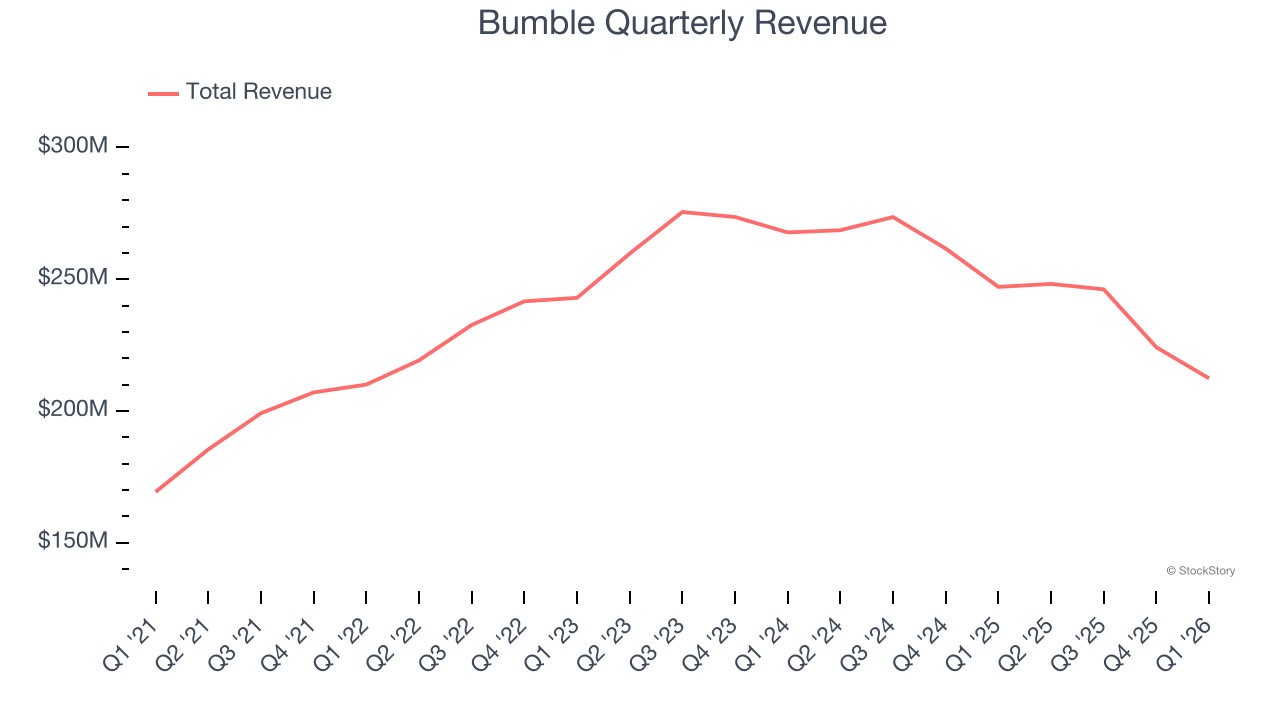
This quarter, Bumble reported a rather uninspiring 14.1% year-on-year revenue decline to $212.4 million of revenue, in line with Wall Street’s estimates. Company management is currently guiding for a 15.8% year-on-year decline in sales next quarter.
Looking further ahead, sell-side analysts expect revenue to decline by 8.5% over the next 12 months, a deceleration versus the last three years. This projection doesn't excite us and implies its products and services will face some demand challenges.
ONE MORE THING: 3 Hidden Platforms Growing 3X Faster than Amazon, Google, and PayPal. Amazon, Google, and Meta all followed the same playbook: Dominate an ignored market. Build an unbeatable moat. Scale until you’re unstoppable.
These three platforms are running that exact playbook right now. The early investors in Amazon made fortunes. The early investors in these could do the same. Get All 3 Stocks Here for FREE.
Paying Users
Buyer Growth
As a subscription-based app, Bumble generates revenue growth by expanding both its subscriber base and the amount each subscriber spends over time.
Bumble struggled with new customer acquisition over the last two years as its paying users have declined by 3.1% annually to 3.17 million in the latest quarter. This performance isn't ideal because internet usage is secular, meaning there are typically unaddressed market opportunities. If Bumble wants to accelerate growth, it likely needs to enhance the appeal of its current offerings or innovate with new products. 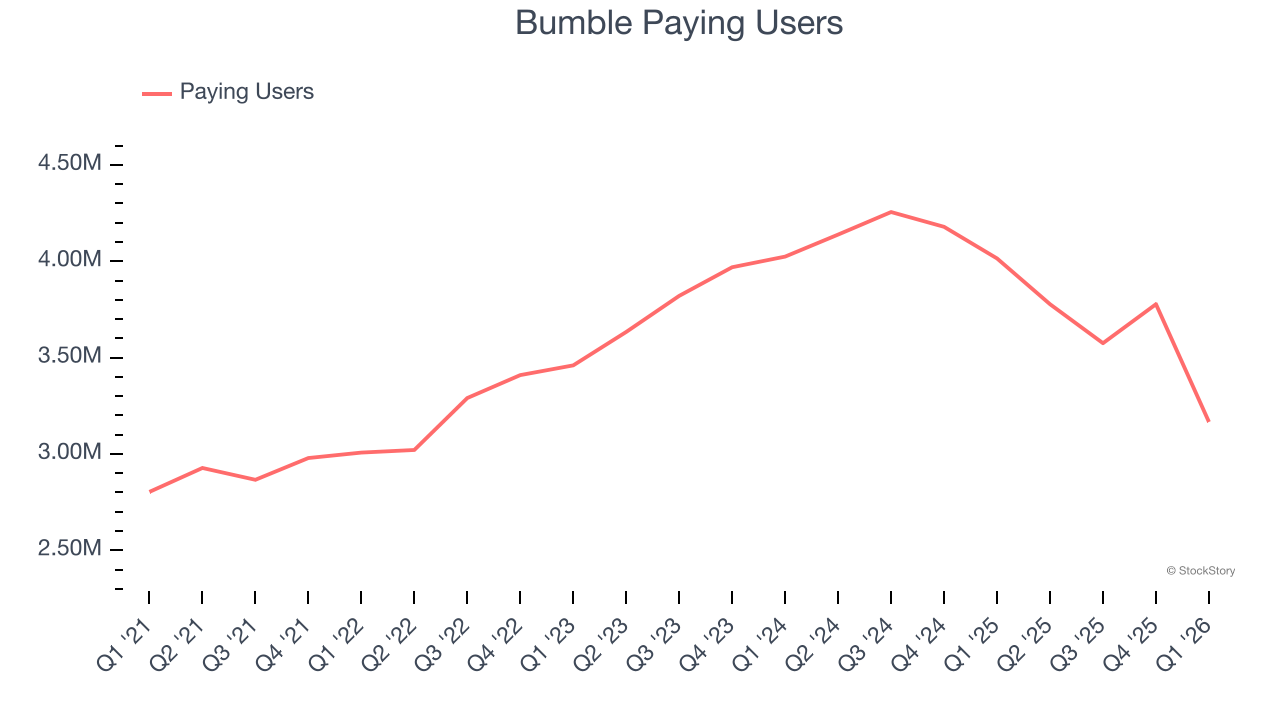
In Q1, Bumble’s paying users once again decreased by 848,400, a 21.1% drop since last year. The quarterly print was lower than its two-year result, suggesting its new initiatives aren’t moving the needle for buyers yet.
Revenue Per Buyer
Average revenue per buyer (ARPB) is a critical metric to track because it measures how much the average buyer spends. ARPB is also a key indicator of how valuable its buyers are (and can be over time).
Bumble’s ARPB fell over the last two years, averaging 16.8% annual declines. This signals its platform’s value is eroding when paired with its declining paying users. If Bumble wants to increase its buyers, it must either develop new features or provide some existing ones for free. 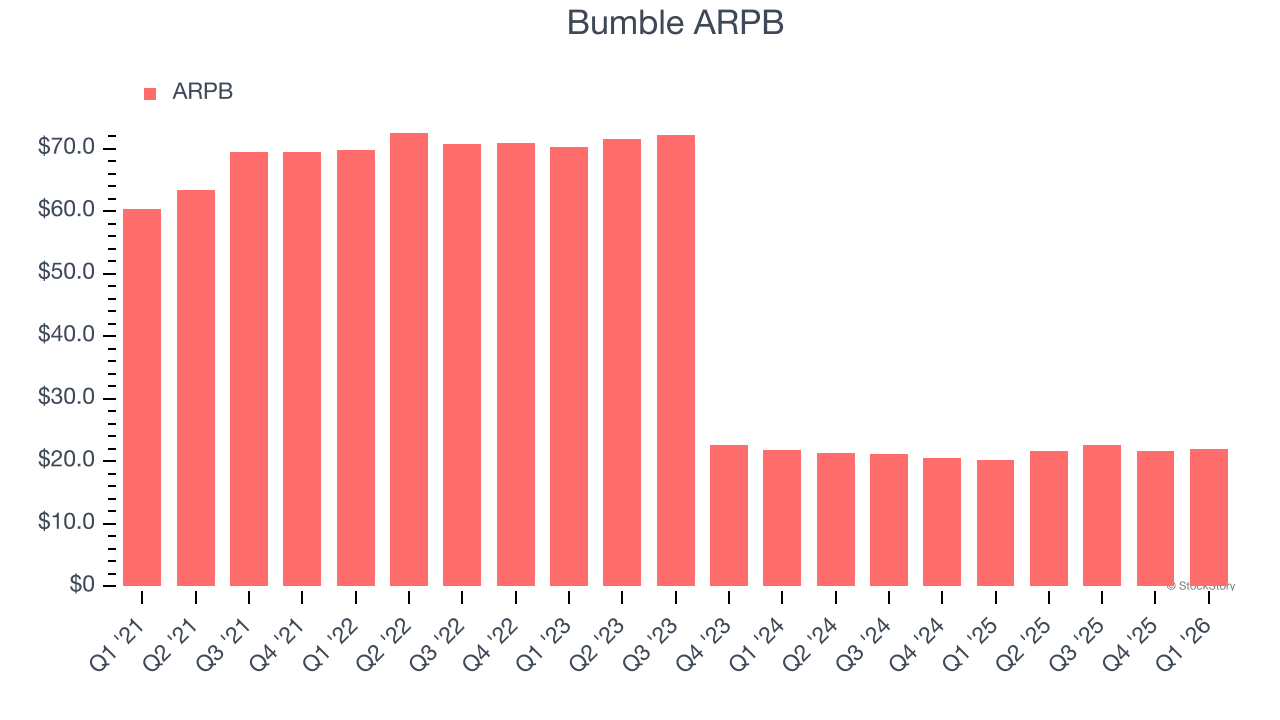
This quarter, Bumble’s ARPB clocked in at $22.04. It grew by 8.9% year on year, faster than its paying users.
Key Takeaways from Bumble’s Q1 Results
We enjoyed seeing Bumble beat analysts’ EBITDA expectations this quarter. On the other hand, its number of buyers declined and its revenue guidance for next quarter fell short of Wall Street’s estimates. Overall, this quarter could have been better. The stock remained flat at $4.25 immediately following the results.
The latest quarter from Bumble’s wasn’t that good. One earnings report doesn’t define a company’s quality, though, so let’s explore whether the stock is a buy at the current price. We think that the latest quarter is only one piece of the longer-term business quality puzzle. Quality, when combined with valuation, can help determine if the stock is a buy. We cover that in our actionable full research report which you can read here (it’s free).

/AI%20(artificial%20intelligence)/AI%20engineer%20working%20on%20laptop%20by%20ART%20STOCK%20CREATIVE%20via%20Shutterstock.jpg)
/Micron%20Technology%20Inc_billboard-by%20Poetra_RH%20via%20Shutterstock.jpg)
/Qualcomm%2C%20Inc_%20logo%20on%20phone-by%20viewimage%20via%20Shutterstock.jpg)
/Advanced%20Micro%20Devices%20Inc_%20logo%20and%20chart%20data-by%20Poetra_%20RH%20via%20Shutterstock.jpg)