




Natural gas producer Gulfport Energy (NYSE:GPOR) fell short of the market’s revenue expectations in Q1 CY2026, but sales rose 103% year on year to $399.5 million. Its GAAP profit of $8.87 per share was 22.7% above analysts’ consensus estimates.
Is now the time to buy Gulfport Energy? Find out by accessing our full research report, it’s free.
Gulfport Energy (GPOR) Q1 CY2026 Highlights:
- Revenue: $399.5 million vs analyst estimates of $411.3 million (103% year-on-year growth, 2.9% miss)
- EPS (GAAP): $8.87 vs analyst estimates of $7.23 (22.7% beat)
- Adjusted EBITDA: $264.2 million vs analyst estimates of $268 million (66.1% margin, 1.4% miss)
- Operating Margin: 57%, up from 6.1% in the same quarter last year
- Free Cash Flow Margin: 29.8%, down from 35% in the same quarter last year
- Oil production: down -29.2% year on year
- Market Capitalization: $3.52 billion
Company Overview
With drilling operations focused on the Utica Shale in eastern Ohio and the SCOOP play in central Oklahoma, Gulfport Energy (NYSE:GPOR) drills for and produces natural gas from underground shale formations.
Revenue Growth
A company’s long-term performance can give signals about its business quality. Even a bad business, especially in a cyclical industry, can shine for a year or so, but a top-tier one should exhibit resilience through cycles. Over the last five years, Gulfport Energy grew its sales at a solid 14.8% compounded annual growth rate. Its growth beat the average energy upstream and integrated energy company and shows its offerings resonate with customers, a helpful starting point for our analysis.
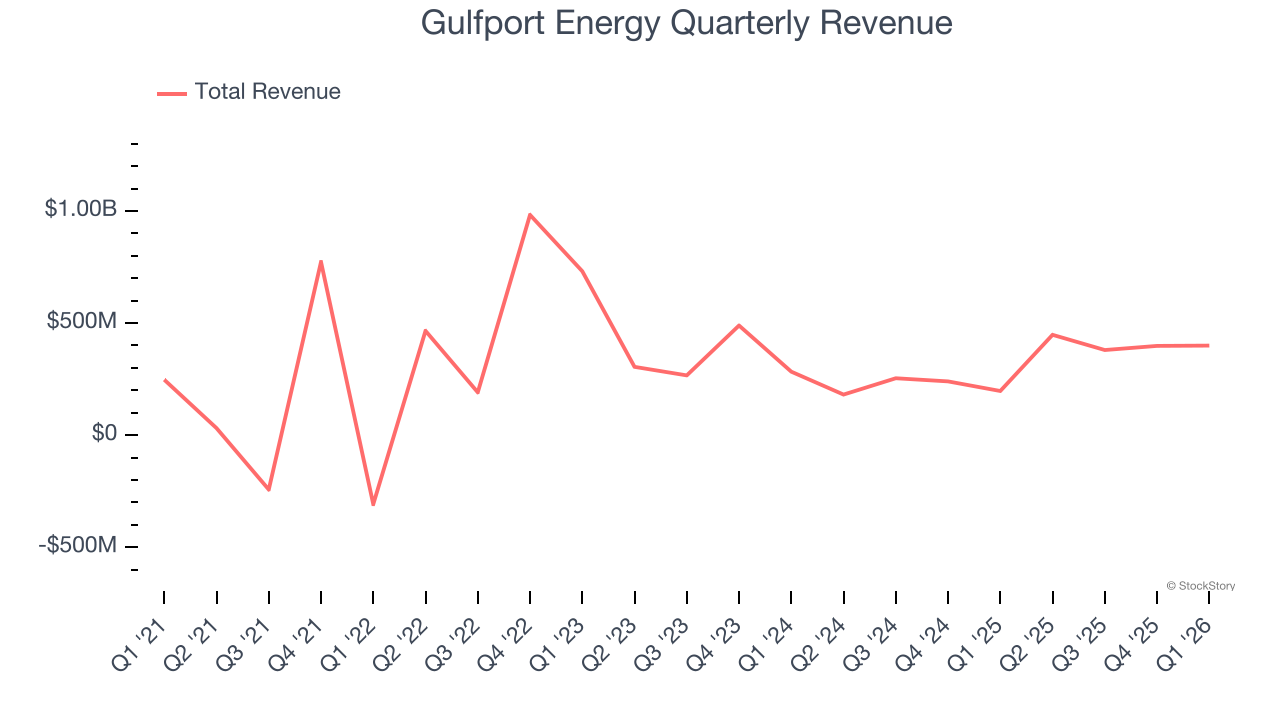
Energy cycles can be long enough that a single five-year period can still reflect one price environment, which is why an additional, decade-long view can help capture through-cycle performance. Gulfport Energy’s annualized revenue growth of 8.9% over the last ten years is below its five-year trend, but we still think the results suggest decent demand.
While looking at revenue is important, it can also introduce noise around commodity prices and M&A. Analyzing drivers of revenue, on the other hand, highlights what is happening inside the asset base and whether the economic footprint of a company is expanding. Over the last two years, Gulfport Energy’s oil production averaged 51% year-on-year growth. On the other hand, its natural gas production averaged 1.8% year-on-year declines. 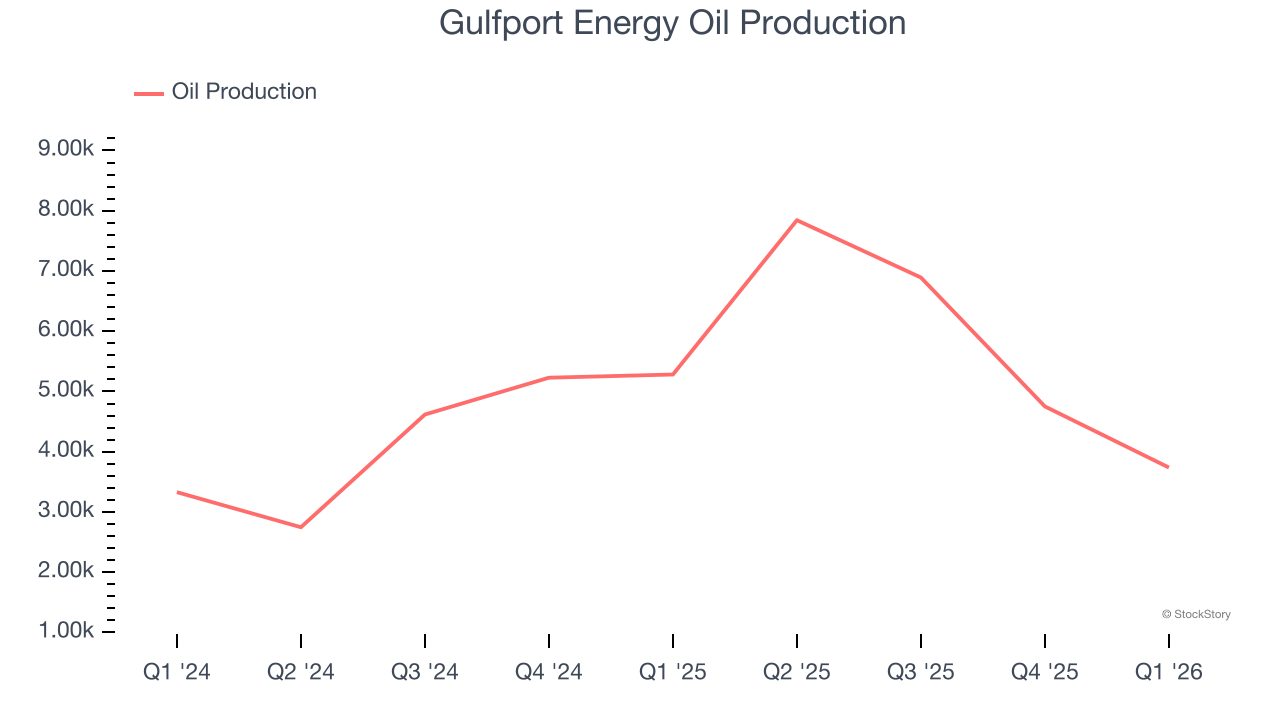
This quarter, Gulfport Energy achieved a magnificent 103% year-on-year revenue growth rate, but its $399.5 million of revenue fell short of Wall Street’s lofty estimates. This quarter, Gulfport Energy’s Oil production fell by 29.2% year on year.
ONE MORE THING: The $21 AI Application Stock Wall Street Forgot. While Wall Street obsesses over who’s building AI, one company is already using it to print money. And nobody’s paying attention.
AI chip stocks trade at ridiculous valuations. This company processes a trillion consumer signals monthly using AI and trades at a third of the price. The gap won’t last. The institutions will figure it out. You need to see this first. Read the FREE Report Before They Notice.
Adjusted EBITDA Margin
Gulfport Energy has been a well-oiled machine over the last five years. It demonstrated elite profitability for an upstream and integrated energy business, boasting an average EBITDA margin of 59%.
Analyzing the trend in its profitability, Gulfport Energy’s EBITDA margin decreased significantly over the last year. This raises questions about the company’s expense base because its revenue growth should have given it leverage on its fixed costs, resulting in better economies of scale and profitability.
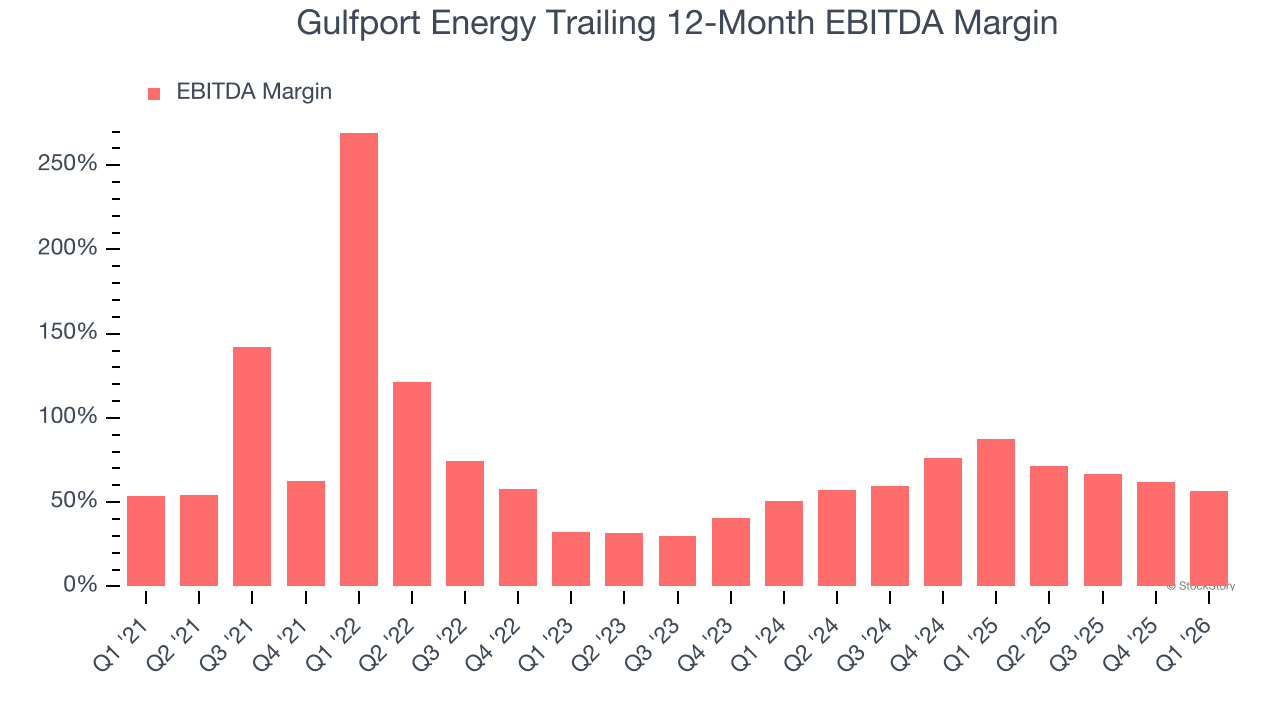
In Q1, Gulfport Energy generated an EBITDA margin profit margin of 66.1%, down 44.7 percentage points year on year. This contraction shows it was less efficient because its expenses grew faster than its revenue. This adjusted EBITDA fell short of Wall Street’s estimates.
Cash Is King
As mentioned above, adjusted EBITDA ignores capital structure and drilling expenditure decisions. These are two huge aspects of an Energy producer, so in order to understand a comprehensive picture of business quality, an investor needs to account for these. Said differently, adjusted EBITDA margins could be solid but free cash flow is abysmal because decline rates of the asset are extreme and the drilling is expensive. Free cash flow tells you about not only the economics of the production that has happened but how much it costs to stay in business as well (further drilling or extraction).
Gulfport Energy has shown terrific cash profitability, driven by its lucrative business model that enables it to reinvest, return capital to investors, and stay ahead of the competition. The company’s free cash flow margin was among the best in the energy upstream and integrated energy sector, averaging 17.7% over the last five years.
Absolute FCF margin levels matter but so does stability of free cash flow. All else equal, we’d prefer a 25.0% average free cash flow margin that is quite steady no matter how commodity prices behave rather than extremely high margins when times are good and negative ones when they’re tough.
Gulfport Energy’s ratio of quarterly free cash flow volatility to WTI crude price volatility over the past five years was 6.3 (lower is better), indicating excellent insulation from commodity swings. This stability supports capital access in downturns and positions Gulfport Energy to act as a consolidator when weaker peers are forced to retrench.
You may be asking why we wait until the free cash flow line to perform this stability analysis versus commodity prices. Why not compare revenue or EBITDA to WTI Crude prices in the case of Gulfport Energy? Because what ultimately matters is not how much revenue or profit you earn when prices are high but how much cash you can generate when prices are low. Free cash flow is the superior metric because it includes everything from hedging prowess to growth and maintenance capex to management behavior during good times and bad.
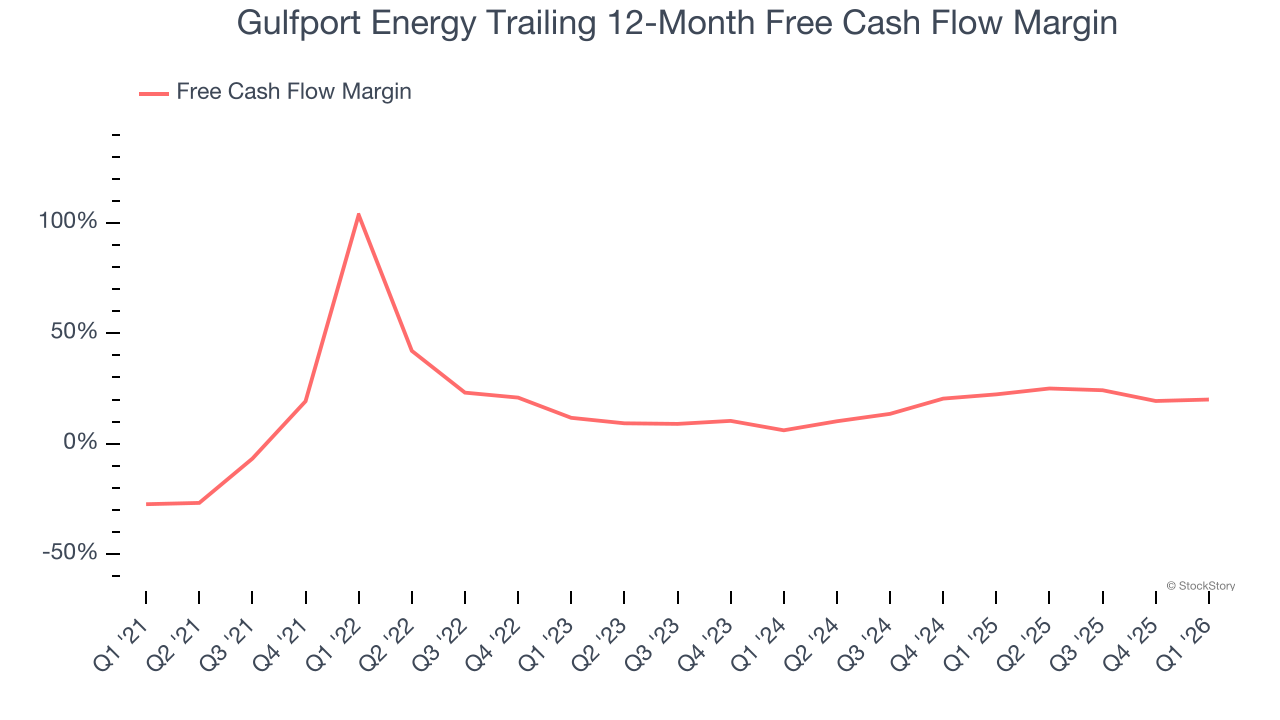
Gulfport Energy’s free cash flow clocked in at $118.9 million in Q1, equivalent to a 29.8% margin. The company’s cash profitability regressed as it was 5.3 percentage points lower than in the same quarter last year, but it’s still above its five-year average. We wouldn’t read too much into this quarter’s decline because investment needs can be seasonal, causing short-term swings. Long-term trends trump temporary fluctuations.
Key Takeaways from Gulfport Energy’s Q1 Results
It was good to see Gulfport Energy beat analysts’ EPS expectations this quarter. On the other hand, its revenue missed and its EBITDA fell slightly short of Wall Street’s estimates. Overall, this was a weaker quarter. The stock remained flat at $197.57 immediately after reporting.
So do we think Gulfport Energy is an attractive buy at the current price? When making that decision, it’s important to consider its valuation, business qualities, as well as what has happened in the latest quarter. We cover that in our actionable full research report which you can read here (it’s free).


/A%20photo%20of%20a%20Sandisk%20Solid%20State%20Drive%20by%20Top%20Popular%20Vector%20by%20Shutterstock.jpg)
/AI%20(artificial%20intelligence)/Data%20Center%20by%20Caureem%20via%20Shutterstock%20(2).jpg)

/ServiceNow%20Inc%20building%20in%20Silicon%20Valley-by%20Sundry%20Photography%20via%20iStock.jpg)