At JPMorgan Chase's (NYSE:JPM) recent investor day, CEO Jamie Dimon provided a lot of insight into how he felt about the banking industry and the economy. One thing Dimon is very concerned about right now is the Federal Reserve's ongoing efforts to shrink its balance sheet in a process known as quantitative tightening (QT).
In fact, Dimon said he thinks he's more concerned about QT than most. Here's why.
We've never done this before
Quantitative easing (QE) and QT are monetary policy tools the Fed can use to influence liquidity in the economy and longer-term interest rates. In QE, the Fed will buy U.S. Treasury bills and mortgage-backed securities, which effectively pumps money into the economy.
After the pandemic started in 2020, the Fed lowered rates to zero and then began QE to try and keep longer-term rates low as well in order to make the economy more accommodative during a very difficult time. The Fed ended up pumping about $4 trillion into the economy and ballooning its balance sheet to nearly $9 trillion. Then, when inflation started to hit the economy hard, the Fed stopped QE and began QT last June, ramping up to the point where it would be letting $95 billion roll off its balance sheet each month.
In particular, Dimon is concerned about how this rapid pace of QE followed by QT will impact broader market conditions and bank deposits, especially with the Fed's reverse repurchase program (RRP) operating in full force. The RRP program is what enables money market mutual funds to offer customers higher interest rates on their deposits, and it has been a big strain on bank deposit levels and deposit costs.
Said Dimon:
We've never had QE before. We've never had QT before. It just started, OK? And you see huge distortions in the marketplace already. We've never had the Fed in the market like this with that RRP program that Jeremy [Barnum, JPM CEO] mentioned. They have $2.3 trillion basically lent out to money funds. And I don't know the full effect of that. And obviously, that's a direct deduction from deposits.
Dimon also still thinks there is too much liquidity in the system, which could mean he thinks deposits are likely to continue to drain as the Fed continues QT.
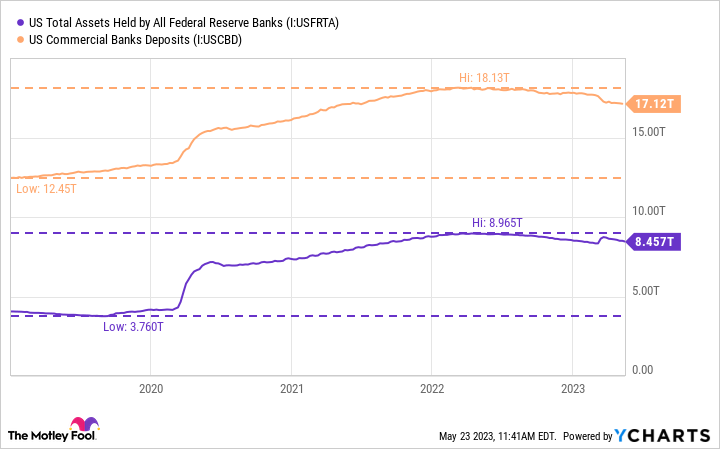
US Total Assets Held by All Federal Reserve Banks data by YCharts
As the chart shows, U.S. commercial bank deposits have pretty much mimicked the Fed's balance sheet. When QE pumped liquidity into the banking system, bank deposits surged, and now they've come down roughly $1 trillion since the Fed began QT.
QT can also have broader market implications as well. For instance, the last time the Fed began QT, it led to a major spike in overnight repo rates in 2019, which some believe had to do with a shortage of bank reserves, causing banks to hoard liquidity.
Why investors should take note
QT seems to have received less coverage this year, despite the fact that it is a contributor to deposit outflows, which have been a big part of the banking crisis. With QT still going, it will be interesting to see the impact on deposits, although hopefully, the banking system can handle the $95 billion per month reduction in the Fed's balance sheet, which is not a lot when you think about how much the Fed's balance sheet has grown since 2020.
Another thing to consider is the impact it might have on longer-term interest rates. If QE is intended to keep longer-term rates lower, can't QT do the opposite? Higher long-term interest rates that go on for longer may not be so great for the broader market.
Ultimately, Dimon is warning people that we are essentially in no-man's-land with this amount of QE and QT having happened so quickly. Investors should watch the situation carefully.
10 stocks we like better than JPMorgan Chase
When our analyst team has a stock tip, it can pay to listen. After all, the newsletter they have run for over a decade, Motley Fool Stock Advisor, has tripled the market.*
They just revealed what they believe are the ten best stocks for investors to buy right now... and JPMorgan Chase wasn't one of them! That's right -- they think these 10 stocks are even better buys.
*Stock Advisor returns as of May 22, 2023
JPMorgan Chase is an advertising partner of The Ascent, a Motley Fool company. Bram Berkowitz has no position in any of the stocks mentioned. The Motley Fool has positions in and recommends JPMorgan Chase. The Motley Fool has a disclosure policy.

/AI%20(artificial%20intelligence)/Artificial%20intelligence%20and%20machine%20learning%20concept%20-%20by%20amgun%20via%20iStock.jpg)
/Broadcom%20Inc%20logo%20on%20building-by%20Poetra_%20RH%20via%20Shutterstock.jpg)
/Oracle%20Corp_%20logo%20on%20phone-by%20WonderPix%20via%20Shutterstock.jpg)