
Civil infrastructure construction company Sterling Infrastructure (NASDAQ:STRL) reported Q1 CY2026 results beating Wall Street’s revenue expectations, with sales up 91.6% year on year to $825.7 million. The company’s full-year revenue guidance of $3.75 billion at the midpoint came in 21% above analysts’ estimates. Its non-GAAP profit of $3.59 per share was 63.9% above analysts’ consensus estimates.
Is now the time to buy Sterling? Find out by accessing our full research report, it’s free.
Sterling (STRL) Q1 CY2026 Highlights:
- Revenue: $825.7 million vs analyst estimates of $592 million (91.6% year-on-year growth, 39.5% beat)
- Adjusted EPS: $3.59 vs analyst estimates of $2.19 (63.9% beat)
- Adjusted EBITDA: $166.6 million vs analyst estimates of $110.2 million (20.2% margin, 51.2% beat)
- The company lifted its revenue guidance for the full year to $3.75 billion at the midpoint from $3.13 billion, a 20% increase
- Management raised its full-year Adjusted EPS guidance to $18.73 at the midpoint, a 36.2% increase
- EBITDA guidance for the full year is $858 million at the midpoint, above analyst estimates of $637.4 million
- Operating Margin: 16.7%, up from 13.4% in the same quarter last year
- Free Cash Flow Margin: 17.7%, up from 15.5% in the same quarter last year
- Market Capitalization: $16.34 billion
Company Overview
Involved in the construction of a major highway, the Grand Parkway in Houston, TX, Sterling Infrastructure (NASDAQ:STRL) provides civil infrastructure construction.
Revenue Growth
Examining a company’s long-term performance can provide clues about its quality. Any business can experience short-term success, but top-performing ones enjoy sustained growth for years. Thankfully, Sterling’s 14.8% annualized revenue growth over the last five years was exceptional. Its growth surpassed the average industrials company and shows its offerings resonate with customers, a great starting point for our analysis.
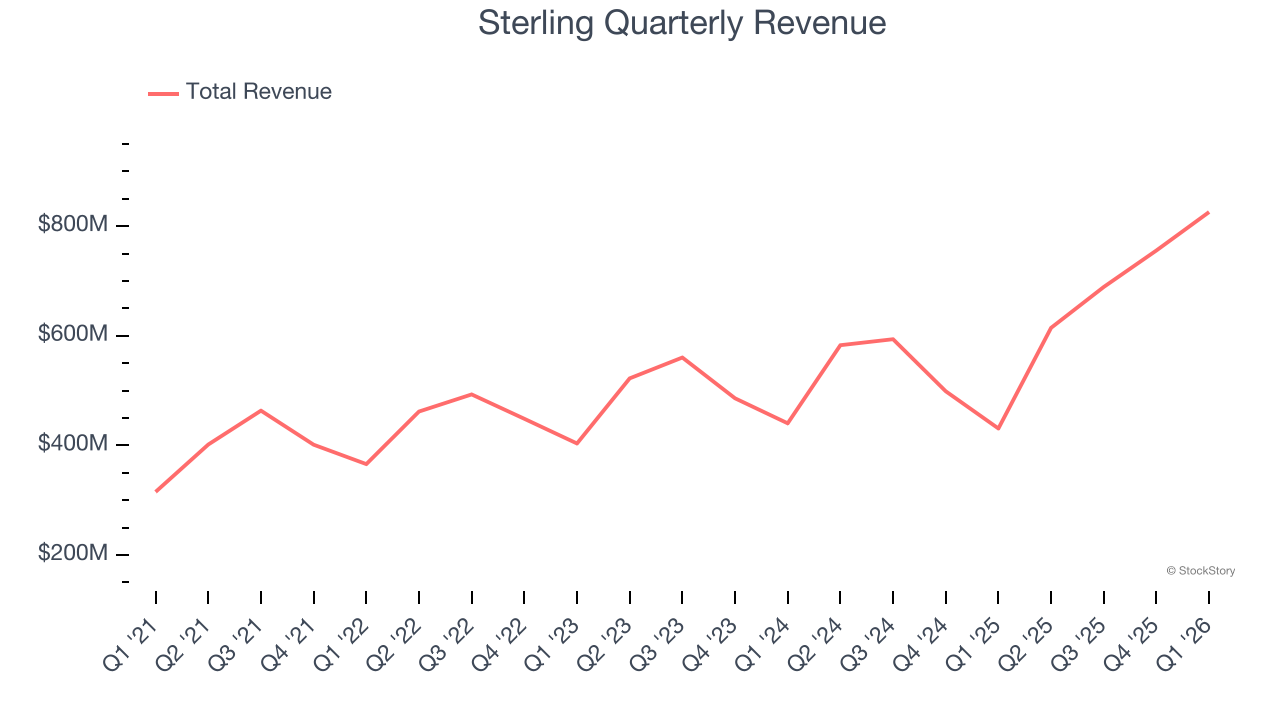
Long-term growth is the most important, but within industrials, a half-decade historical view may miss new industry trends or demand cycles. Sterling’s annualized revenue growth of 19.8% over the last two years is above its five-year trend, suggesting its demand was strong and recently accelerated. 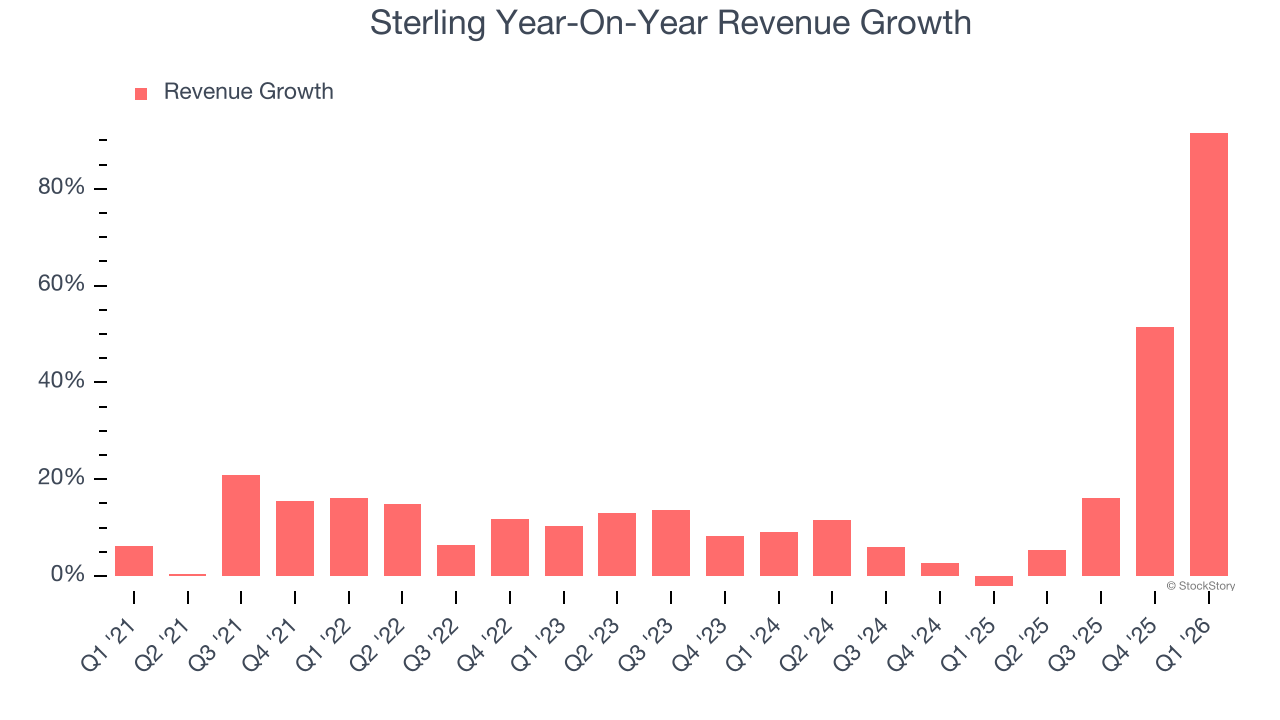
This quarter, Sterling reported magnificent year-on-year revenue growth of 91.6%, and its $825.7 million of revenue beat Wall Street’s estimates by 39.5%.
Looking ahead, sell-side analysts expect revenue to grow 21% over the next 12 months, similar to its two-year rate. This projection is eye-popping and suggests its newer products and services will spur better top-line performance.
ONE MORE THING: 3 Hidden Platforms Growing 3X Faster than Amazon, Google, and PayPal. Amazon, Google, and Meta all followed the same playbook: Dominate an ignored market. Build an unbeatable moat. Scale until you’re unstoppable.
These three platforms are running that exact playbook right now. The early investors in Amazon made fortunes. The early investors in these could do the same. Get All 3 Stocks Here for FREE.
Operating Margin
Sterling has been an efficient company over the last five years. It was one of the more profitable businesses in the industrials sector, boasting an average operating margin of 12.2%. This result was particularly impressive because of its low gross margin, which is mostly a factor of what it sells and takes huge shifts to move meaningfully. Companies have more control over their operating margins, and it’s a show of well-managed operations if they’re high when gross margins are low.
Looking at the trend in its profitability, Sterling’s operating margin rose by 10.1 percentage points over the last five years, as its sales growth gave it immense operating leverage.
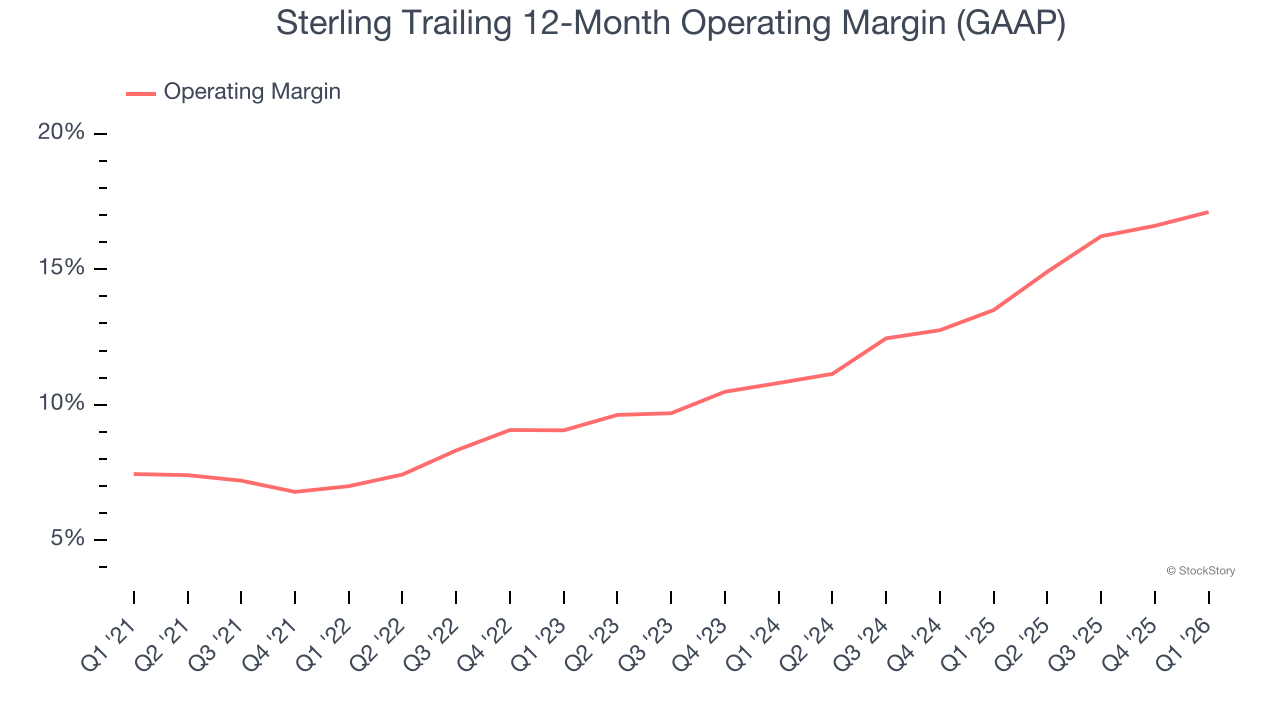
This quarter, Sterling generated an operating margin profit margin of 16.7%, up 3.3 percentage points year on year. The increase was encouraging, and because its operating margin rose more than its gross margin, we can infer it was more efficient with expenses such as marketing, R&D, and administrative overhead.
Earnings Per Share
Revenue trends explain a company’s historical growth, but the long-term change in earnings per share (EPS) points to the profitability of that growth – for example, a company could inflate its sales through excessive spending on advertising and promotions.
Sterling’s EPS grew at 48.2% compounded annual growth rate over the last five years, higher than its 14.8% annualized revenue growth. This tells us the company became more profitable on a per-share basis as it expanded.
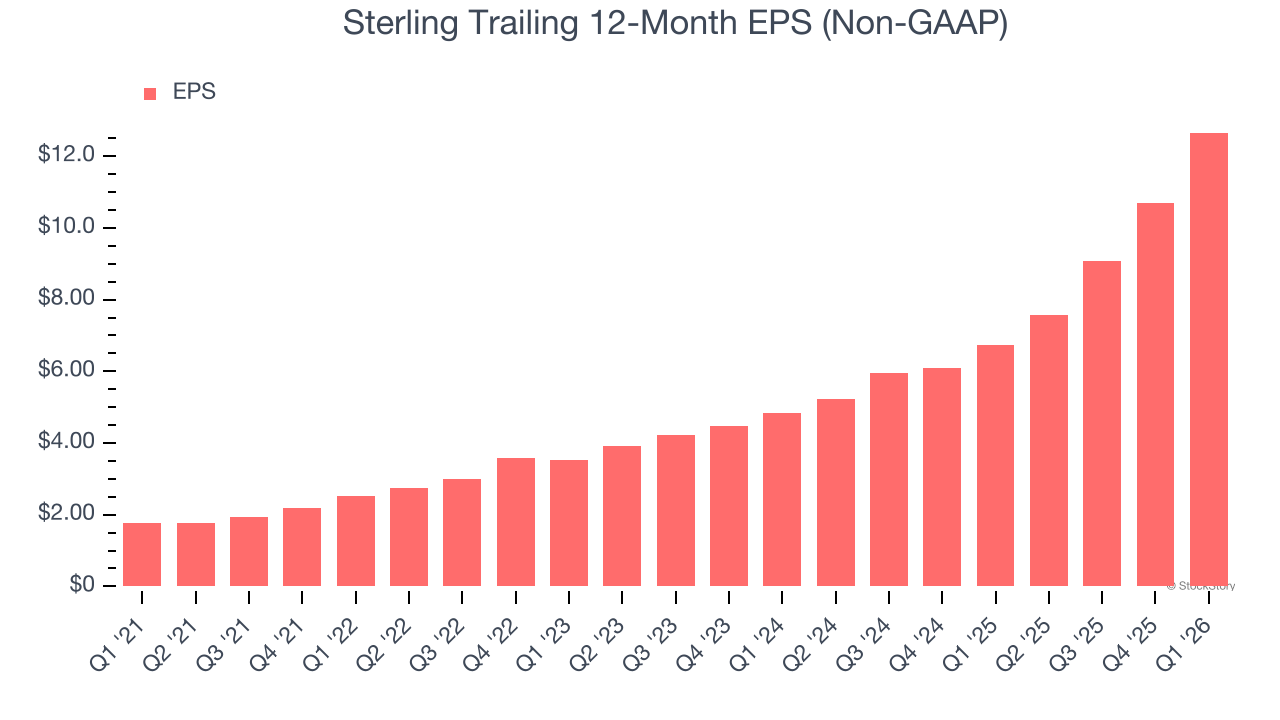
We can take a deeper look into Sterling’s earnings to better understand the drivers of its performance. As we mentioned earlier, Sterling’s operating margin expanded by 10.1 percentage points over the last five years. This was the most relevant factor (aside from the revenue impact) behind its higher earnings; interest expenses and taxes can also affect EPS but don’t tell us as much about a company’s fundamentals.
Like with revenue, we analyze EPS over a more recent period because it can provide insight into an emerging theme or development for the business.
For Sterling, its two-year annual EPS growth of 61.8% was higher than its five-year trend. We love it when earnings growth accelerates, especially when it accelerates off an already high base.
In Q1, Sterling reported adjusted EPS of $3.59, up from $1.63 in the same quarter last year. This print easily cleared analysts’ estimates, and shareholders should be content with the results. Over the next 12 months, Wall Street expects Sterling’s full-year EPS of $12.66 to grow 7.7%.
Key Takeaways from Sterling’s Q1 Results
It was good to see Sterling beat analysts’ EPS expectations this quarter. We were also excited its EBITDA outperformed Wall Street’s estimates by a wide margin. Zooming out, we think this was a solid print. The stock traded up 21.6% to $644.07 immediately following the results.
Sterling put up rock-solid earnings, but one quarter doesn’t necessarily make the stock a buy. Let’s see if this is a good investment. What happened in the latest quarter matters, but not as much as longer-term business quality and valuation, when deciding whether to invest in this stock. We cover that in our actionable full research report which you can read here (it’s free).

/CPU%20Chip.jpg)
/A%20photo%20of%20a%20Sandisk%20Solid%20State%20Drive%20by%20Top%20Popular%20Vector%20by%20Shutterstock.jpg)
/Broadcom%20Inc%20logo%20on%20phone%20and%20site-by%20Majahid%20Mottakin%20via%20Shutterstock.jpg)
/Abbott%20Laboratories%20vials%20and%20Logo-by%20Melniov%20Dmitriy%20via%20Shutterstock.jpg)