



Computer processor maker Intel (NASDAQ:INTC) reported Q1 FY2023 results that beat analyst expectations, with revenue down 36.2% year on year to $11.7 billion. Guidance for next quarter's revenue was $12 billion at the midpoint, which is 1.78% above the analyst consensus. Intel made a GAAP loss of $2.76 billion, down on its profit of $8.11 billion, in the same quarter last year.
Is now the time to buy Intel? Access our full analysis of the earnings results here, it's free.
Intel (INTC) Q1 FY2023 Highlights:
- Revenue: $11.7 billion vs analyst estimates of $11.1 billion (5.25% beat)
- EPS (non-GAAP): -$0.04 vs analyst estimates of -$0.14
- Revenue guidance for Q2 2023 is $12 billion at the midpoint, above analyst estimates of $11.8 billion
- Free cash flow was negative $8.76 billion, down from positive free cash flow of $3.06 billion in previous quarter
- Inventory Days Outstanding: 153, up from 141 previous quarter
- Gross Margin (GAAP): 34.2%, down from 50.4% same quarter last year
Inventor of the x86 processor that powered decades of technological innovation in PCs, data centers, and numerous other markets, Intel (NASDAQ: INTC) is the leading manufacturer of computer processors and graphics chips.
The biggest demand drivers for processors (CPUs) and graphics chips at the moment are secular trends related to 5G and Internet of Things, autonomous driving, and high performance computing in the data center space, specifically around AI and machine learning. Like all semiconductor companies, digital chip makers exhibit a degree of cyclicality, driven by supply and demand imbalances and exposure to PC and Smartphone product cycles.
Sales Growth
Intel's revenue has been declining over the last three years, dropping annually on average by 8.04%. Last year the quarterly revenue declined from $18.4 billion to $11.7 billion. Semiconductors are a cyclical industry and long-term investors should be prepared for periods of high growth, followed by periods of revenue contractions (which can sometimes offer opportune times to buy).
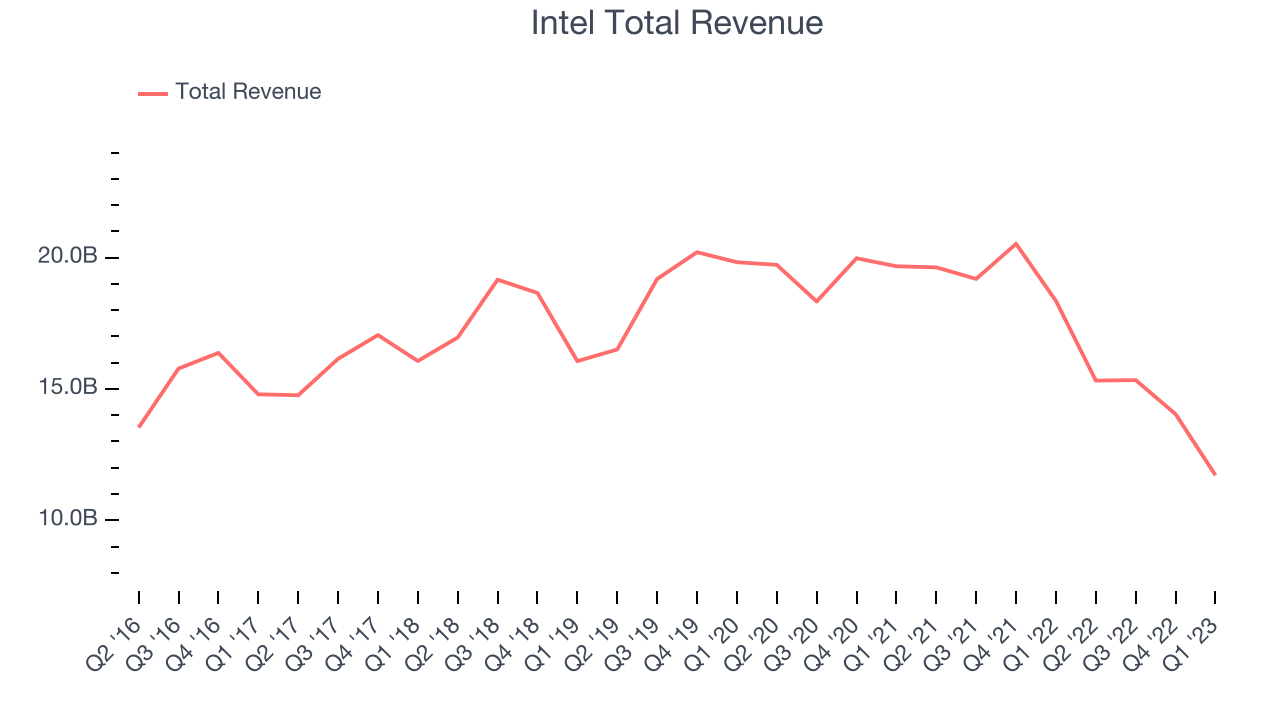
Despite Intel revenues beating analyst estimates, this was still a slow quarter with a 36.2% revenue decline.
Intel's looks headed into the trough of the semi cycle, as it is guiding to revenue declines of 21.7% YoY next quarter, and analysts are estimating 3.52% declines over the next twelve months.
In volatile times like these we look for robust businesses with strong pricing power. Unknown to most investors, this company is one of the highest-quality software companies in the world, and their software products have been the default standard in critical industries for decades. The result is an impressive business that is up an incredible 18,152% since the IPO. You can find it on our platform for free.
Product Demand & Outstanding Inventory
Days Inventory Outstanding (DIO) are an important metric for chipmakers, as it reflects the capital intensity of the business and the cyclical nature of semiconductor supply and demand. In a tight supply environment, inventories tend to be stable, allowing chipmakers to exert pricing power. Steadily increasing DIO can be a warning sign that demand is weak, and if inventories continue to rise the company may have to downsize production.
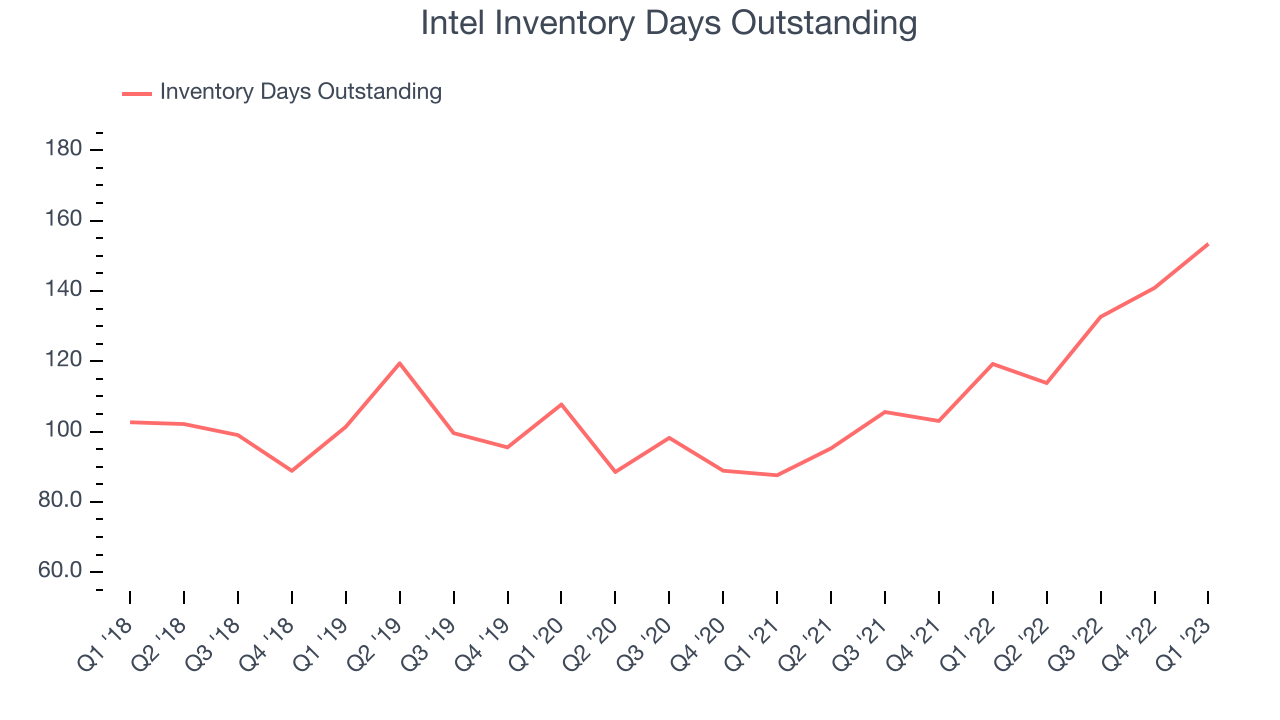
This quarter, Intel’s inventory days came in at 153, 46 days above the five year average, suggesting that that inventory has grown to higher levels than what we used to see in the past.
Key Takeaways from Intel's Q1 Results
Since it has still been burning cash over the last twelve months it is worth keeping an eye on Intel’s balance sheet, but we note that with a market capitalization of $120 billion and more than $27.5 billion in cash, the company has the capacity to continue to prioritise growth over profitability.
It was good to see Intel outperform analysts’ expectations this quarter. On the other hand, revenue is in decline, gross margins are dropping and operating margin deteriorated. Overall, this quarter's results were not the best we've seen from Intel, although there was a slight sliver of hope with next quarter guidance being slightly above expectations. The company is down 2.45% on the results and currently trades at $29.11 per share.
Intel may have had a tough quarter, but does that actually create an opportunity to invest right now? It is important that you take into account its valuation and business qualities, as well as what happened in the latest quarter. We look at that in our actionable report which you can read here, it's free.
One way to find opportunities in the market is to watch for generational shifts in the economy. Almost every company is slowly finding itself becoming a technology company and facing cybersecurity risks and as a result, the demand for cloud-native cybersecurity is skyrocketing. This company is leading a massive technological shift in the industry and with revenue growth of 70% year on year and best-in-class SaaS metrics it should definitely be on your radar.
The author has no position in any of the stocks mentioned.

/AI%20(artificial%20intelligence)/AI%20technology%20concept%20by%20NMStudio789%20via%20Shutterstock.jpg)


/Space/Planet%20earth%20with%20flying%20rocket%20by%20Sergey%20Mironov%20via%20Shutterstock.jpg)
/Sign%20of%20Intel%20at%20entrance%20%20by%20michaelmond.jpeg)