




Editor's note: Any and all references to time frames longer than one trading day are for purposes of market context only, and not recommendations of any holding time frame. Daily rebalancing ETFs are not meant to be held unmonitored for long periods. If you don't have the resources, time or inclination to constantly monitor and manage your positions, leveraged and inverse ETFs are not for you.
Iran tensions have dominated the headlines, but the next big item on the calendar is closer to home: the Federal Reserve’s April 28-29 meeting and Chair Jerome Powell’s press conference.
At the March meeting, the Fed left rates unchanged at 3.50%-3.75% and said uncertainty remained elevated, with policymakers explicitly watching how Middle East developments could affect both inflation and growth. Fed officials are also likely weighing war-driven energy risks against a still-resilient U.S. labor market.
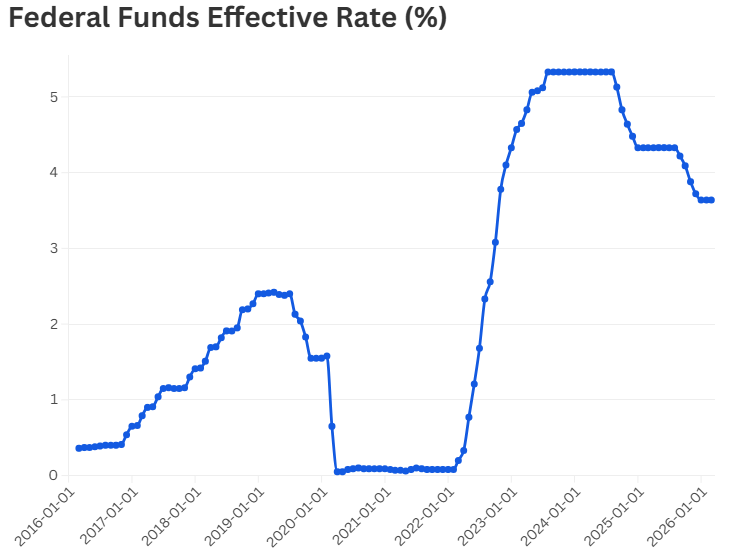
Source: Board of Governors of the Federal Reserve System (US), Federal Funds Effective Rate [FEDFUNDS], retrieved from FRED, Federal Reserve Bank of St. Louis; https://fred.stlouisfed.org/series/FEDFUNDS, April 8, 2026.
For now, futures markets are largely pricing in no rate change at the April 28-29 meeting, according to CME FedWatch. Even if the Fed stays on hold, the statement and Powell’s press conference could still move markets if they shift expectations for future rate cuts or change how investors view inflation* and growth risks.
Key Takeaways
The April 28-29 Fed meeting could reset rate expectations after weeks of geopolitical and inflation-driven volatility.*
Biotech often trades like a duration-sensitive growth sector because lower rates can boost the value of future cash flows and ease funding pressure.
Financials are also rate sensitive, but in more of a two-way approach, with the curve, funding costs, loan demand, and credit sentiment all in play.
For traders who want a more direct rates view, long-duration Treasuries may offer a cleaner play on a dovish or hawkish Fed reaction.
Biotech: A Duration Trade with a Kicker
Biotech is one of the cleaner rate-sensitive equity groups because so much of the story rests on future earnings potential, pipeline value, and access to capital. Lower rates typically support biotech by lowering R&D funding costs and increasing the value investors place on future cash flows. That is one reason biotech can respond quickly when the Fed leans more dovish.
Bullish Catalysts
Dovish Fed Surprise: Softer policy language could help rate-sensitive growth groups catch a bid .
Lower Discount Rate: Falling yields can make long-dated biotech pipelines look more valuable.
Risk Appetite Revival: A calmer macro backdrop could bring money back into higher-beta parts of healthcare.
For traders interested in bullish exposure, the Direxion Daily S&P Biotech Bull 3X ETF (Ticker: LABU) seeks daily investment results, before fees and expenses, of 300% of the performance of the S&P Biotechnology Select Industry Index*. Traders looking for a narrower bullish angle may also watch the Direxion Daily Biotech Top 5 Bull 2X ETF (Ticker: TBXU), which seeks daily investment results, before fees and expenses, of 200% of the performance of the NYSE Biotechnology Top 5 Equal Weight Index*.
Bearish Catalysts
Higher-for-Longer Signal: Sticky inflation or oil-driven price pressure could keep rate-cut hopes in check.
Funding Pressure: Higher rates can weigh more heavily on companies that rely on external capital.
Selective Market: Even in better environments, investors have been favoring stronger balance sheets and more mature pipelines.
For traders positioning for potential downside, the Direxion Daily S&P Biotech Bear 3X ETF (Ticker: LABD) seeks daily investment results, before fees and expenses, of 300% of the inverse (or opposite) of the performance of the S&P Biotechnology Select Industry Index.
Financials: Watching the Curve, Not Just the Fed
Financials are also rate sensitive, but the trade is less straightforward. Lower rates can help risk appetite, credit quality, and deal activity. At the same time, the shape of the yield curve and the path of deposit costs still matter for bank profitability.
Bullish Catalysts
Dovish Tone Helps Sentiment: A softer Fed could improve risk appetite across financials.
Better Credit Mood: If growth fears ease, investors may get more comfortable with cyclical lenders and brokers.
Deal Activity Hope: A steadier macro outlook can support capital markets and fee-driven businesses.
For traders interested in bullish exposure, the Direxion Daily Financial Bull 3X ETF (Ticker: FAS) seeks daily investment results, before fees and expenses, of 300% of the performance of the Financial Select Sector Index*.
Bearish Catalysts
Hawkish Hold Risk: If inflation worries dominate, the Fed may sound less willing to ease.
Funding Cost Pressure: Higher yields can keep pressure on financing conditions and margins.
Curve Confusion: Rate volatility alone can make the financials trade harder to handicap.
For traders positioning for potential downside, the Direxion Daily Financial Bear 3X ETF (Ticker: FAZ) seeks daily investment results, before fees and expenses, of 300% of the inverse (or opposite) of the performance of the Financial Select Sector Index.
A Direct Trade on Long-Term Rates
For traders who want the most direct read on a dovish or hawkish Fed, long-duration Treasuries may be the cleaner setup. A softer Fed tone or renewed rate-cut expectations could support long bonds, while sticky inflation, higher oil, or a more cautious policy outlook could pressure them. The Direxion Daily 20+ Year Treasury Bull 3X ETF (Ticker: TMF) and Direxion Daily 20+ Year Treasury Bear 3X ETF (Ticker: TMV) seek daily investment results, before fees and expenses, of 300%, or 300% of the inverse (or opposite), of the performance of the ICE U.S. Treasury 20+ Year Bond Index*.
The Bottom Line on the April Fed Meeting
The real hinge point is not just whether the Fed holds in April, it is what Powell says about inflation, oil, and how much patience policymakers still have. If the Fed sounds more worried about growth, duration-sensitive trades may get room to run. If inflation and energy stay in the driver’s seat, biotech, financials, and long bonds could all react very differently (opposite) of the performance of the Indxx Magnificent 7 Index*.
* Definitions and Index Descriptions
An investor should carefully consider a Fund’s investment objective, risks, charges, and expenses before investing. A Fund’s prospectus and summary prospectus contain this and other information about the Direxion Shares. To obtain a Fund’s prospectus and summary prospectus call 866-476-7523 or visit our website at direxion.com. A Fund’s prospectus and summary prospectus should be read carefully before investing.
The S&P Biotechnology Select Industry Index (SPSIBITR) is provided by S&P Dow Jones Indices LLC and includes domestic companies from the biotechnology industry. The Index is a modified equal-weighted index that is designed to measure the performance of the biotechnology sub-industry based on the Global Industry Classification Standards (GICS).
The NYSE Biotechnology Top 5 Equal Weight Index consists of the top five securities in the NYSE Biotechnology Index, which includes U.S.-listed companies in the biotechnology sub-industry as classified by the Global Industry Classification Standards.
The Financial Select Sector Index (IXMTR) is provided by S&P Dow Jones Indices and includes securities of companies from the following industries: Banks; Thrifts & Mortgage Finance; Diversified Financial Services; Consumer Finance; Capital Markets; Insurance; and Mortgage Real Estate Investment Trusts (REITs).
The ICE U.S. Treasury 20+ Year Bond Index (IDCOT20) is a market value weighted index that includes publicly issued U.S. Treasury securities that have a remaining maturity of greater than 20 years. Eligible securities must be fixed rate, denominated in U.S. dollars, and have $300 million or more of outstanding face value, excluding amounts held by the Federal Reserve. Securities excluded from the Index are inflation-linked securities, Treasury bills, cash management bills, any government agency debt issued with or without a government guarantee and zero-coupon issues that have been stripped from coupon-paying bonds.
Direxion Shares Risks – An investment in a Fund involves risk, including the possible loss of principal. A Fund is non-diversified and includes risks associated with the Fund’s concentrating its investments in a particular industry, sector, or geography which can increase volatility. The use of derivatives such as futures contracts and swaps are subject to market risks that may cause prices to fluctuate over time.
Leverage Risk – Each Fund obtains investment exposure in excess of its net assets by utilizing leverage and may lose more money in market conditions that are adverse to its investment objective than a fund that does not utilize leverage. A total loss may occur in a single day. Leverage will also have the effect of magnifying any differences in the Fund’s correlation or inverse correlation with the Index and may increase the volatility of the Fund.
Daily Index Correlation Risk – A number of factors may affect the Bull Fund’s ability to achieve a high degree of correlation with the Index and therefore achieve its daily leveraged investment objective. The Bull Fund’s exposure to the Index is impacted by the Index’s movement. Because of this, it is unlikely that the Bull Fund will be perfectly exposed to the Index at the end of each day. The possibility of the Bull Fund being materially over- or under-exposed to the Index increases on days when the Index is volatile near the close of the trading day.
Daily Inverse Index Correlation Risk – A number of factors may affect the Bear Fund’s ability to achieve a high degree of inverse correlation with the Index and therefore achieve its daily inverse leveraged investment objective. The Bear Fund’s exposure to the Index is impacted by the Index’s movement. Because of this, it is unlikely that the Bear Fund will be perfectly exposed to the Index at the end of each day. The possibility of the Bear Fund being materially over- or under-exposed to the Index increases on days when the Index is volatile near the close of the trading day.
Biotechnology Industry Risk – Companies within the biotechnology industry are subject to the risks of heavy investment in research and development to varying degrees of success, rapid obsolescence, significant governmental regulation and changes to governmental policies or the need for regulatory approvals, which may delay or inhibit the release of new products.
Healthcare Sector Risk — Companies in the healthcare sector may be affected by extensive, costly and uncertain government regulation, rising costs of medical products and services, changes in the demand for medical products and services, an increased emphasis on outpatient services, limited product lines, industry innovation and/or consolidation, changes in technologies and other market developments.
Financials Sector Risk —Performance of companies in the financials sector may be materially impacted by many factors, including but not limited to, government regulations, economic conditions, credit rating downgrades, changes in interest rates and decreased liquidity in credit markets.
U.S. Government Securities Risk – A security backed by the U.S. Treasury or the full faith and credit of the United States is guaranteed only as to the timely payment of interest and principal when held to maturity. The market prices for such securities are not guaranteed and will fluctuate.
Additional risks of each Fund include Effects of Compounding and Market Volatility Risk, Market Risk, Counterparty Risk, Rebalancing Risk, Intra-Day Investment Risk, Other Investment Companies (including ETFs Risk), Cash Transaction Risk, Passive Investment and Index Performance Risk and for the Direxion Daily S&P Biotech Bear 3X ETF, Direxion Daily Financial Bear 3X ETF, and the Direxion Daily 20+ Year Treasury Bear 3X ETF, Shorting or Inverse Risk. Please see the summary and full prospectuses for a more complete description of these and other risks of a Fund.
Distributor: ALPS Distributors, Inc.



/Boston%20Scientific%20Corp_%20phone%20and%20website-by%20T_Schneider%20via%20Shutterstock.jpg)
/Tesla%20Inc%20logo%20by-%20baileystock%20via%20iStock.jpg)