
Homebuilder Taylor Morrison Home (NYSE:TMHC) announced better-than-expected revenue in Q4 CY2025, but sales fell by 10.9% year on year to $2.1 billion. Its non-GAAP profit of $1.91 per share was 10% above analysts’ consensus estimates.
Is now the time to buy Taylor Morrison Home? Find out by accessing our full research report, it’s free.
Taylor Morrison Home (TMHC) Q4 CY2025 Highlights:
- Revenue: $2.1 billion vs analyst estimates of $1.96 billion (10.9% year-on-year decline, 7.2% beat)
- Adjusted EPS: $1.91 vs analyst estimates of $1.74 (10% beat)
- Adjusted EBITDA: $293.2 million vs analyst estimates of $248.9 million (14% margin, 17.8% beat)
- Operating Margin: 10.9%, down from 15.3% in the same quarter last year
- Backlog: $1.86 billion at quarter end, down 41.8% year on year
- Market Capitalization: $6.49 billion
"We are pleased to report strong fourth quarter results that met or exceeded our expectations across nearly all key operational metrics, despite continued challenging market conditions. These results concluded a solid year of performance in 2025, during which we delivered nearly 13,000 homes at an adjusted home closings gross margin of 23.0% and generated 40 basis points of SG&A expense leverage on essentially flat home closings revenue. Coupled with $381 million of share repurchases, these results drove a 13% return on equity and 14% growth in our book value per share. Our resilient performance reflects the strength of our diversified geographic and consumer portfolio and our disciplined focus on strategically balancing pace and price across our portfolio of well-located communities," said Sheryl Palmer, Taylor Morrison Chairman and CEO.
Company Overview
Named “America’s Most Trusted Home Builder” in 2019, Taylor Morrison Home (NYSE:TMHC) builds single family homes and communities across the United States.
Revenue Growth
Examining a company’s long-term performance can provide clues about its quality. Any business can put up a good quarter or two, but many enduring ones grow for years. Over the last five years, Taylor Morrison Home grew its sales at a tepid 5.8% compounded annual growth rate. This was below our standard for the industrials sector and is a tough starting point for our analysis.
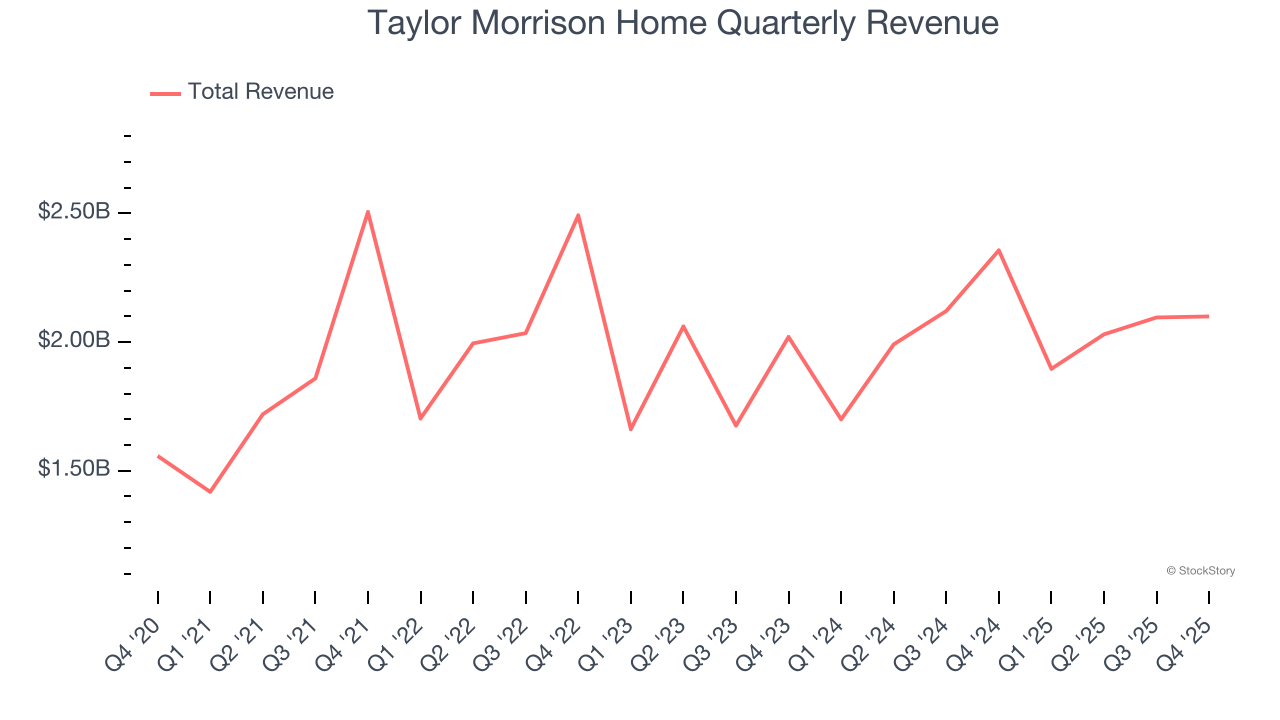
We at StockStory place the most emphasis on long-term growth, but within industrials, a half-decade historical view may miss cycles, industry trends, or a company capitalizing on catalysts such as a new contract win or a successful product line. Taylor Morrison Home’s recent performance shows its demand has slowed as its annualized revenue growth of 4.6% over the last two years was below its five-year trend. 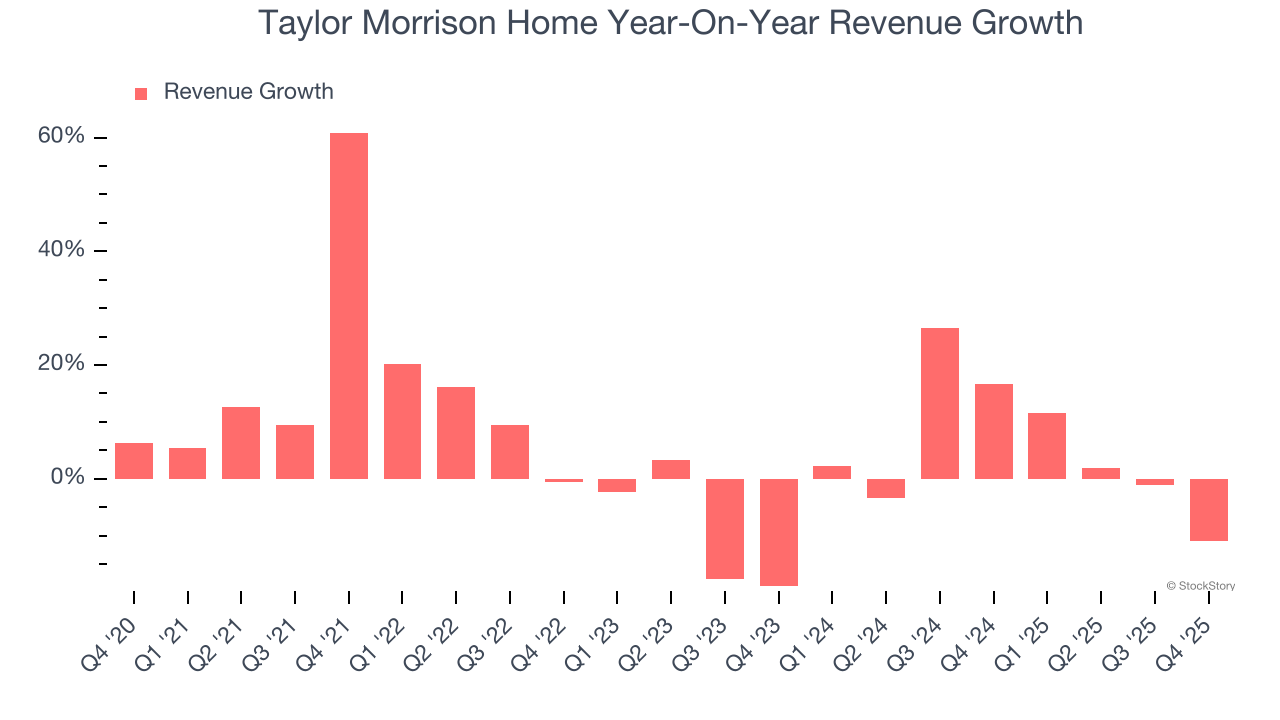
We can dig further into the company’s revenue dynamics by analyzing its backlog, or the value of its outstanding orders that have not yet been executed or delivered. Taylor Morrison Home’s backlog reached $1.86 billion in the latest quarter and averaged 18.5% year-on-year declines over the last two years. Because this number is lower than its revenue growth, we can see the company hasn’t secured enough new orders to maintain its growth rate in the future. 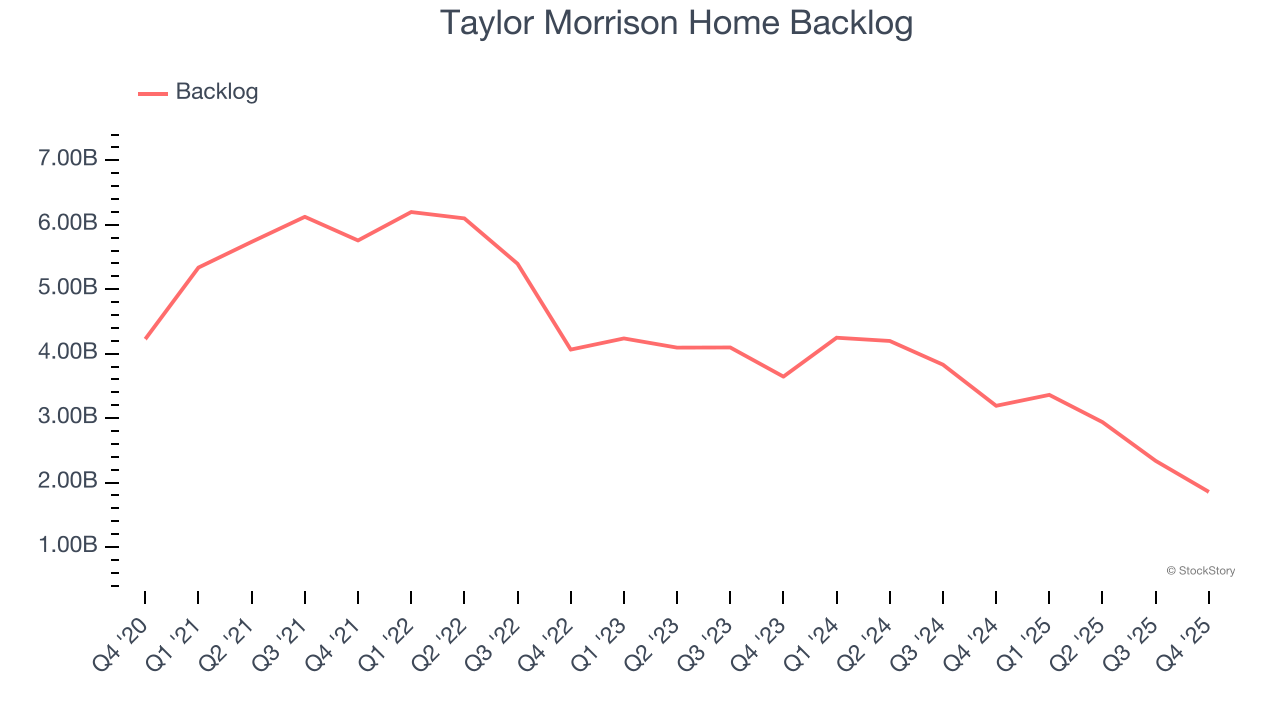
This quarter, Taylor Morrison Home’s revenue fell by 10.9% year on year to $2.1 billion but beat Wall Street’s estimates by 7.2%.
Looking ahead, sell-side analysts expect revenue to decline by 12.6% over the next 12 months, a deceleration versus the last two years. This projection doesn't excite us and suggests its products and services will face some demand challenges.
While Wall Street chases Nvidia at all-time highs, an under-the-radar semiconductor supplier is dominating a critical AI component these giants can’t build without. Click here to access our free report one of our favorites growth stories.
Operating Margin
Taylor Morrison Home has been an efficient company over the last five years. It was one of the more profitable businesses in the industrials sector, boasting an average operating margin of 14.5%. This result was particularly impressive because of its low gross margin, which is mostly a factor of what it sells and takes huge shifts to move meaningfully. Companies have more control over their operating margins, and it’s a show of well-managed operations if they’re high when gross margins are low.
Analyzing the trend in its profitability, Taylor Morrison Home’s operating margin rose by 1.7 percentage points over the last five years, as its sales growth gave it operating leverage. Its expansion was impressive, especially when considering most Home Builders peers saw their margins plummet.
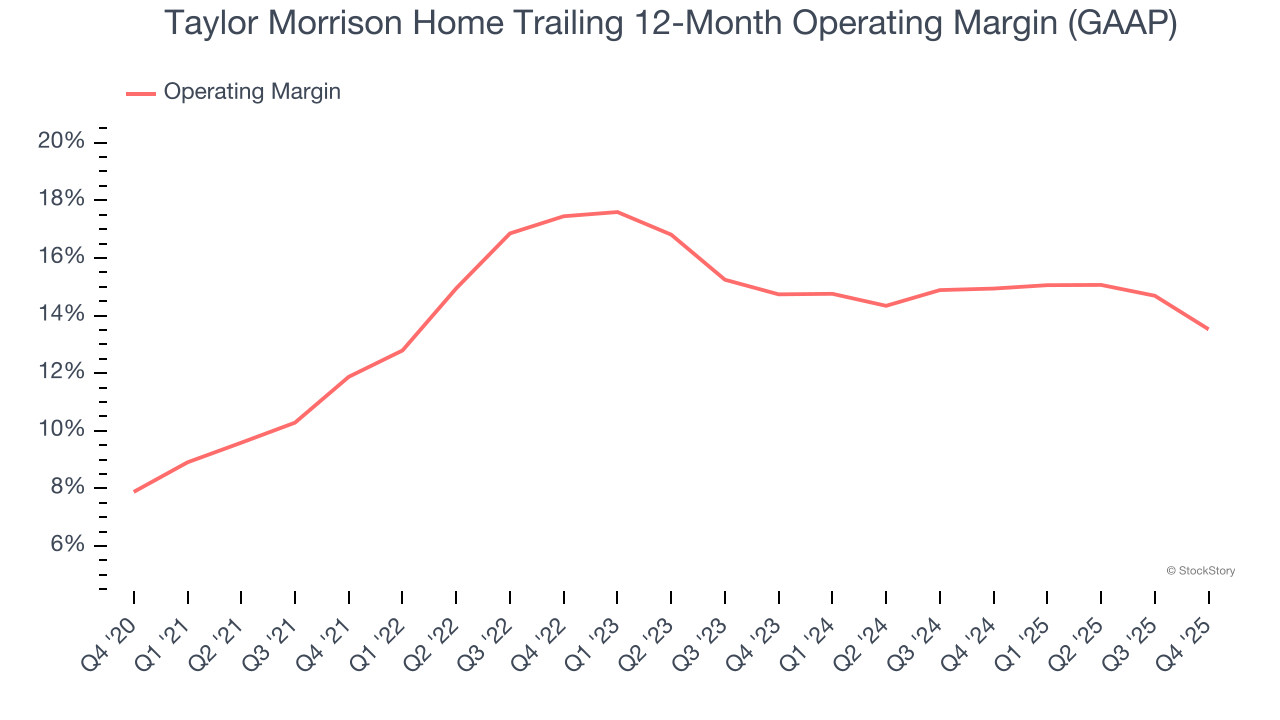
This quarter, Taylor Morrison Home generated an operating margin profit margin of 10.9%, down 4.4 percentage points year on year. Since Taylor Morrison Home’s operating margin decreased more than its gross margin, we can assume it was less efficient because expenses such as marketing, R&D, and administrative overhead increased.
Earnings Per Share
We track the long-term change in earnings per share (EPS) for the same reason as long-term revenue growth. Compared to revenue, however, EPS highlights whether a company’s growth is profitable.
Taylor Morrison Home’s EPS grew at an astounding 20.1% compounded annual growth rate over the last five years, higher than its 5.8% annualized revenue growth. This tells us the company became more profitable on a per-share basis as it expanded.
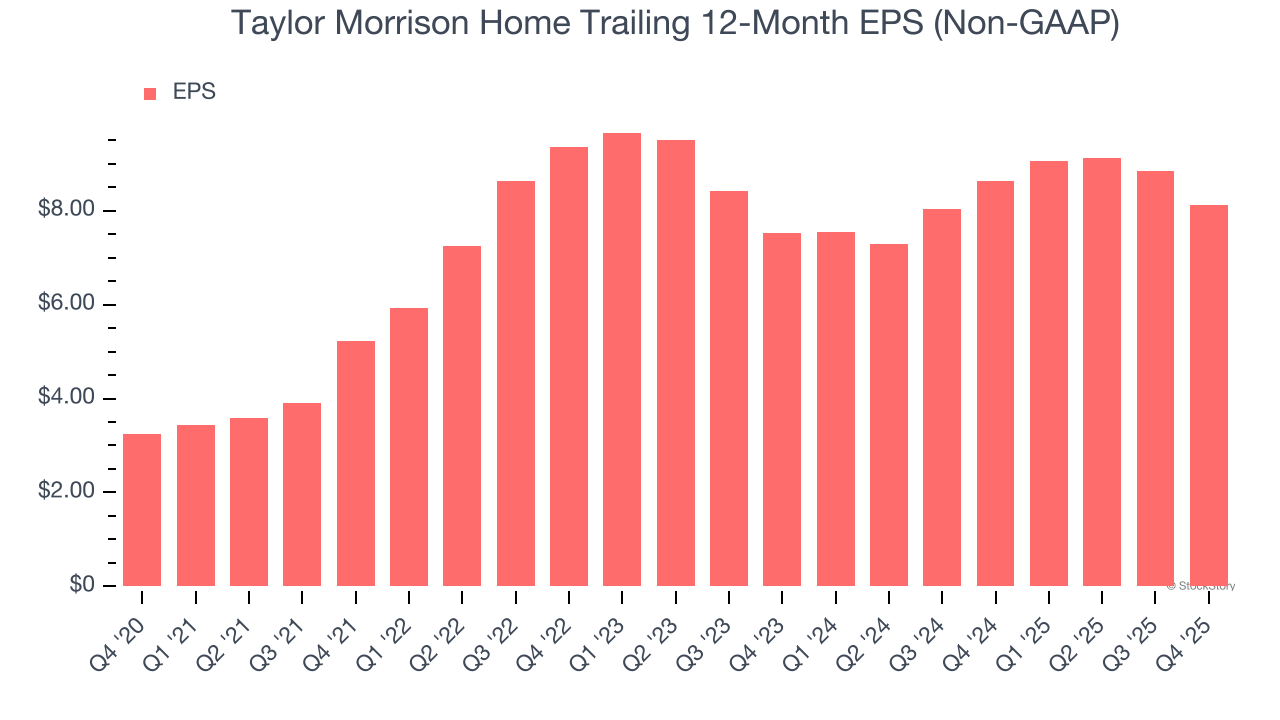
Diving into Taylor Morrison Home’s quality of earnings can give us a better understanding of its performance. As we mentioned earlier, Taylor Morrison Home’s operating margin declined this quarter but expanded by 1.7 percentage points over the last five years. Its share count also shrank by 25.3%, and these factors together are positive signs for shareholders because improving profitability and share buybacks turbocharge EPS growth relative to revenue growth. 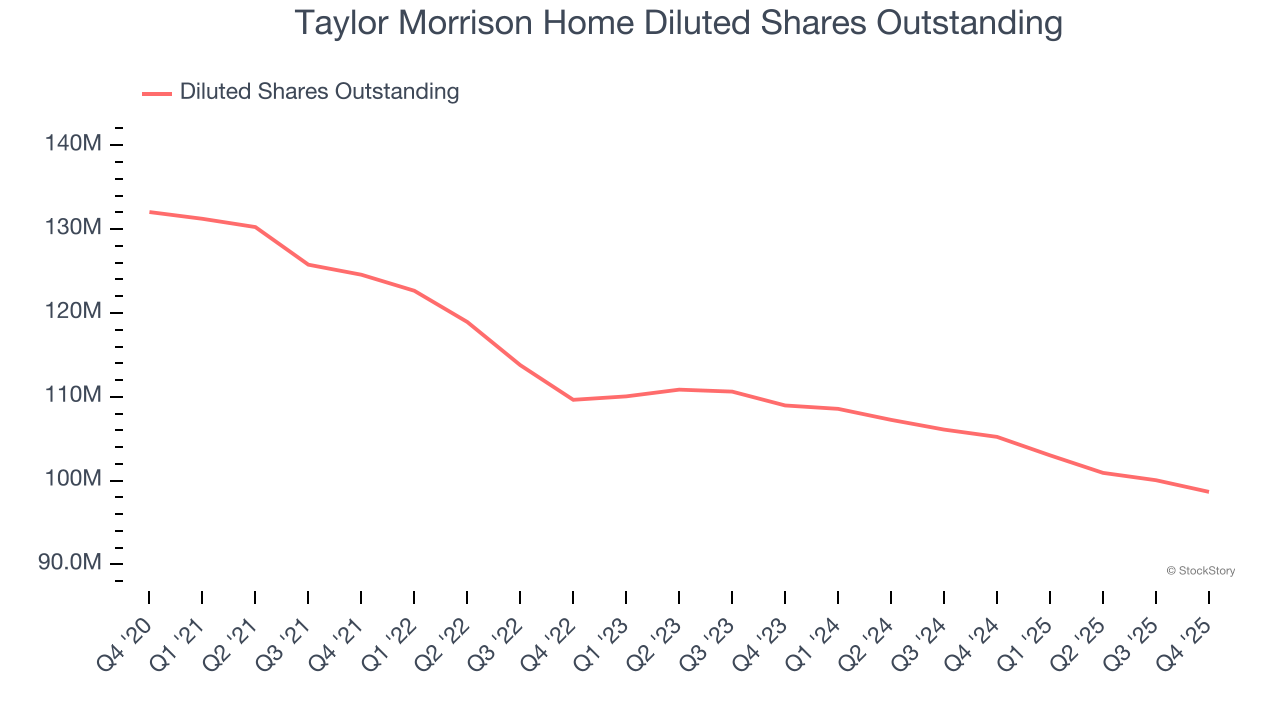
Like with revenue, we analyze EPS over a shorter period to see if we are missing a change in the business.
For Taylor Morrison Home, its two-year annual EPS growth of 3.8% was lower than its five-year trend. We hope its growth can accelerate in the future.
In Q4, Taylor Morrison Home reported adjusted EPS of $1.91, down from $2.64 in the same quarter last year. Despite falling year on year, this print beat analysts’ estimates by 10%. Over the next 12 months, Wall Street expects Taylor Morrison Home’s full-year EPS of $8.12 to shrink by 22%.
Key Takeaways from Taylor Morrison Home’s Q4 Results
We were impressed by how significantly Taylor Morrison Home blew past analysts’ EBITDA expectations this quarter. We were also excited its revenue outperformed Wall Street’s estimates by a wide margin. Zooming out, we think this was a good print with some key areas of upside. The stock remained flat at $66.41 immediately following the results.
So should you invest in Taylor Morrison Home right now? If you’re making that decision, you should consider the bigger picture of valuation, business qualities, as well as the latest earnings. We cover that in our actionable full research report which you can read here (it’s free).



/Cisco%20Systems%2C%20Inc_%20HQ-by%20Sundry%20Photography%20via%20iStock.jpg)