




When Fear Turns to Fuel: The Catalysts Behind the Equity Reversal
Sentiment in the equity space has undergone a dramatic transformation since early March, driven by a convergence of geopolitical, monetary, and fundamental developments that collectively stripped out an enormous amount of risk premium.
The primary shock that defined March was the US-Iran war. The closure of the Strait of Hormuz on March 4 triggered the largest oil supply disruption in the history of the global oil market, with Brent crude peaking near $120 per barrel. The simultaneous pivot to Section 122 tariffs following the Supreme Court's IEEPA ruling added a second layer of uncertainty, with a 150-day clock now ticking toward late July without a deal in sight.
The market’s reversal came from multiple directions simultaneously. Pakistan-mediated ceasefire negotiations produced an agreement on April 7, with Trump announcing a suspension of military operations and Iran agreeing to open the Strait of Hormuz. Though the ceasefire has remained contested and negotiations in Islamabad have been stop-start, markets latched onto the diplomatic progress as confirmation that the worst-case scenario was off the table. Trump subsequently extended the ceasefire without a fixed expiration date on April 21, removing the hard deadline that had kept risk premium elevated and giving participants the confidence to unwind defensive positioning. On the earnings front, Intel delivered the fundamental catalyst that gave the rally its legs, reporting Q1 EPS of $0.29 against a consensus of just $0.02, with AI-driven revenue up 40% year-over-year. The stock surged 23.6% on April 24, its best single-session gain since October 1987, dragging AMD up approximately 14%, Qualcomm up 10%, and Nvidia back to a $5 trillion market capitalisation. The Philadelphia Semiconductor Index extended its winning streak to 18 consecutive sessions. Adding to the constructive tone, the DOJ dropped its investigation into Fed Chair Jerome Powell, removing a lingering cloud over monetary policy continuity heading into the April 28 to 29 Fed meeting. NQ became acutely sensitive to this alignment of easing geopolitical risk, AI earnings momentum, and clearing institutional overhangs, creating the conditions for an explosive move higher.
What the Market Has Done
- In March, sellers were able to defend offers at 25500 (Daily Level 2), which is also confluent with the 2026 VWAP, establishing it as a significant overhead reference. The energy shock and tariff uncertainty reinforced the supply at that level.
- In the last week of March, the market broke out of its consolidation block below 24000 (Daily Level 3). However, buyers were not willing to accept prices at those levels. Despite the macro headwinds, participants quickly responded, bidding prices aggressively back up into the consolidation range. The failure to sustain below 24000 was a significant tell.
- Shorts began unwinding as ceasefire developments emerged. On April 7, President Trump announced a two-week suspension of military operations against Iran, triggering a historic single-day equity rally. The Dow surged 1,325 points (2.85%), and the Nasdaq Composite ripped 2.80% that session, its largest single-day gain since April 2025. West Texas Intermediate crude fell more than 16% that day, its largest single-day drop since April 2020, as the risk premium embedded in energy prices began to deflate.
- As buyers piled in alongside the unwinding of shorts and the removal of geopolitical risk premium, NQ rallied aggressively, breaking through prior ATHs at 26372 and printing new all-time highs at 27435. The Nasdaq Composite snapped a 13-day winning streak on April 20, its longest positive streak since 1992, illustrating just how one-sided the move had become.
- The market has expanded quickly and is now far from value. With price having moved this far, this fast, some consolidation or a pullback to reestablish value is a reasonable expectation. The underlying ceasefire remains fragile, with both the US and Iran accusing each other of violations, and the Strait of Hormuz reopening remaining conditional and contested.
What to Expect in the Coming Weeks
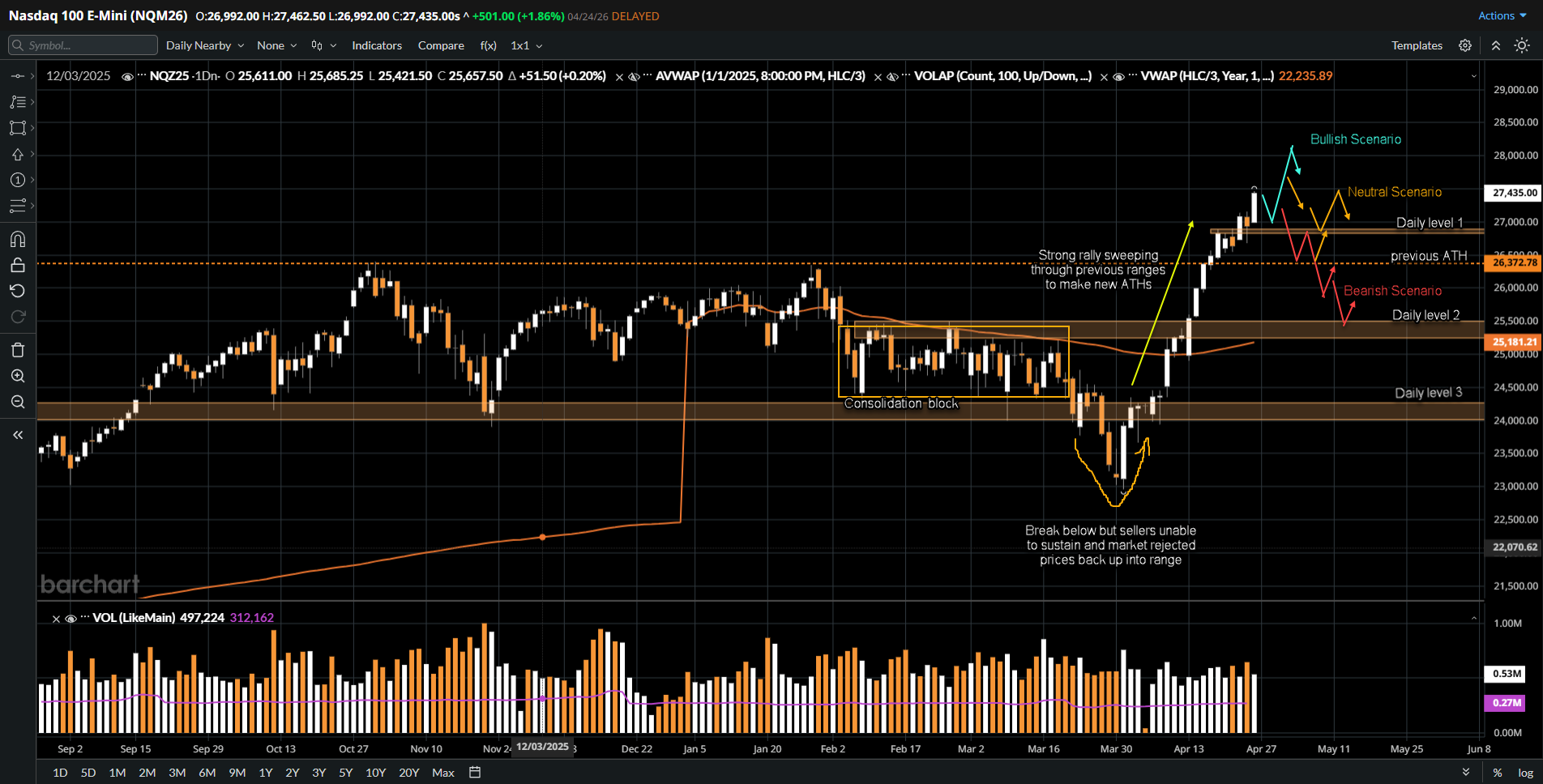
The key near-term level to watch is 26850 (Daily Level 1).
Neutral Scenario
- If buyers are unable to sustain a break above ATHs, or if buyers step in and defend the 26500 area (prior ATHs) on a pullback, expect two-way rotation between 27435 and 26500 to reestablish value.
- This scenario would likely be triggered by a macro backdrop in which the US-Iran ceasefire holds on paper but remains unresolved at the negotiating table, with the Strait of Hormuz conditionally open and oil prices stabilizing in the $90 to $100 range. In this environment, the Fed remains on hold, the tariff timeline creates ongoing uncertainty as the 150-day Section 122 clock ticks toward late July, and there is no clear catalyst to drive a sustained directional move. Markets rotate within the established range as participants wait for resolution.
Bullish Scenario
- A possible pullback to 26850 (Daily Level 1) before continuation would be a healthy development. If buyers are able to hold above 26850, expect a further move up to make new ATHs and extend toward the 28000 level.
- This scenario would possibly be triggered by a durable diplomatic breakthrough in US-Iran talks, either through the ongoing Islamabad negotiations or through a formal reopening of the Strait of Hormuz, combined with a sustained drop in oil prices back toward pre-war levels.
- A de-escalation of the tariff situation, whether via a trade deal or a court-driven resolution, would add further fuel to the bullish case. Continued strength in AI and semiconductor earnings from mega-cap tech names would reinforce the structural bid.
Bearish Scenario
- If buyers are unable to hold bids at 26850 (Daily Level 1), expect prices to move down to the 26500 area (prior ATHs). If buyers do not defend here, the next area of interest is 26000, followed by 25500 (Daily Level 2), where buyers are expected to respond.
- This scenario would possibly be triggered by a breakdown in US-Iran peace talks, a resumption of full-scale hostilities, or a reimposition of the Strait of Hormuz blockade driving oil back above $100 per barrel.
- A hot inflation print from April CPI, which analysts have already flagged as likely to be uncomfortably strong given March's energy-driven surge, could also reignite hawkish Fed expectations and weigh on rate-sensitive tech.
- Any fresh escalation in the tariff war, particularly if the Section 122 clock expires without a deal, would add to downside pressure.
Conclusion
NQ has staged one of its most aggressive rallies in recent memory, built on a potent combination of ceasefire optimism, short covering, AI-driven earnings beats, and the clearing of macro overhangs that had accumulated since February. Technically, the market is extended and far from value, with 26850 (Daily Level 1) serving as the pivotal near-term reference on any pullback. Fundamentally, the ceasefire remains fragile and actively contested, the Strait of Hormuz is conditionally open at best, oil is still well above pre-war levels, the semiconductor sector's 18-session winning streak is historically overbought, and the tariff timeline is approaching a critical inflection point in late July. The bulls have momentum and the earnings cycle is providing real fundamental support, but the macro backdrop is far from resolved. How NQ handles 26850 on any pullback will tell us whether participants are genuinely accepting value at new highs, or whether the market has simply run ahead of the fundamentals. Which scenario are you positioning for?
We are a professional-grade futures brokerage engineered by traders to provide the high-performance architecture and futures trading platform required for serious market participation. We serve as a professional technical partner for traders who prioritize data integrity and objective analysis. Take the next step in your professional evolution and Open an Account today.
Disclaimer:
This article is provided for informational and educational purposes only and does not constitute financial, investment, or trading advice. The analysis presented reflects the author’s market observations and opinions at the time of writing and is not a recommendation to buy or sell any futures contract, security, or financial instrument. Futures trading involves significant risk and is not suitable for all market participants. Losses may exceed initial margin deposits, and market conditions can change rapidly.
Any scenarios, levels, or market expectations discussed are hypothetical in nature and are intended solely to illustrate potential market behavior. They do not represent actual trading results and should not be interpreted as guarantees of future performance. Past performance, market behavior, or historical price action are not indicative of future outcomes.
Readers are solely responsible for their own trading decisions and risk management. Always conduct independent research, consider your financial situation and risk tolerance, and consult with a qualified financial professional, if necessary, before engaging in futures or derivatives trading.


/Boston%20Scientific%20Corp_%20phone%20and%20website-by%20T_Schneider%20via%20Shutterstock.jpg)
/Tesla%20Inc%20logo%20by-%20baileystock%20via%20iStock.jpg)