




Upgrade Cycles, Staking ETFs, and Corporate Whales: What Is Actually Moving Ethereum
Ethereum has underperformed Bitcoin meaningfully over the past several weeks, but that relative lag is increasingly being read as a coiling dynamic rather than a structural divergence, and ETH carries its own distinct set of catalysts that Bitcoin does not.
The most significant protocol development on the horizon is the Glamsterdam hard fork, tentatively targeting June 2026. In plain terms, the upgrade is designed to make Ethereum dramatically faster and cheaper to use, with gas fees projected to fall by approximately 78 percent and transaction throughput targeting roughly ten times current capacity. Historically, major Ethereum upgrades have produced notable pre-fork price gains in the preceding months, and the market is beginning to factor in that potential, though not yet with full conviction.
On the regulatory front, an SEC interpretive ruling in mid-March 2026 clarified that Ethereum staking rewards are not securities, a decision that retroactively validated BlackRock's ETHB staking ETF and opened the door for staking features across the broader ETF product landscape. Staking within ETFs locks supply and generates yield for institutional holders, a dynamic that could mirror the demand wave Bitcoin ETFs produced in 2024. Spot ETH ETFs have already recorded nine consecutive days of positive inflows through April 21, with cumulative net inflows reaching 12.05 billion dollars according to SoSoValue.
Corporate accumulation has also been a standout development. Bitmine Immersion Technologies disclosed a treasury of approximately 4.98 million ETH, including 101,627 ETH purchased in a single week leading up to April 22, which was reported as the largest seven-day accumulation of the year. Separately, the Ethereum Foundation itself staked 45,000 ETH in a single day in early April rather than selling it to fund operations, a deliberate shift that removes a historically consistent source of sell pressure.
The broader macro backdrop mirrors what is driving Bitcoin. The US-Iran conflict and the naval blockade of the Strait of Hormuz have kept risk sentiment fragile. President Trump extended the ceasefire indefinitely on April 21, but formal peace talks have not progressed, and Iran fired on three ships near the Strait of Hormuz as recently as this week. Any resumption of hostilities would reprice risk assets broadly. The CLARITY Act, which would establish a unified regulatory framework for digital assets under both the SEC and CFTC, is expected to advance to markup in late April, with Polymarket odds of passage in 2026 sitting near 50 percent, making it a meaningful but uncertain near-term catalyst.
What the Market Has Done
- The market has been in a block step down trend since October 2025, when price broke below 4000 (daily level 1).
- The market crossed below the 2025 yearly VWAP in November and remained below it, signaling sustained institutional distribution during that phase.
- Price then entered a sideways consolidation range between 3500 (daily level 2), and 2700(daily level 3), into late January 2026.
- At the end of January, the market gapped down and broke below this range, confirming continuation of the broader downtrend structure.
- Buyers responded at 1750 (daily level 5), establishing a clear demand zone and halting the downside momentum.
- Since then, the market has been rotating within a consolidation range between 2440 (daily level 4), and 1750.
- More recently, since March, buyers have been stepping up bids within this range, leading to price compression toward 2440, which is also confluent with the 2026 yearly VWAP.
What to Expect in the Coming Weeks
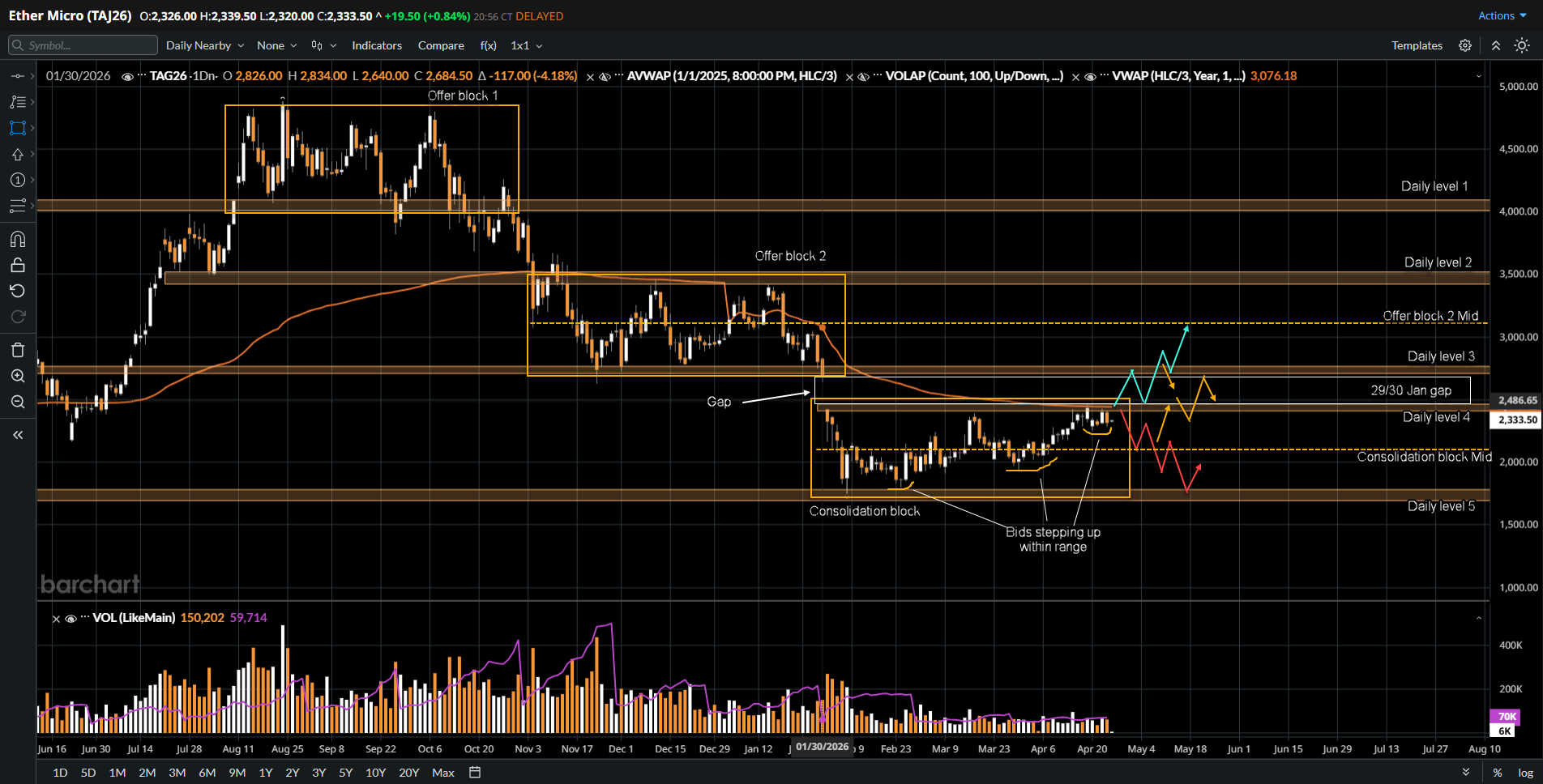
The key level to watch is 2440, which is the daily level 4 and the 2026 yearly VWAP.
Bullish Scenario
- If buyers are able to break and accept above 2440, it would signal a shift from consolidation toward expansion.
- In this case, expect a move up to the 2700 area to close the late January gap.
- If sellers do not hold at 2700, price could extend higher back into offer block 2, targeting the 3120 area, which is the midpoint of that structure, where sellers are expected to respond.
- Possible macro trigger: A credible peace agreement in the Iran conflict, formal passage of the CLARITY Act establishing regulatory clarity for digital assets, or SEC approval of staking features within Ethereum ETFs would each represent powerful demand catalysts capable of sustaining the bid through the 2440 area and beyond.
Neutral Scenario
- If buyers are able to hold the 2140 area, which is the consolidation block midpoint, or sellers defend the 2700 area, expect continued two way rotation within these two levels.
- This would likely result in price action that repairs the January 29 to 30 gap before any directional resolution.
- Possible macro trigger: A continuation of the current ceasefire-adjacent ambiguity in the Middle East, combined with a Federal Reserve that stays on hold and delays any decision on the CLARITY Act, would leave markets drifting without conviction and ETH oscillating in a directionless range.
Bearish Scenario
- If sellers are able to defend 2440, which aligns with the yearly VWAP, expect a rotation lower toward the 2140 area.
- A break below 2140 would open the door for a move through the range back toward 1750, where buyers are expected to respond again.
- Possible macro trigger: A breakdown of Iran ceasefire talks and a resumption of active conflict, a delay or failure of the CLARITY Act that reintroduces regulatory uncertainty, or a hotter-than-expected inflation print that forces the Fed to signal a hawkish stance would all represent the type of shock capable of reversing the accumulation dynamic and sending price back through the range.
Conclusion
Ethereum is at a technical and fundamental inflection point. The compression toward 2440 and the 2026 yearly VWAP reflects genuine accumulation at the range low, backed by record corporate buying from Bitmine, nine consecutive days of positive spot ETF inflows, and the Ethereum Foundation's own pivot away from selling. On the protocol side, the Glamsterdam upgrade targeting June 2026 represents the most consequential change to the network since The Merge, and history suggests the market tends to front-run these events. On the macro side, the Iran situation remains the most immediate directional trigger, and any credible de-escalation would provide the risk-on environment that ETH needs to clear 2440 and close the January gap. The 2440 level is where the next chapter gets written. Is this the coil before the break, or one more rejection in a year-long downtrend?
If you are looking for evergreen content sourced from the desks of professional traders, this is the definitive resource for your technical workflow. Combine world-class insights with a world-class platform. Open an Account today.
Disclaimer:
This article is provided for informational and educational purposes only and does not constitute financial, investment, or trading advice. The analysis presented reflects the author’s market observations and opinions at the time of writing and is not a recommendation to buy or sell any futures contract, security, or financial instrument. Futures trading involves significant risk and is not suitable for all market participants. Losses may exceed initial margin deposits, and market conditions can change rapidly.
Any scenarios, levels, or market expectations discussed are hypothetical in nature and are intended solely to illustrate potential market behavior. They do not represent actual trading results and should not be interpreted as guarantees of future performance. Past performance, market behavior, or historical price action are not indicative of future outcomes.
Readers are solely responsible for their own trading decisions and risk management. Always conduct independent research, consider your financial situation and risk tolerance, and consult with a qualified financial professional, if necessary, before engaging in futures or derivatives trading.


/Microsoft%20sign%20at%20the%20headquarters%20by%20VDB%20Photos%20via%20Shutterstock.jpg)

/Space/Cargo%20spacecraft%20in%20low-Earth%20orbit%20by%20Paopano%20via%20Shutterstock.jpg)