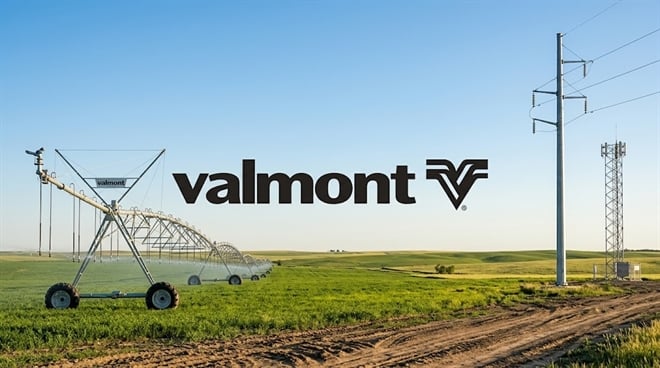
On April 21, 2026, industrial manufacturer Valmont Industries (NYSE: VMI) saw its stock rise over 12% to reach multi-year highs. The move was a direct response to a first-quarter earnings report that decisively surpassed market expectations and painted a bullish picture for Valmont Industries's future.
Valmont announced earnings per share (EPS) of $5.51, easily beating analyst consensus estimates of $4.72. Bolstered by this performance, management raised its full-year 2026 EPS guidance to a new, higher range of $21.50 to $23.50.
For investors, this solid financial result is more than just a headline number. It reveals a unique dynamic at the heart of Valmont’s current market strategy. Valmont Industries is currently firing on two distinct and powerful engines. The first is its Infrastructure segment, which is capitalizing on the growing and immediate demand created by the artificial intelligence (AI) revolution. The second is its Agriculture segment, which is quietly demonstrating incredible profitability and resilience, positioning itself for the inevitable next upcycle in the global farming sector. This dual-catalyst profile offers investors a compelling combination of high-octane near-term growth and stable, long-term value.
Forging the $1.4 Trillion Backbone of AI
The primary driver of Valmont’s stock price is the performance of its Infrastructure segment. In the first quarter, sales in the North American Utility division rose by 27.4%. This wasn't just due to higher prices; it was driven by a combination of strong production volumes and disciplined pricing power. This growth was so significant that it pushed the entire Infrastructure segment’s operating margin to 17.8%, highlighting the division's profitability.
This boom is tied directly to one of the largest macroeconomic trends of our time. U.S. utilities are embarking on a historic $1.4 trillion capital spending cycle planned through 2030. While part of this involves modernizing an aging grid, a massive driver is the urgent need to support the voracious energy appetite of new AI data centers.
AI datacenters require vast, uninterrupted power, and the current grid is simply not equipped to handle the load. Valmont is a direct beneficiary, manufacturing the mission-critical steel transmission poles and distribution structures that are the essential picks-and-shovels for this digital gold rush.
The demand is tangible and measurable in Valmont Industries' operational data. Valmont is currently working through a $1.65 billion backlog. Furthermore, lead times for its utility structures now extend out to 44 weeks. This indicates that demand is significantly outstripping industry supply, creating a favorable pricing environment that allows Valmont to pass on costs and protect its margins.
Don't Bet the Farm: Valmont's Profitable Long Game
While infrastructure provides today's explosive growth, Valmont’s Agriculture segment offers a compelling story of strategic resilience and long-term potential. A surface-level look shows that agriculture sales declined 15.1% during the quarter.
The decline was the result of temporary international disruptions in key markets like the Middle East and Brazil, combined with a cyclical period of caution among North American farmers. However, savvy investors will look past the headline sales number to a far more telling metric.
Despite the lower volume, the Agriculture segment’s operating margins actually expanded to a healthy 14.8%. This is a critical data point. It proves that Valmont possesses significant pricing power and that its strategic focus on high-tech solutions, such as precision irrigation and water management software, along with recurring aftermarket parts revenue, creates a highly profitable business even at the bottom of the cycle.
This resilience positions Valmont's agriculture business as a coiled spring. Long-term fundamentals like global population growth, climate volatility, and the critical need for water conservation make efficiency-enhancing irrigation technology an eventual necessity for farmers worldwide.
As the market leader with its iconic Valley brand, Valmont is perfectly positioned to capture this demand when the cycle inevitably turns. The segment is not just surviving a downturn; it is optimizing for profitability in preparation for the next supercycle.
A Balance Sheet as Strong as Steel
A compelling growth story is only as strong as the financial foundation it is built upon. Valmont’s management has demonstrated a clear and effective strategy for both fortifying the balance sheet and generously returning capital to shareholders. This builds a deep layer of investor confidence. Recent actions include:
Substantial Dividend Growth: Valmont Industries recently approved a 13% increase to its quarterly dividend, raising it to 77 cents per share. This signals not only current financial health but also management's confidence in future cash flows.
Aggressive Share Buybacks: During the first quarter, Valmont repurchased $57.5 million of its own stock. This action is inherently accretive, as it reduces the number of shares outstanding and directly boosts EPS.
Simultaneously, management has proven adept at navigating external risks. To mitigate the financial impact of Section 232 tariffs, Valmont Industries has proactively reconfigured its supply chain to maximize the use of U.S.-sourced steel.
This strategic move effectively de-risks a key part of its operations. This financial discipline is evident in Valmont Industries's low net leverage ratio of approximately 1.1x, giving it ample flexibility to invest in future growth or weather economic uncertainty.
2 Essential Markets, 1 Compelling Stock
Valmont Industries has successfully positioned itself at the crossroads of two essential, long-term global trends. It offers investors a rare combination of immediate, high-octane growth from the build-out of the AI-powered electrical grid, balanced by a profitable, resilient foundation in an agricultural market poised for a future resurgence.
This dual-engine approach is validated by management's own confident forecast, a raised full-year EPS guidance of $21.50 to $23.50. This bullish outlook is mirrored by market analysts, who hold a consensus Moderate Buy rating on the stock with an average price target of $487.
For investors seeking a company that is not only surviving but thriving by providing the essential building blocks for the digital and physical worlds, Valmont Industries presents a compelling case.
With its dual-engine strategy successfully bridging the gap between today’s technological requirements and tomorrow’s agricultural necessities, the manufacturer is reinforcing its position as a critical infrastructure player for the long term.
Where Should You Invest $1,000 Right Now?
Before you make your next trade, you'll want to hear this.
MarketBeat keeps track of Wall Street's top-rated and best performing research analysts and the stocks they recommend to their clients on a daily basis.
Our team has identified the five stocks that top analysts are quietly whispering to their clients to buy now before the broader market catches on... and none of the big name stocks were on the list.
They believe these five stocks are the five best companies for investors to buy now...
The article "1 Stock Is Powering the AI Boom and the Next Farm Supercycle" first appeared on MarketBeat.

/Micron%20Technology%20Inc_%20logo%20on%20building-by%20vzphotos%20vis%20iStock.jpg)