



Alcoa’s (NYSE: AA) fiscal Q1 2026 earnings left plenty to be desired, with the top and bottom lines falling short of the consensus. However, the market is looking past the weakness toward more robust times ahead.
The combination of seasonal factors in Q1, demand trends, and pricing points to accelerating growth, improving profitability and capacity for capital returns. While headwinds remain, demand trends suggest nothing but growth, with the market expected to grow 40% by 2030 and sustain a modest single-digit compound annual growth rate through 2050.
Long-term demand supports pricing, but in the near term, aluminum prices have been high due to the war in Iran. While the war is expected to end soon, the impacts and fallout will not. Not only is global shipping blocked, but key smelters in Persian Gulf nations are offline, and repairs won't happen quickly. The United Arab Emirates experienced a forced shutdown while liquid aluminum remained in the piping, leading to solidification and extensive reconstruction. The best-case scenario is that this facility comes back to production within a year, but delays are likely. The takeaway for investors is that aluminum spot prices are at four-year highs as of mid-April and not expected to fall significantly soon.
As it stands, the spot price for aluminum is surging, up more than 60% from 2025’s low and on track to hit record levels by year’s end. Analysts had forecast an oversupply at the start of 2026, but are now reversing course and raising price targets amid demand imbalances. Deficits are now cited, driven by sectors such as transportation, construction, packaging, and electrical. Within it all are data centers, which rely on aluminum for their construction and infrastructure. All told, data centers are expected to drive upward of 1 million tonnes in combined aluminum and copper demand by 2030, worth more than 130 basis points in incremental growth on its own.
Analysts Respond Favorably to Alcoa’s Q1 Report—Buy the Dip
Analysts responded favorably to Alcoa’s report, with the first update a reaffirmed rating from BMO Capital Markets. It maintained a Market Perform rating and $75 price target, calling the Q1 miss explainable and expecting Q2 results to be much better. The core of the argument is aluminum pricing, which is working in the company’s favor.
Analyst updates following the report align with trends, which include a firm consensus of Hold based on 12 ratings, a bullish bias, with 41% of ratings at Buy, and an uptrend in the price target. The consensus target lags as of mid-April but provides a floor for action in the low $60 range, having risen by more than 20% in the month preceding the report. High-end target aligns this market with record-high trading levels.
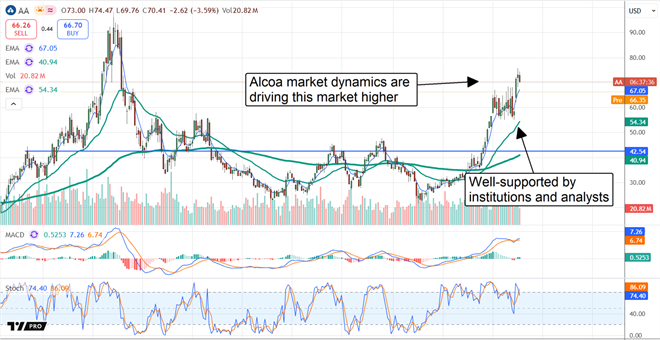
Institutions will be likely buyers when Alcoa’s price target dips. MarketBeat’s data show they own about 85% of the stock and have aggressively accumulated over the trailing 12-month period (TTM). The TTM balance is running at approximately $4 bought for each $1 sold, a robust tailwind for price action, with activity ramping in Q4 2025 and Q1 2026 to long-term highs. With this in place, investors can assume the downside is limited, with a technical floor in the $60 to $65 range coinciding with the analyst consensus target.
Alcoa Market Pulls Back to Touch Base With Reality: Higher Prices Ahead
Alcoa’s stock price fell following the Q1 release, indicating a top is in place. However, this top is likely to be a short-term hurdle, crossed by mid-year or soon after. Until then, there is a risk of a deeper pullback, but support is likely in the $60 to $65 range. A move below $60 would be bearish, but not a deal-breaker, given the early 2026 trading range and the 150-day exponential moving average. They suggest the critical support level is as low as $54.50 and that support is strengthening. In this scenario, a move into the support range will likely trigger a strong market response; the only question is how deep the market will take the price before committing to the trade.
Catalysts for Alcoa include the restart of critical elements. The company’s Q1 results were impacted by seasonally expected shutdowns and the restart of its San Ciprián facility. The facility is not expected to become cash flow neutral until 2027, but it is expected to reduce aluminum production costs across the network, positively impacting results in 2026. The biggest risk for investors is Alcoa’s high beta. A beta above one indicates higher than normal market volatility; Alcoa’s beta is 1.7.
Where Should You Invest $1,000 Right Now?
Before you make your next trade, you'll want to hear this.
MarketBeat keeps track of Wall Street's top-rated and best performing research analysts and the stocks they recommend to their clients on a daily basis.
Our team has identified the five stocks that top analysts are quietly whispering to their clients to buy now before the broader market catches on... and none of the big name stocks were on the list.
They believe these five stocks are the five best companies for investors to buy now...
The article "Alcoa Dips After Q1 Miss, But Higher Aluminum Prices Loom" first appeared on MarketBeat.

/Advanced%20Micro%20Devices%20Inc_%20logo%20on%20phone%20and%20website-by%20T_Schneider%20via%20Shutterstock.jpg)
/Intel%20Corp_%20badge%20holder-by%20hasrul_rais%20via%20Shutterstock.jpg)
/Palantir%20by%20Hiroshi-Mori-Stock%20via%20Shutterstock.jpg)
/Dell%20Technologies%20by%20Poetra_RH%20via%20Shutterstock.jpg)
/AI%20(artificial%20intelligence)/AI%20engineer%20working%20on%20laptop%20by%20ART%20STOCK%20CREATIVE%20via%20Shutterstock.jpg)