




Pound in the Crossfire: What's Driving Cable Right Now
Sentiment on Cable has been pulled in multiple directions throughout 2025 and into 2026, with the pair's moves largely a reflection of US dollar dynamics rather than outright sterling strength. The dollar fell roughly 10% in 2025, its worst annual performance since 1979, which provided the primary tailwind for GBP/USD's 6.5% gain over the same period. Heading into 2026, that tailwind has become less reliable, and pound-specific fundamentals have come back into focus.
On the UK side, the Bank of England cut rates by 25 basis points to 3.75% at its January 2026 meeting, continuing a gradual easing cycle that began in 2024. Markets had been pricing in further cuts through 2026, though more recent UK inflation data showing consumer prices rising at 3.2% annually in March has shifted expectations toward a more cautious, and potentially hawkish, BoE stance. Meanwhile, UK Q1 2026 GDP growth surprised to the upside at 0.5%, lending some additional support to sterling. Chancellor Rachel Reeves has attempted to manage gilt market concerns through a degree of fiscal restraint, though the broader fiscal picture remains fragile and political risk under Prime Minister Keir Starmer continues to be flagged by analysts as a latent downside risk for the pound.
On the macro and geopolitical front, two developments have been central to recent price action. First, the fragile US-Iran ceasefire and Tehran's ongoing blockade of the Strait of Hormuz has kept energy markets elevated, stoking UK inflation fears and prompting markets to price in a more hawkish BoE posture. Second, and more impactful to the most recent leg higher, has been developing optimism around a potential Russia-Ukraine peace deal. A top aide to Ukrainian President Zelenskyy indicated that Kyiv is close to reaching an agreement with Russia, while Russia announced a 32-hour Easter ceasefire, providing a meaningful boost to risk sentiment across European currencies. The dollar has come under selling pressure in recent sessions, though this move is driven by geopolitical relief and risk-on sentiment rather than Fed easing expectations. Markets have sharply repriced the Fed rate cut outlook, with futures now implying at most one cut in 2026, down from two priced at the start of the year, and a roughly 48% probability of no cut at all this year, as spiking oil prices from Tehran's Strait of Hormuz blockade have kept the Fed firmly on hold. Near-term dollar softness is therefore a sentiment and risk-appetite trade rather than a rate differential story, keeping Cable's path of least resistance two-sided with a mild upward tilt in the near term.
What has the market done?
- The market has been sideways in a large consolidation range since May 2025 between 1.38 as daily resistance and the 1.32 area as daily support, establishing a well-defined balance area.
- Sellers attempted a breakdown below 1.32 in November 2025, but the move failed as buyers absorbed the supply, which coincided with improving United Kingdom growth data and a temporary pullback in the United States dollar, leading to a rotation back into the range.
- In mid-January 2026, the market rallied strongly with six consecutive sessions of one time frame up, driven in part by a repricing of Bank of England expectations after inflation data showed a sharper than expected decline, which reinforced a soft landing narrative and, alongside a pullback in US yields, supported a short covering rally in sterling, alongside a brief weakening in the dollar as Treasury yields pulled back. This led to a probe above the consolidation range into late January, but the breakout failed to find acceptance.
- Following the failed breakout, sellers regained control and drove prices lower in a block step manner, stepping down offers as the dollar strengthened on the back of resilient United States economic data, resulting in a rotation back toward the 1.32 daily support.
- Since March, the market has transitioned into a tighter consolidation phase, rotating between 1.345 (daily level 2) and the 1.32, daily support area, forming the current consolidation block.
- More recently, buyers have stepped in aggressively and bid prices higher through the block, supported by a combination of geopolitical relief following the US-Iran ceasefire and developing optimism around a Russia-Ukraine peace framework, which lifted risk sentiment broadly and weighed on the dollar, allowing buyers to rotate Cable higher through the consolidation block.
What to expect in the coming week(s)?
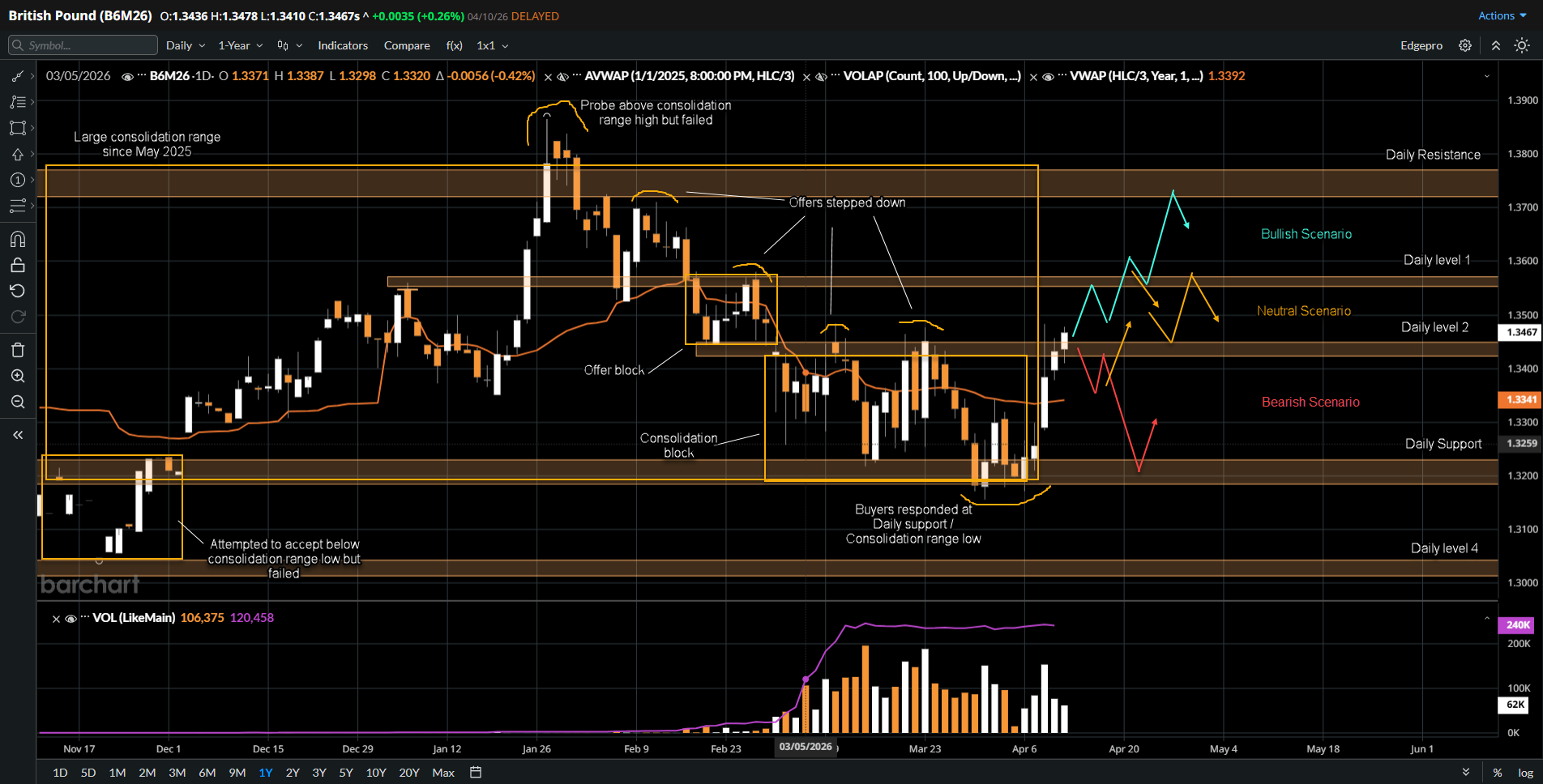
The 1.345 area (Daily Level 2) is the key level to watch.
Bullish Scenario
- If sellers are unable to hold offers at the 1.345 area, expect a move up through the offer block toward 1.356 (Daily Level 1).
- A resolution or meaningful de-escalation of the US-Iran conflict, including a credible reopening of the Strait of Hormuz, would pull oil prices sharply lower, ease inflation fears, and reopen the door to Fed cut expectations, weakening the dollar and providing the fundamental fuel for buyers to sustain pressure above 1.345.
- If sellers are unable to defend 1.356 (Daily Level 1), expect further upside extension back toward 1.38 (daily resistance), completing a full rotation back to the top of the broader consolidation range.
Neutral Scenario
- If sellers are able to step in and defend at 1.356 (Daily Level 1), expect rotation back down toward 1.345 (Daily Level 2) where buyers are expected to respond and establish two-way rotation.
- If markets attempt lower but buyers defend at 1.334 (2026 VWAP), expect rotation back up above 1.345 for continued two-way activity within the block.
- A possible scenario is one where the US-Iran ceasefire holds tenuously but talks fail to produce a durable agreement, keeping the market in a holding pattern. With oil prices elevated but not spiking further, both the Fed and BoE remain in wait-and-see mode, leaving Cable in two-way rotation.
Bearish Scenario
- If sellers are able to hold offers at 1.345 (Daily Level 2) and prevent buyers from establishing above this level, expect a rotation back down through the consolidation block toward 1.32 area (daily support), where buyers are expected to respond.
- A possible scenario is the re-escalation of the US-Iran conflict, whether through a breakdown of the ceasefire, further Iranian aggression in the Strait of Hormuz, or a broadening of the Middle East conflict involving Israel and Lebanon, would drive oil prices higher, entrench the Fed's on-hold stance, revive safe-haven dollar demand, and provide sellers the macro weight to drive price back down through the range.
Conclusion
Cable sits at a technically and fundamentally pivotal juncture. The longer-term range between 1.32 and 1.38 remains fully intact, and the current buyer response off 1.32 support has brought price back to the 1.345 area where sellers have previously held their ground. The structure of the consolidation block formed since March makes the response at this level meaningful, as acceptance above it opens the door toward 1.356 and ultimately 1.38, while a rejection keeps the broader range in play to the downside. On the macro front, the picture is unusually complex. The Fed is on hold with a hawkish tilt, as spiking oil prices from Tehran's Strait of Hormuz blockade have effectively closed the window on near-term easing, with futures now implying a roughly 48% probability of no cut at all in 2026. The BoE faces its own inflation challenge, with UK CPI running at 3.2% annually in March and Q1 GDP surprising to the upside, shifting market expectations in a more hawkish direction. Should the US-Iran ceasefire hold tenuously but talks fail to produce a durable agreement, oil prices remain elevated but do not spike further, leaving both central banks in wait-and-see mode and Cable caught in two-way rotation. With so many live variables in play, traders would do well to let the 1.345 level speak first before committing to a directional bias.
We believe that professional growth is impossible without the truth found in your own data. Our presence on Barchart bridges the gap between complex exchange data and professional execution. Open an Account and access the tools you need to see your performance clearly.
Disclaimer:
This article is provided for informational and educational purposes only and does not constitute financial, investment, or trading advice. The analysis presented reflects the author’s market observations and opinions at the time of writing and is not a recommendation to buy or sell any futures contract, security, or financial instrument. Futures trading involves significant risk and is not suitable for all market participants. Losses may exceed initial margin deposits, and market conditions can change rapidly.
Any scenarios, levels, or market expectations discussed are hypothetical in nature and are intended solely to illustrate potential market behavior. They do not represent actual trading results and should not be interpreted as guarantees of future performance. Past performance, market behavior, or historical price action are not indicative of future outcomes.
Readers are solely responsible for their own trading decisions and risk management. Always conduct independent research, consider your financial situation and risk tolerance, and consult with a qualified financial professional, if necessary, before engaging in futures or derivatives trading.


/A%20corporate%20sign%20for%20SK%20Hynix%20by%20Tada%20Images%20via%20Adobe%20Stock.jpeg)

/2d%20illustration%20of%20Cloud%20computing%20by%20Blackboard%20via%20Shutterstock.jpg)
/Server%20racks%20by%20dotshock%20via%20Shutterstock.jpg)