



KB Home (NYSE: KBH) is a high-quality stock that can return significant capital to its investors. However, a combination of factors suggests that Q2 2026 isn’t the best time to buy this construction stock; rather, it's best to watch it and see what happens. What is expected is continued revenue and earnings contraction, though contraction could cease by year’s end.
KB Homes may be near its price bottom as March comes to an end; however, there is a significant chance of Q2 weakness and the stock price moving even lower.
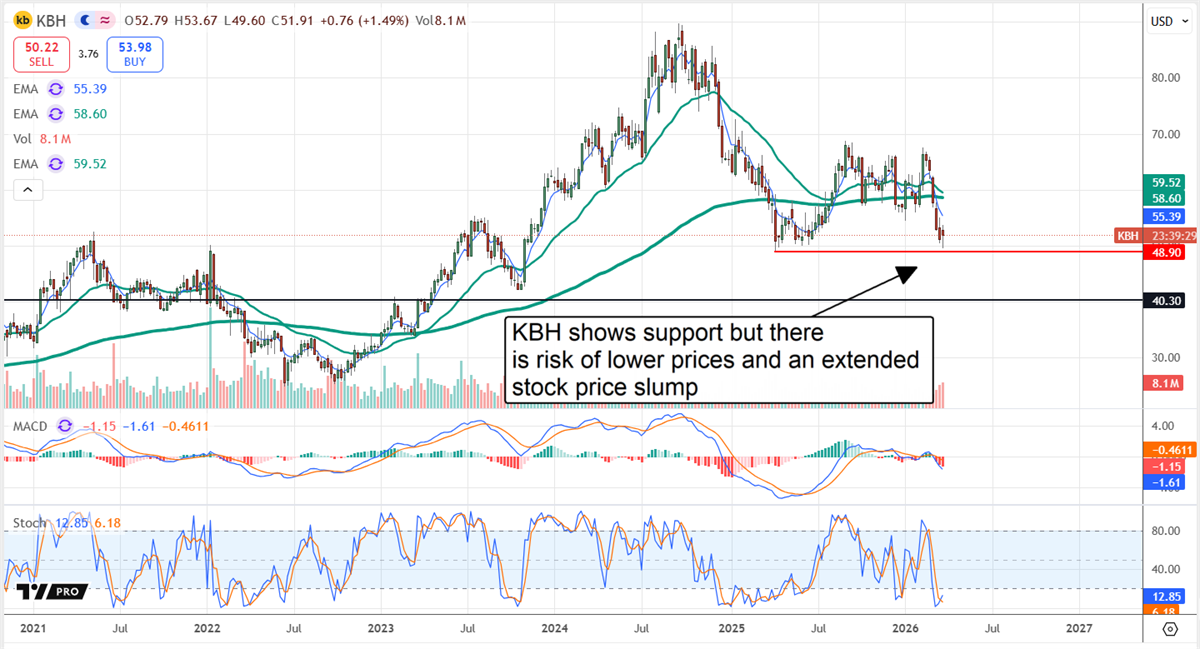
The critical support level is near the 2025 lows at $48.90. This level has been supporting the market since Q2 2025 and is in jeopardy of collapsing. The stochastic and MACD indicators reflect weakened market conditions and susceptibility to decline, while the cluster of exponential moving averages is on the verge of a Death Cross.
The Death Cross is the opposite of a Golden Crossover, occurring when short-term EMAs cross under a longer-term EMA, signalling a bearish shift in market dynamics. The Death Cross often precedes major market sell-offs and could send this stock to the low end of its long-term range near $25.
Weak Results Signal Risk for KBH Capital Returns
KB Home struggled in fiscal Q1 2026, with revenue of $1.07 billion down approximately 23% year over year (YOY). Weakness was seen not only in the decline, but also in the underperformance, which topped 180 basis points (bps). The decline is caused by a 14% reduction in deliveries and lower prices, with forward-looking metrics indicating the weakness will continue. The company’s backlog is down by double digits in value and home count.
Margin news was also poor. The company experienced margin pressure at all levels, with costs rising and revenue deleveraging. The net impact was 52 cents in GAAP earnings, 2 cents shy of MarketBeat’s reported consensus, down approximately 65% YOY and compounded by weakened guidance.
Guidance was as poor as the Q1 results, with the company forecasting a nearly 24% contraction, accelerating its decline sequentially, and falling short of the consensus estimate. The only good news is that the margin is expected to hold steady, but even that isn’t that great. The critical takeaway is that margin compression and sales declines cut deeply into earnings power, leaving capital returns in jeopardy.
The capital return is significant as it underpins the stock price action. Returns include a dividend and share buybacks, which reduced the Q1 count by an average of 12.7% YOY. The problem is that cash flow is insufficient to cover the payments, leaving the company to lean on its cash pile. The cash pile is sufficient to sustain returns but not indefinitely, and the buybacks are already slowing. The Q1 pace is down 75% YOY, and the Q2 forecasts suggest the same for the current quarter. Looking forward, the pace of buybacks may slow to nil before the company reverts to growth and has the capacity to resume.
Analysts, Institutions, and Short-Sellers Present Headwinds for Investors
Analysts, institutions, and short-sellers, the three groups that investors need on their side, are not bullish on this stock. The analyst coverage remains firm, but the consensus rating has slipped to Hold, and the price targets are falling.
The existing low target of $25 suggests a price floor is in place, but it’s not firm. All it will take is another string of downgrades or price target reductions to send this market through the floor to lower lows, and there doesn’t appear to be anyone willing to buy.
Institutions, which own about 97% of this stock, have sold on a trailing 12-month basis and ramped their activity in Q1, capping gains and sending the market to long-term lows. There is no incentive for them to accumulate in the Q1 results or guidance update. Meanwhile, short interest is off its highs but remains elevated near 10%. It represents an overhang that may strengthen, given the weakened outlook and potential for underperformance. In this scenario, the KBH market is distributing shares and is likely to continue doing so.
The catalyst for higher prices is the built-to-order strategy. The company is working to reduce dependence on walk-in sales and build mostly as needed. The move is amplifying near-term weakness, but sets the company to return to growth in 2027 with stronger margins.
Where Should You Invest $1,000 Right Now?
Before you make your next trade, you'll want to hear this.
MarketBeat keeps track of Wall Street's top-rated and best performing research analysts and the stocks they recommend to their clients on a daily basis.
Our team has identified the five stocks that top analysts are quietly whispering to their clients to buy now before the broader market catches on... and none of the big name stocks were on the list.
They believe these five stocks are the five best companies for investors to buy now...
The article "KB Home's Earnings Slump Puts Dividends and Buybacks at Risk" first appeared on MarketBeat.

/Micron%20Technology%20Inc_billboard-by%20Poetra_RH%20via%20Shutterstock.jpg)

/Netflix%20open%20on%20tablet%20by%20rswebsols%20via%20Pixabay.jpg)
/Tesla%20Inc%20logo%20by-%20baileystock%20via%20iStock(1).jpg)