



Despite a drop of around 2% in the five trading days ending March 26, Palantir Technologies Inc. (NASDAQ: PLTR) stock is up over 8.5% since closing at a low of around $128 in late February.
Although the sell-off was broad-based across the tech sector, it renewed questions about Palantir's lofty valuation.
The ongoing conflict with Iran is a key reason for the reversal. No matter what investors think about Palantir, any military action by the United States is a showcase for Palantir, particularly in the age of artificial intelligence (AI).
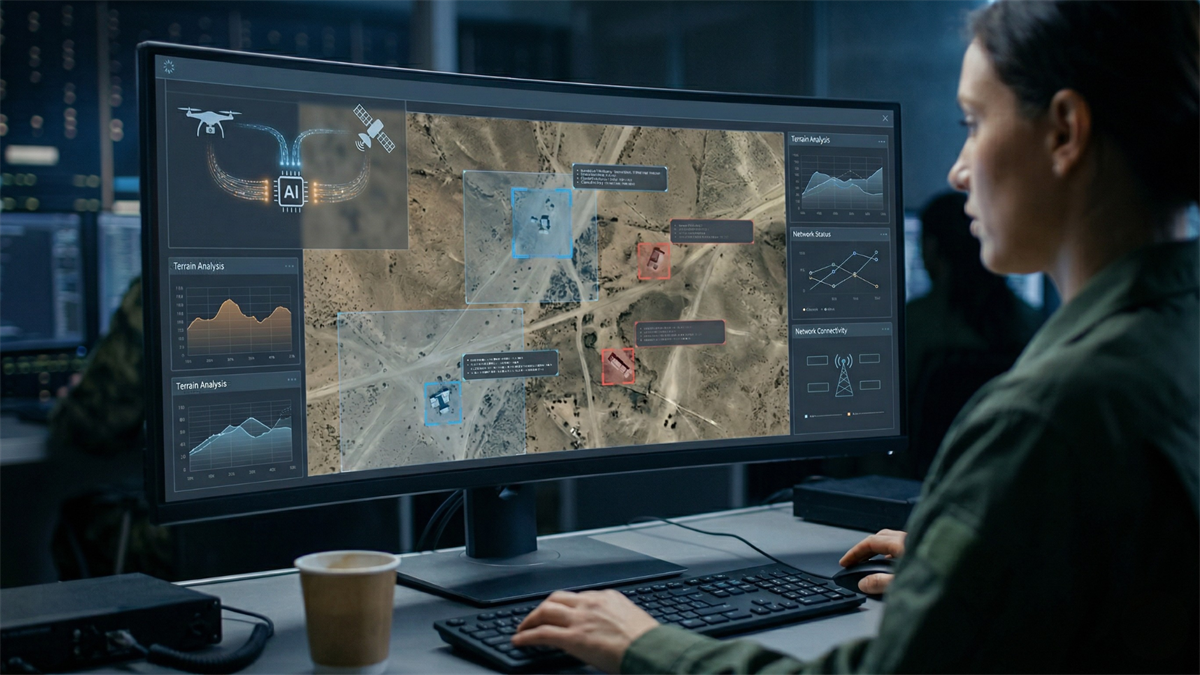
The product at the center of that attention is Maven. Originally launched as a Pentagon initiative to apply AI to the intelligence process, Maven has evolved into an operational platform that helps military teams sort through large volumes of data, fuse inputs from multiple sources, and turn that information into actionable workflows for tracking and targeting.
Operation Epic Fury, which began Feb. 28, offered a live demonstration of Maven's capabilities, with reports indicating the platform helped process 1,000 targets within the first 24 hours of operations.
That kind of high-profile validation matters on its own, but it also arrived alongside a more durable catalyst: On March 9, the U.S. Department of Defense designated Palantir’s Maven Smart System as a program of record across the military services. That formal step typically signals institutional adoption and a more durable funding path. The designation is expected to take effect by September 2026.
A frequently leveled criticism about Palantir is that the company is too dependent on U.S. government revenue, particularly from the military. The argument has some merit, since that revenue is typically tied to contracts that come up for renewal. If those contracts aren’t renewed, it could, in theory, pull the rug out from under millions in annual revenue and potentially billions in forecasted revenue.
The Maven announcement turns that revenue into a long-term funding structure. But, with a stock that trades at over 80x sales, this announcement doesn’t remove all concerns. In fact, it doesn’t even change the math.
But it may change the way investors think about that math. And for a company that posted 55% U.S. government revenue growth in 2025 (to $1.855 billion), the structural underpinning of that growth just got significantly more durable.
Maven’s Expansion Was Already Underway
Current Palantir shareholders are familiar with Project Maven, but this news may pique the interest of those looking on from the sidelines. Project Maven launched in 2017 as a way for the Pentagon to use AI to help analysts process massive volumes of surveillance imagery and video.
Since then, it’s evolved into a broad military intelligence and targeting platform by fusing data from satellites, drones, and ground sensors to identify objects, assess threats, and support operational decisions in real time. Plus, NATO formalized its own Maven adoption in March 2025, making Palantir's platform a trans-Atlantic standard, not just an American one.
The latest announcement about Maven isn’t a complete surprise; the program’s (and Palantir’s) footprint has expanded in the last four years through a series of escalating awards:
- The U.S. Army inked an initial $480 million, five-year Indefinitely Delivered, Indefinitely Quantity (IDIQ) contract with Palantir in May 2024.
- In May 2025, the Pentagon leaders boosted the existing contract ceiling by $795 million on the expectation that there would be a significant influx in demand from military users over the next four years.
- In 2025, the Army also awarded Palantir an enterprise agreement—that could be worth up to $10 billion over a decade—aimed at consolidating data and software systems across the service.
All told, recent reporting has described combined contract ceilings and framework capacity around Maven-related work as reaching roughly $13 billion from the initial $480 million award.
The Details Matter, but the Bull Case Remains
Since critics like to highlight all the “yeah buts” about Palantir, it’s important to bring up one “yeah but” about the company’s future revenue from the Maven program: the company isn’t guaranteed to get all $13 billion.
That amount is considered IDIQ. The government doesn’t have to spend that much, but they have pre-authorization to spend it. And if the Pentagon gets that approval, it has a strong incentive to spend it.
Nevertheless, it’s fair to say that while the revenue from Maven has an annuity-like impact on Palantir’s top line (and bottom line, for that matter), the amount the company receives from year to year may be lumpy.
A Wide Moat to Counter a Lofty Valuation
The most significant takeaway for investors is that it widens the company’s already large moat.
For example, the Maven deal with the U.S. Army alone consolidates 75 separate contracts into one. If the cost of switching was expensive before, it’s become enormous now.
Furthermore, the Maven program has grown from 5,000 to 20,000 active users. This adds more context to the procurement process. Government contracts are renewed and expanded based on adoption. With 20,000 active users, Palantir’s users make the case for adoption better than the company ever could. That kind of embedded, daily reliance is what transforms a vendor relationship into infrastructure, which doesn't get cut from the budget.
Where Should You Invest $1,000 Right Now?
Before you make your next trade, you'll want to hear this.
MarketBeat keeps track of Wall Street's top-rated and best performing research analysts and the stocks they recommend to their clients on a daily basis.
Our team has identified the five stocks that top analysts are quietly whispering to their clients to buy now before the broader market catches on... and none of the big name stocks were on the list.
They believe these five stocks are the five best companies for investors to buy now...
The article "How Maven Turns Palantir's Biggest Risk Into Its Biggest Strength" first appeared on MarketBeat.


/Micron%20Technology%20Inc_billboard-by%20Poetra_RH%20via%20Shutterstock.jpg)

/Netflix%20open%20on%20tablet%20by%20rswebsols%20via%20Pixabay.jpg)
/AI%20(artificial%20intelligence)/AI%20by%20TierneyMJ%20via%20Shutterstock.jpg)