
Adobe (ADBE) is due to report earnings next Thursday after the closing bell. The Barchart Technical Opinion rating is a 72% Sell with a Weakening short term outlook on maintaining the current direction. Long term indicators fully support a continuation of the trend.
ADBE rates as a Strong Buy according to 17 analysts with 1 Moderate Buy and 3 Hold ratings. Implied volatility is 43.92% which gives ADBE and IV Percentile of 75% and an IV Rank of 62.54%
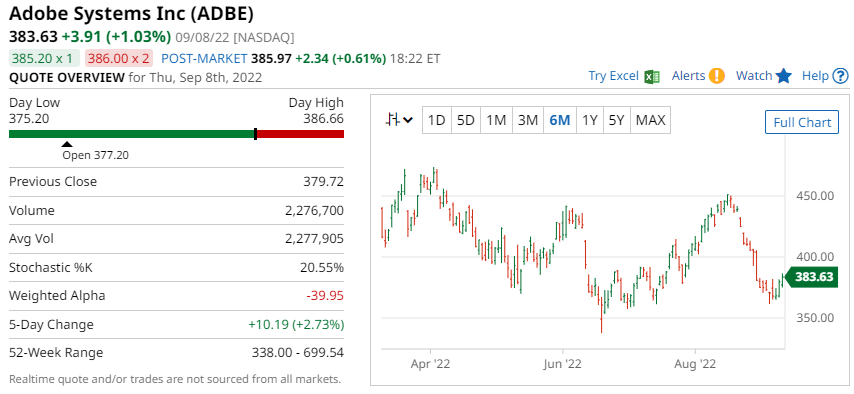
Today, we will analyze three different ideas:
- A Short Iron Condor
- A Bull Put Spread
- A Butterfly Spread
Short Iron Condor
The first strategy is a short iron condor. An iron condor aims to profit from a drop in implied volatility, with the stock staying within an expected range.
When implied volatility is high, the wider the expected range becomes. Adobe’s IV Rank is slightly lower than 50%, but an Iron Condor could still work if the stock doesn’t move much after earnings.
The maximum profit for an iron condor is limited to the premium received while the maximum potential loss is also capped. To calculate the maximum loss, take the difference in the strike prices of the long and short options, and subtract the premium received.
Using the September 16 expiration, traders could sell the 350-strike put and buy the 345-strike put. Then on the calls, sell the 420 call and buy the 425 call.
Yesterday, that condor was trading around $1.25 which means the trader would receive $125 into their account. The maximum risk is $375 for a total profit potential of 33%.
The profit zone ranges between 148.80 and 163.7. This can be calculated by taking the short strikes and adding or subtracting the premium received.
Let’s take a look at another potential option strategy.
Bull Put Spread
Traders thinking that ADBE might continue with its bullish bias could just trade the bull put spread side of the iron condor.
Trading just the bull put spread side would involve selling the September 16th 350 put and buying the 345 put. This spread could be sold yesterday for around $0.72 or $72 in total premium.
The maximum gain is $72 with total risk of $428 for a potential return of 16.82% with a breakeven price of 344.28.
The final idea we will look at is a butterfly spread.
Butterfly Spread
A butterfly spread is constructed by buying an in-the-money call, selling two at-the-money calls and buying an out-of-the-money call. The trade is entered for a net debit meaning the trader pays to enter the trade. This debit is also the maximum possible loss.
The maximum profit is calculated as the difference between the short and long calls less the premium that you paid for the spread.
Using the September 16 expiry, traders could buy the 370 strike call, sell two of the 385 strike calls and buy one of the 400 strike calls. The cost for the trade would be $230 which is the most the trade could lose. The maximum potential gain is $1,230 which would occur if ADBE finished right at 385 at expiration.
Conclusion And Risk Management
There you have three different trade ideas for Adobe’s earnings. All three are risk defined trades, so you always know the worst-case scenario even if ADBE makes a bigger than expected move.
Short-term trades over earnings such as these ones are almost impossible to adjust. Either the trade works, or it doesn’t so position sizing is vital. Short strangles involve naked options and should be avoided by beginner traders.
Short-term trades also have assignment risk, so traders need to be aware of that possibility.
Please remember that options are risky, and investors can lose 100% of their investment.
This article is for education purposes only and not a trade recommendation. Remember to always do your own due diligence and consult your financial advisor before making any investment decisions.
*Disclaimer: On the date of publication, Gavin McMaster did not have (either directly or indirectly) any positions in any of the securities mentioned in this article. All information and data in this article is solely for informational purposes. Data as of after-hours, September 8, 2022.
More Stock Market News from Barchart



/Intel%20Corp_%20logo%20on%20mobile%20phone-by%20Piotr%20Swat%20via%20Shutterstock.jpg)
/Amazon%20pickup%20%26%20returns%20building%20by%20Bryan%20Angelo%20via%20Unsplash.jpg)