



3 Options Trading Mistakes That Wipe Out Accounts
Ask 100 options traders if they're successful - I'm sure you'll find many have blown up their accounts, at least at one point, all for one simple reason. They think they understand options, but don't understand how they work.
If you've ever wondered why you haven't been as successful as you'd like, you're not alone. Options are simple on the internet, but then, you realize every move you make comes with math, charting, and some risk you didn't think about when you entered the trade.
So, with options trading volume exploding, and retail investors treating it like gambling, is your strategy built to survive the stock market's volatility we've experienced over the past few years? I ask because the data says most people aren't even close. And that's exactly what I'm covering today.
In this article, I'll show you the three most common mistakes almost every new options trader makes, and a feature we have here at Barchart that almost no one pays attention to. It's something that could completely change how you trade, and your chances of success.
If you want to avoid the mistakes that wipe out most new traders, stay with me. This is going to save you years of pain.
Failing To Understand Options Mechanics
One of the biggest mistakes new options traders make is, funny enough, one of the easiest to fix. It's not knowing the full story when trading options.
If you're here, you probably know that options are contracts that let you buy and sell shares at specific prices, on or before a specific date. But what most of us miss is how to trade these options to make money.
Long and short options are pretty basic - buying and selling contracts that serve as directional bets. Each strategy comes with its own set of risks.
But then you expand to more complex option strategies like spreads, condors, and diagonals, and then you realize - wait a minute, maybe you don't entirely know what they are, and most especially, when to use them.
And that's the thing. The market offers us options traders an unlimited number of opportunities. For many, the only thing keeping them from taking advantage of these opportunities is knowing what strategy to use.
Thankfully, Barchart can be a tremendous help. We've got tons of material dedicated to options trading, including its mechanics, various strategies, key metrics, and more.
Prefer reading up on a particular strategy? Head on over to our Options Learning Center, where we cover practically every options trading strategy under the sun, each with examples for a better understanding.
Of course, we've also got a ton of other videos on our YouTube channel.
Not Setting Proper Expectations
Now, let's say you learned about all your available option strategies. You know when to use a bull call spread, how to maximize your income with cash-secured puts while keeping your assignment risk low, and you learned about the iron condor.
Then, you go to different forums, comment sections, and subreddits, and you see traders making thousands of dollars on their options trade. And you think to yourself - I'll get exactly the same results with my trading.
But then months pass, and you're barely keeping your head above water.
If that's you, you just stumbled into the second biggest mistake new option traders make: not setting proper expectations.
Yes, option trading allows you the kind of leverage that you simply cannot beat when just trading stocks. Imagine paying for a fraction of the cost of 100 shares and yet getting almost the same exposure as owning the stock.
But like with everything else, high rewards come with high risk. Remember, leverage cuts both ways. When it works, you're a genius. When it doesn't, well, we go silent.
Aside from that, if you set your mind to chasing hundred-plus percent returns in your first outing, well, you'll be forced to take unnecessary risks.
So how do you avoid this?
Well, Barchart has several forward-facing tools that can help you succeed - the first time.
Every strategy-specific screener includes a probability metric - either profit or loss. Certain multi-legged strategies like spreads, condors, and butterflies come with risk/reward ratios.
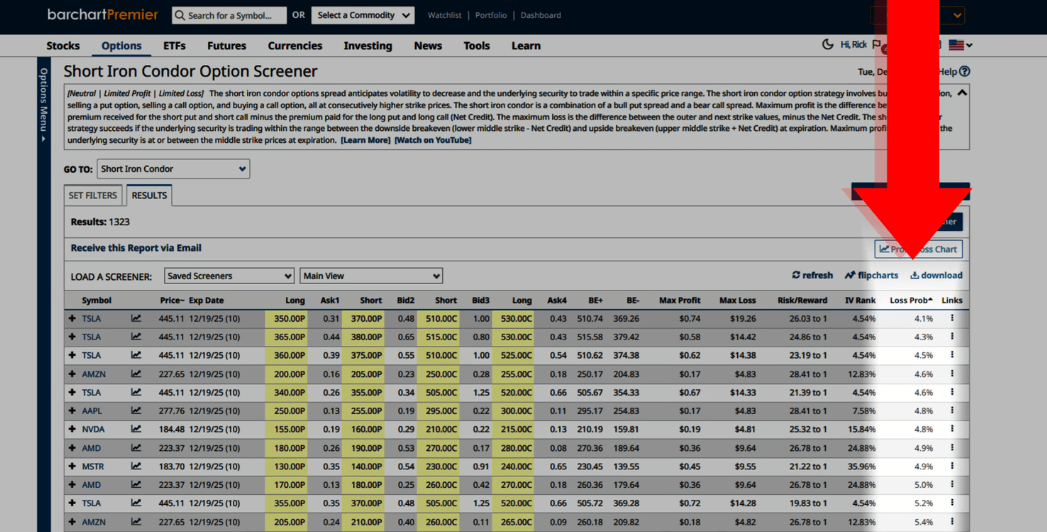
Want stock-level metrics? Easy. We have analyst ratings, which you can access directly from the stock's profile page.
There's also Barchart's proprietary technical opinion, right here on the right side of the profile page, which combines over a dozen popular technical indicators to provide an easy-to-understand rating.
Want more? Check out the trader's cheat sheet to identify key levels and price hotspots.
And if you prefer a more hands-on approach, Barchart's interactive chart allows you to plug in whatever indicator you need to do your analysis.
Together, these metrics can help you establish exactly what type of trade you're getting into before you even start.
Trading Without a Plan/Emotional Trading
Speaking of managing and adjusting your position, let's talk about one of the most important aspects of trading: planning.
Without a clear plan, you're just… gambling. Entering trades “just to try it out”, without a solid goal, strict boundaries, or anything resembling a well-crafted strategy.
Planning goes well beyond figuring out if you're speculating, hedging, or looking to generate a steady income. You need to know the options you want to trade, the strike prices you choose, the expiration dates you want, and the levels at which you cut your losses or take your profits - way before you press buy or close to open.
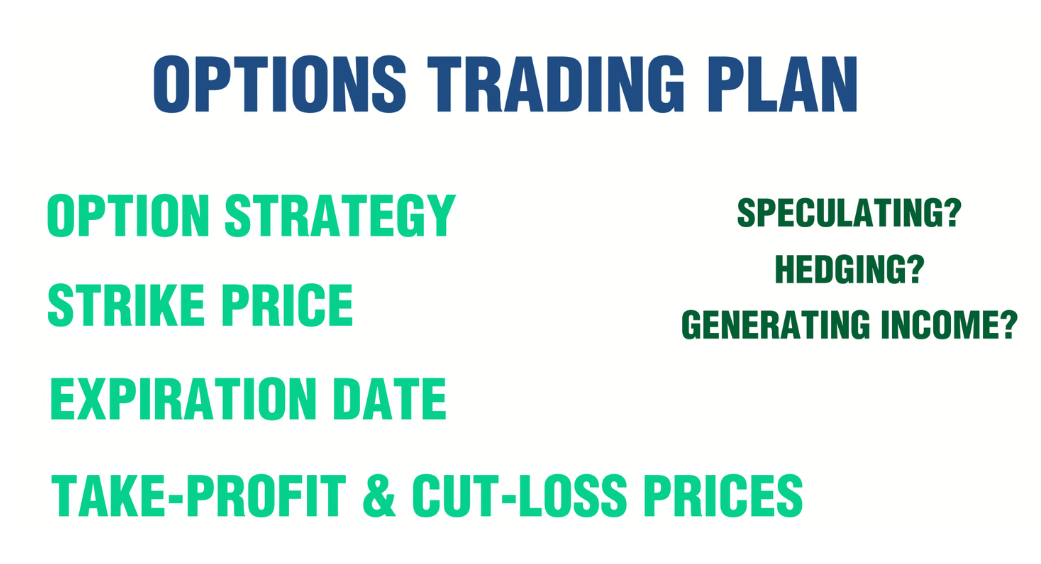
For new traders, this can be a lot to take in. So let's break it down into manageable pieces.
Trading Goal
First, ask yourself, why are you trading options? Are you looking for high returns or consistent income? Defining your target narrows down the strategies to the most effective ones, relative to your goal.
Let's say, for example, you want income.
That leaves the covered calls, cash-secured puts, credit spreads, short condors, straddles, and strangles.
Say you want to generate income while waiting to buy Nvidia stock at a lower price?
Cash-secured put is the strategy for you. It's a strategy that involves selling a put option on an underlying asset to earn a premium while setting aside enough capital to buy the shares should you get assigned.
Selling cash-secured puts can be a clever way to earn additional income in bullish markets. Should the underlying security trade below the strike at expiration, you'll purchase the underlying at a discount to the price at which the trade was initially opened. And that's the part most newer traders overlook: you're not just selling puts for premium, you're also naming your preferred entry price.
If we jump over to Barchart.com and to the stock's naked put screener.
Strike Price & Expiration Date Selection
Next, select a strike price and expiration date. The expiration date is typically based on your trading preferences, but 30-45 days is often the sweet spot. So let's change the expiration date to January 16, 2026, 41 days from now.
Barchart has a few tools to help you identify the best strike prices. First is the expected move, found here in the P&L charts.
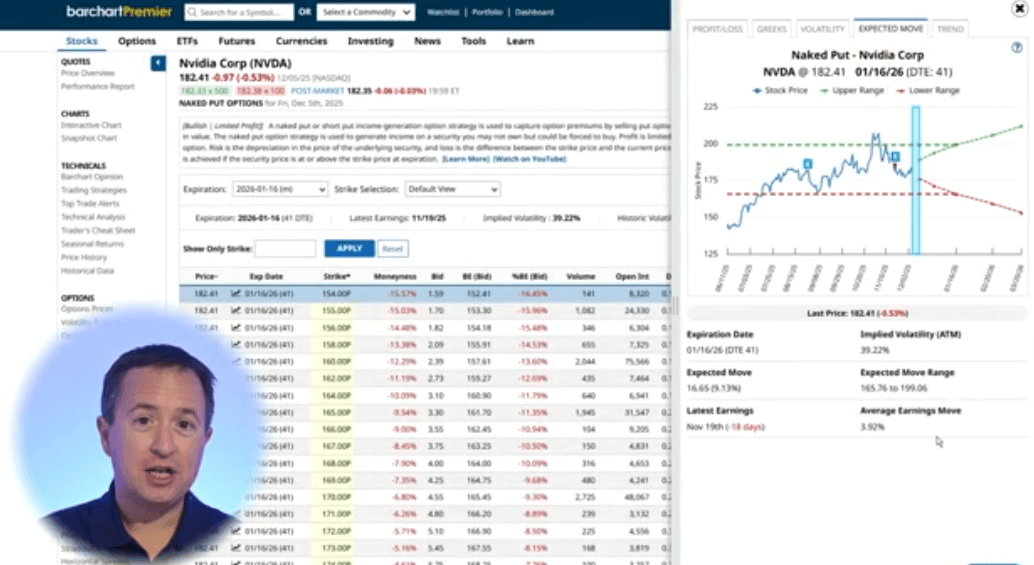
This feature projects the range where a stock is likely to trade by your selected expiration date. It's based on 85% of the price of the at-the-money straddle, and that range is automatically calculated and displayed both as a price range and a percentage move, so put your calculator away.
For selling puts, you can use the lower end of the range as a guide, which, in this case, is around $166.
If you want to further reduce assignment risk, you can pick an expiration below $166, though the trade-off here is that premiums will decline with the strike prices.
If you want to increase your chances of assignment, say you're happy to buy the Nvidia, you can set it above $166.
And if you want even odds, like 50/50, just set it at $166.
According to the screener, this 166-strike short put results in a $3.55 net credit per share or $355 total, with a 79% chance of profit. And if you get assigned, you get to buy Nvidia at an 11% discount based on its current trading price.
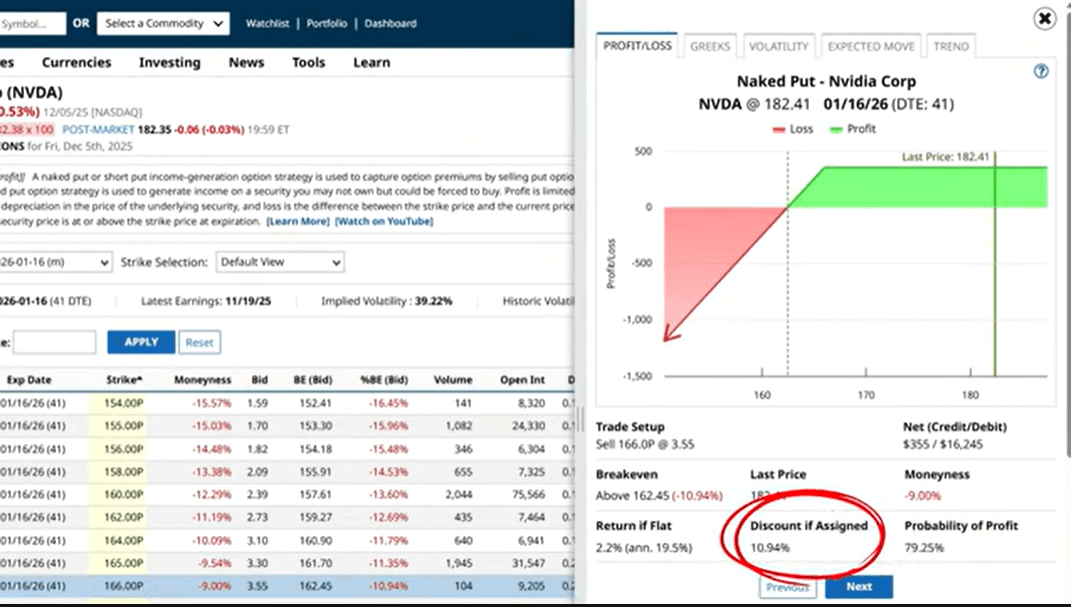
Not bad at all.
Avoiding Shorter-Dated Options
When you sell options, you receive the premium and the obligation to fulfill whatever the contract specifies if the buyer exercises, which is called assignment- at least from the seller's point of view.
If you sold a call, you need to sell 100 shares of the underlying stock if you're assigned. If you sold a put, you buy 100 shares.
And remember, these options contracts are time-bound, meaning they end at the expiration date.
So, a lot of new traders think, "Wouldn't my risk be lower if I just sell options that expire soon, like one or zero-day trades?"
And on the surface, it's not a bad idea. Short-dated options wouldn't leave much room for the stock to move against you, right?
Well… yes. But it wouldn't give you much room to react, either.
Think of it this way: when you sell short-dated options, you don't avoid the risk; you just compress it.
That means you undertake the same amount of dollar risk, but with a much shorter time frame.
And if you want to see just how this works, well, look no further than the options Greek: gamma.
Gamma measures how quickly an option's delta changes when the underlying stock price moves.
Delta tells you how much the option price should move for every $1 change in the stock price. Gamma tells you how much delta itself will change as the stock moves.
So if delta is the speed, gamma is the acceleration.
But why does that matter?
Well, as expiration gets closer, gamma gets bigger, especially if the stock is trading near the strike. And with short-dated options, most of the remaining premium is concentrated near the money, which makes those near-the-money options the only ones worth selling.
Even a slight change in the stock price can cause big jumps in delta. And when delta jumps, the option's price can move dramatically, which can turn your small risk into a potentially larger loss.
The good thing is, Barchart gives you access to gamma, delta, all other options Greeks.
By the way, if you want to know more about the options Greeks in detail, check this video here.
But Greeks alone won't make you a successful trader, Other features I want to show you are our P&L graphs.
You can access them by going into any option screener and clicking the P&L Graph here, or the P&L icon beside the days to expiration.
Here, you can check your trade details, review the Greeks before and during the trade, check the expected move, volatility, and general trend metrics. Each tab in this feature gives you essential information that - without exaggerating - can make or break your trade.
Aside from these important details, if you're going to sell options, I'd recommend selling longer-dated ones - at the very least, 30 to 45 days to expiration, or DTE.
With these types of trade, you'll get a relatively higher premium due to the added time value, and have more time to manage or adjust your position, if something doesn't go your way.
Trade Management
So, let's say you sold that cash-secured put. Do you then just collect the money and leave the trade alone? Of course not. A big part of success in option trading comes with monitoring and risk management.
When I say risk management, I mean actively watching how the trade behaves as the stock moves and volatility shifts. It's about knowing your exit points, deciding ahead of time when you'll take profits, and setting boundaries for when you'll cut the trade loose if things turn against you.
Now, cut-loss and take-profit prices are highly subjective, but let me give you my personal strategy. When selling options, I take profit at around 85% of the net credit. The calculation here is simple: I take 85% of the original premium, that's around $3, then subtract it from the original net credit to get 55 cents.
So, if that 166-strike put is now selling for 55 cents, I'll buy-to-close that position.
That means I walk away with $300 in profit and don't have to think about assignment.
By the way, when selling short options, it's always a good idea to close them before expiration. It takes away all the risk.
Now, let's say the opposite happens. Nvidia is trading closer and closer to your strike price, and you realize, you don't want to spend $16,600 on buying 100 Nvidia shares just yet. Maybe you want to buy another stock instead, or you need that money for something else.
If that were me, I would close out the trade at around 150% to 200% of the premium. That means if the premium is now costing between $5.33 and $7.10, I'll buy to close the trade - at a loss, yes, but your chance of assignment drops to zero. Of course, you can use the wheel strategy to help mitigate those losses.
Regardless, I think you can immediately see how setting a plan - backed by data - can help you avoid emotional trading. Instead of flinching every time the underlying stock moves, you already have set entry and exit points and the conditions you need to monitor to trigger those levels.
And by the way, many brokerages support entering all these orders at once.
Conclusion
As they say, the first step to solving your problem is recognizing there is one. That's why identifying the most common mistakes in options trading will help you recognize when you're drifting off-course, understand why certain trades aren't working, and build good habits that lead to more consistent results.