Policy Divergence, Fiscal Flows, and Geopolitics
EURUSD sentiment has remained broadly constructive since the start of 2026, reflecting a structural bearish shift in the U.S. dollar that began in 2025. The U.S. Dollar Index declined roughly 10% in 2025, its weakest annual performance in over a decade, as markets priced in an earlier Federal Reserve easing cycle that has since been repriced toward a more cautious and data dependent path. The Federal Reserve delivered three consecutive 25 basis point cuts in 2025, bringing rates to a 3.50 to 3.75% range, now viewed as near neutral, with recent communication from the Federal Reserve reinforcing a higher for longer stance and limiting expectations for further easing.
On the European side, Germany’s fiscal pivot has been a key driver. In late November 2025, Berlin approved a record defense budget of approximately 82.7 billion euros and launched a 500 billion euro infrastructure fund after suspending its debt brake. This shift has supported Eurozone growth expectations, with Goldman Sachs estimating that fiscal expansion could contribute meaningfully to Germany’s projected 2026 growth. These developments have driven capital rotation into European assets, requiring euro buying and supporting EURUSD.
Geopolitical developments have added shorter term volatility. The February 28, 2026 U.S. and Israeli strikes on Iran triggered a temporary safe haven bid in the dollar, briefly pushing the DXY back above 100. However, firms such as ING have noted that the dollar’s safe haven appeal has weakened relative to prior cycles, limiting the durability of these rallies. As a result, EURUSD remains highly sensitive to central bank guidance, inflation data, and geopolitical headlines, but within a broader structure that still leans against the dollar.
What the Market Has Done
- The market imbalanced higher and broke out of the consolidation range at the end of January, driven by a softer dollar environment and earlier expectations of Federal Reserve easing that have since been repriced.
- Buyers attempted to defend bids at 1.18, which aligns with the 2026 VWAP and daily level 1, throughout February; however, buyers were unable to revisit the 1.21 area, marking the swing high established at the end of January.
- As stronger United States data and persistent inflation reinforced a higher for longer stance from the Federal Reserve, the dollar strengthened and long positions began to unwind.
- Price rotated back into the consolidation range as longs liquidated, reflecting a shift in positioning rather than a full structural reversal.
- Buyers have responded from the 1.145 area, defined as daily level 2, indicating demand at lower levels.
- Sellers have stepped down at the composite VPOC, reinforcing this level as a key area of resistance and acceptance within the current structure.
What to Expect in the Coming Weeks
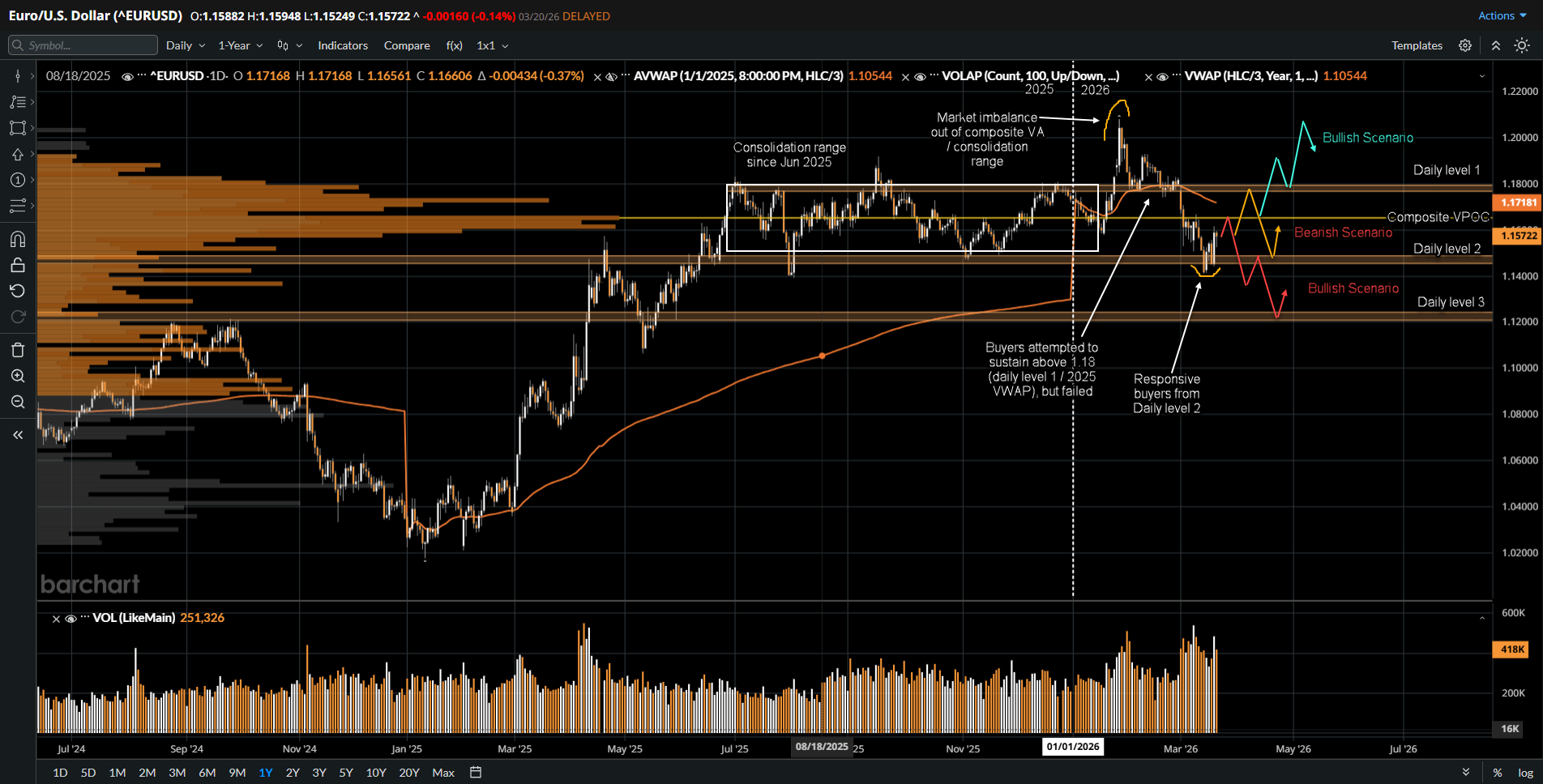
The key levels to watch are 1.165, which aligns with the composite VPOC and 2026 VWAP, and the 1.145 area, which represents daily level 2.
Bearish Scenario
- The first clue of a bearish scenario is if sellers defend offers at 1.165, confirming this level as resistance.
- If bids fail to hold at 1.145, which marks daily level 2 and the consolidation range low, expect a move toward the 1.12 area, defined as daily level 3, as more longs liquidate.
- This scenario would likely be supported by continued strength in United States data or a shift toward no cuts or delayed easing, reinforcing the Federal Reserve’s higher for longer stance.
Neutral Scenario
- If sellers do not defend at 1.165, expect a move toward the 1.18 area, which aligns with daily level 1 and the projected 2026 VWAP.
- Responsive sellers are expected to emerge at 1.18, maintaining the broader consolidation structure.
- Expect two way balance within the consolidation range between 1.18 and 1.145 as the market waits for a stronger macro catalyst.
Bullish Scenario
- The first clue for a bullish scenario is if buyers step up and hold bids at 1.165, flipping the composite VPOC into support.
- This would open the path for a move back toward 1.18.
- If the market breaks and accepts above 1.18, expect a continuation toward the 1.21 area, which represents the January swing high.
- This scenario would likely require sustained disinflation in United States data that allows the Federal Reserve to credibly signal easing, alongside continued improvement in European growth expectations.
Conclusion
EURUSD is currently trading within a well defined consolidation range, reflecting a market caught between a structurally weaker dollar narrative and a near term higher for longer stance from the Federal Reserve. While European fiscal expansion and capital rotation continue to support the euro over the medium term, resilient United States data and limited expectations for rate cuts have capped upside and driven the recent return to balance.
From a technical perspective, 1.165 remains the key pivot where acceptance or rejection will dictate direction, while 1.145 defines the lower bound of support. The failure to reclaim the 1.21 swing high and subsequent liquidation reinforces the importance of these levels as areas where positioning resets.
A sustained move higher will likely require clear disinflation that allows the Federal Reserve to shift its stance, while a break lower would be driven by continued strength in United States data reinforcing current policy expectations. Until then, expect two way trade within the range.
For traders, this creates a structured environment to express directional views with defined risk. Euro FX futures provide a capital efficient way to position around these key levels, allowing alignment between macro conviction and technical execution as the market searches for its next imbalance.
We believe that professional growth is impossible without the truth found in your own data. Our presence on Barchart bridges the gap between complex exchange data and professional execution. Open an Account and access the tools you need to see your performance clearly.
Disclaimer:
This article is provided for informational and educational purposes only and does not constitute financial, investment, or trading advice. The analysis presented reflects the author’s market observations and opinions at the time of writing and is not a recommendation to buy or sell any futures contract, security, or financial instrument. Futures trading involves significant risk and is not suitable for all market participants. Losses may exceed initial margin deposits, and market conditions can change rapidly.
Any scenarios, levels, or market expectations discussed are hypothetical in nature and are intended solely to illustrate potential market behavior. They do not represent actual trading results and should not be interpreted as guarantees of future performance. Past performance, market behavior, or historical price action are not indicative of future outcomes.
Readers are solely responsible for their own trading decisions and risk management. Always conduct independent research, consider your financial situation and risk tolerance, and consult with a qualified financial professional, if necessary, before engaging in futures or derivatives trading.

/An%20image%20of%20a%20Tesla%20humanoid%20robot%20in%20front%20of%20the%20company%20logo%20Around%20the%20World%20Photos%20via%20Shutterstock.jpg)