




Geopolitics, Oil, and the Dollar Dynamic
USDCAD reflects the value of one U.S. dollar in Canadian dollars and is primarily driven by oil prices, interest rate differentials, trade policy, and global risk sentiment. Canada is a major crude exporter to the United States, so higher oil prices generally support the loonie and weigh on USDCAD, while weaker crude tends to lift the pair. Policy expectations between the Federal Reserve and the Bank of Canada also remain central, as shifting rate expectations quickly alter capital flows.
Geopolitical risk escalated sharply over the weekend following coordinated military strikes by the United States and Israel on Iranian targets. The operation reportedly resulted in the death of Ali Khamenei, Iran’s Supreme Leader since 1989, significantly raising regional instability concerns. Iran responded with missile and drone activity across parts of the Middle East, increasing fears of broader conflict and potential disruption to energy infrastructure and shipping routes.
Because Iran is a major oil producer and sits near the Strait of Hormuz, through which a significant portion of global crude flows, heightened tensions immediately affected energy markets. Crude oil prices moved sharply on supply risk concerns, which in turn influenced the Canadian dollar. Periods of rising oil supported the loonie and pressured USDCAD lower, while simultaneous safe haven flows into the U.S. dollar during risk-off episodes provided offsetting support to the pair.
This push and pull between oil strength and safe haven USD demand has added another layer of volatility to USDCAD, reinforcing the importance of monitoring both geopolitical headlines and commodity price reactions alongside technical levels.
Recent Market Price Action: What the Market Has Done
From July through November 2025, buyers were in control in the short term, stepping up bids and auctioning price up toward 1.413, which represented a key daily level 2 and the consolidation block low, where sellers defended. This period coincided with firmer U.S. dollar positioning as stronger U.S. economic data reduced expectations for near term rate cuts from the Federal Reserve. At the same time, crude oil prices softened from earlier highs, limiting support for the Canadian dollar despite Canada’s status as a major oil exporter. Trade uncertainty also resurfaced after the United States Supreme Court struck down certain emergency tariffs, adding volatility to North American currencies and supporting defensive U.S. dollar flows.
In December 2025, the market experienced a structural shift as sellers took back control, offering prices back down below 1.392 and driving USDCAD toward 1.366. Here, buyers responded at a daily trendline and attempted to push prices higher. This downside move aligned with firmer crude oil prices amid renewed geopolitical tensions involving Iran and concerns about potential energy supply disruptions in the Middle East. Stronger Canadian employment data during the period also supported the loonie and pressured the pair lower.
However, sellers had lowered their offers back toward 1.392 and prices rotated downward again, breaking the daily trendline and meeting with responsive buyers at 1.348, a daily level 3 support area. The renewed downside rotation occurred as safe haven demand for the U.S. dollar re-emerged during episodes of global risk aversion, including volatility in U.S. equities and heightened geopolitical uncertainty following coordinated U.S. and Israeli strikes on Iranian targets, which injected fresh instability into energy markets and broader financial flows.
What to Expect in the Coming Weeks
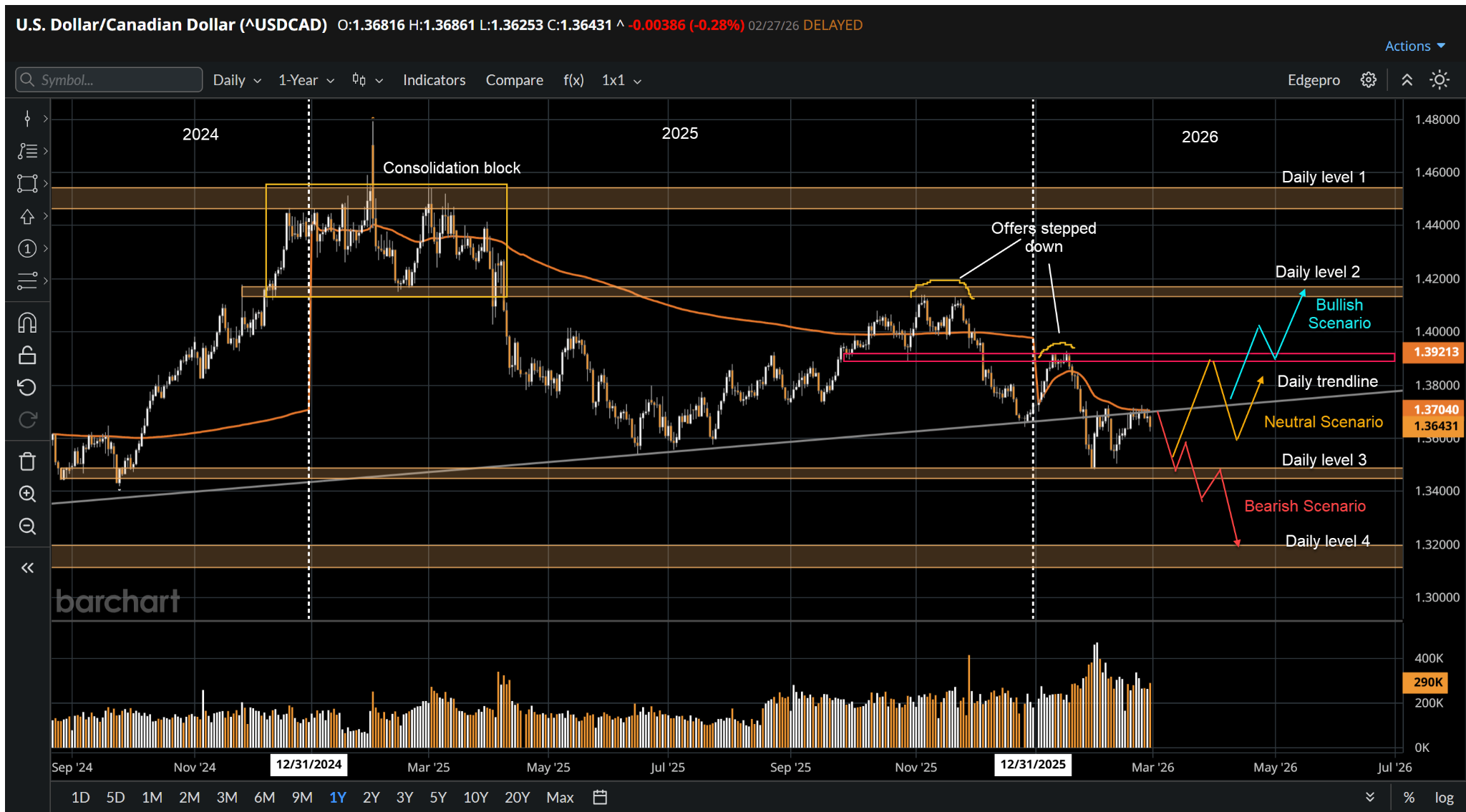
The Key level to watch is the descending trendline and the 2026 yearly VWAP which currently sits at 1.37040 as of this writing.
Bullish Scenario
• If the market is able to regain above 1.37040, which represents the 2026 yearly volume weighted average price and the daily trendline confluence, expect a move up to 1.392 where sellers are likely to respond.
• If buyers are able to hold above the 2026 yearly VWAP and daily trendline, then a break above 1.392 could propel the pair toward 1.413 (daily level 2).
Neutral Scenario
• If buyers hold the 1.35 area, a daily level 3 support zone, and regain back above the yearly VWAP but run into responsive selling at 1.392, expect a sideways rotation between 1.392 and 1.35 as the market balances.
Bearish Scenario
• If buyers fail to regain back above the 2026 yearly VWAP or produce a false break above that level and bids cannot hold the 1.35 support, the pair may extend lower toward 1.392, aligning with a daily level 4 downside scenario.
Conclusion
USDCAD is positioned at an inflection point where macro uncertainty and technical structure converge. The escalation in Middle East tensions introduces a significant new variable for oil markets and broader risk sentiment. The extent and persistence of any resulting price movement will depend on how energy markets respond and whether safe haven flows favor the U.S. dollar or commodity linked currencies.
From a technical perspective, the 2026 yearly VWAP and daily trendline remain pivotal reference points. A sustained move above 1.37040 would indicate that buyers are regaining initiative and could open the path toward 1.392 and possibly 1.413. Conversely, failure to reclaim value above VWAP, especially if 1.35 fails to hold, would suggest that sellers remain dominant and that further downside rotation may unfold.
With geopolitical risk elevated, near term focus should remain on developments in the Middle East and their impact on crude oil prices and broader risk sentiment. Over the medium term, USDCAD is likely to be shaped by the ongoing push and pull between oil market dynamics and shifting policy expectations between the Federal Reserve and the Bank of Canada. The interaction between energy prices, interest rate differentials, and clearly defined structural levels will determine whether the pair breaks from balance or continues rotating within its established range.
For traders looking to express views in the currency markets such as the USDCAD, trading the 6C futures offers transparency, centralized pricing, and regulated execution that many exchange traded products cannot match. EdgeClear delivers direct access to global futures markets through trader focused platforms built for serious market participation. Learn more at edgeclear.com.
Disclaimer:
This article is provided for informational and educational purposes only and does not constitute financial, investment, or trading advice. The analysis presented reflects the author’s market observations and opinions at the time of writing and is not a recommendation to buy or sell any futures contract, security, or financial instrument. Futures trading involves significant risk and is not suitable for all market participants. Losses may exceed initial margin deposits, and market conditions can change rapidly.
Any scenarios, levels, or market expectations discussed are hypothetical in nature and are intended solely to illustrate potential market behavior. They do not represent actual trading results and should not be interpreted as guarantees of future performance. Past performance, market behavior, or historical price action are not indicative of future outcomes.
Readers are solely responsible for their own trading decisions and risk management. Always conduct independent research, consider your financial situation and risk tolerance, and consult with a qualified financial professional, if necessary, before engaging in futures or derivatives trading.

/Micron%20Technology%20Inc_billboard-by%20Poetra_RH%20via%20Shutterstock.jpg)

/Netflix%20open%20on%20tablet%20by%20rswebsols%20via%20Pixabay.jpg)
/Tesla%20Inc%20logo%20by-%20baileystock%20via%20iStock(1).jpg)