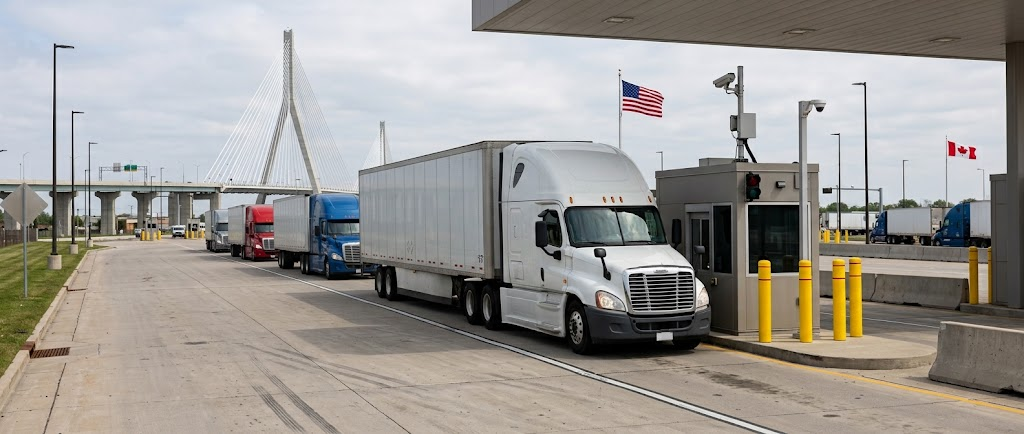
The bond market continues to flash warning signs as the Trump administration expands its trade war, and no, you haven’t entered a time machine and returned to April 2025. This time, it’s the Section 338 law being applied, but the proclamation titled “Motor Vehicles” doesn’t actually apply to cars (or other goods) that were already targeted by Section 232 tariffs. Instead, these Section 338 levies target imports like apparel, plywood, cement, textiles, and sporting goods manufactured in Canada. Companies headquartered in Canada that don’t manufacture there aren’t subject to these levies, which is why stocks like Lululemon Athletica Inc. (NASDAQ: LULU) and Gildan Activewear Inc. (NYSE: GIL) didn’t move on the announcement.
Canada Goose: The Clean-Cut Loser of the Latest Tariff Barrage
The biggest loser of the new tariffs is Canada Goose Holdings Inc. (NYSE: GOOS), which manufactures most of its apparel within Canada. While U.S. revenue is only 25% of the total line, this is still a significant headwind for a company that doesn’t have options to source from Asia like Lululemon or Gildan.
During its Q1 fiscal year 2027 earnings call in July, CEO Neil Bowden said the current tariff implementation, without mitigation, would reduce Canada Goose’s fiscal 2027 operating margin to less than 200 basis points (bps).
The stock is down more than 7% since the earnings announcement, and has lost almost 40% of its value so far in 2026. However, management retained its fiscal 2027 revenue projections, so guidance during the Nov. 5 conference call will be the key factor to watch moving forward.
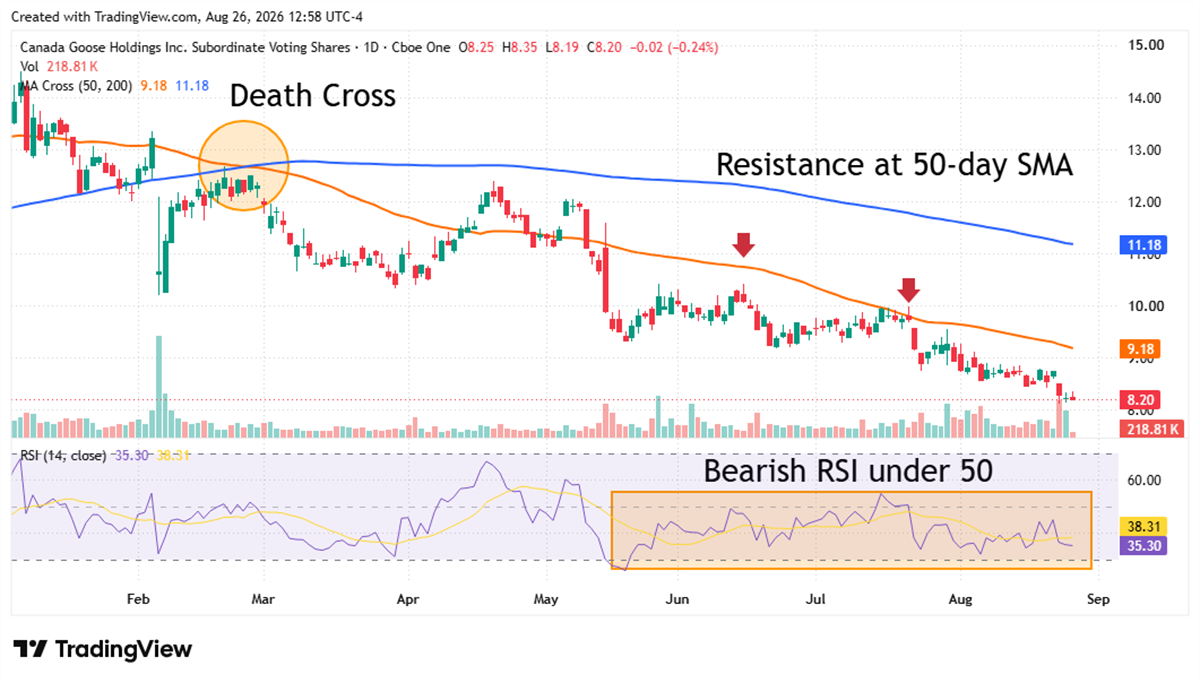
The stock’s collapse will be hard to reverse in the current environment, and the chart shows several technical headwinds putting more pressure on buyers. Resistance at the 50-day moving average has been strong, and the Relative Strength Index (RSI) continues to tread under 50 without reaching the Oversold zone that could trigger a rebound.
West Fraser: Cumulative Tariff Affects Continuing to Pressure Bottom Line
According to management at West Fraser Timber Co. Ltd. (NYSE: WFG), the new tariffs affect about 3% of its plywood and 20% of its laminated veneer lumber (LVL), which is fairly immaterial to its bottom line.
But the Section 338 tariffs stack on top of the Section 232 tariffs, which have already started impacting the company.
West Fraser missed both top- and bottom-line expectations in its Q2 2026 numbers released July 29, losing 78 cents per share in the period.
Management maintained guidance but noted it was still measuring the impact of the new tariffs and dealing with rising costs.
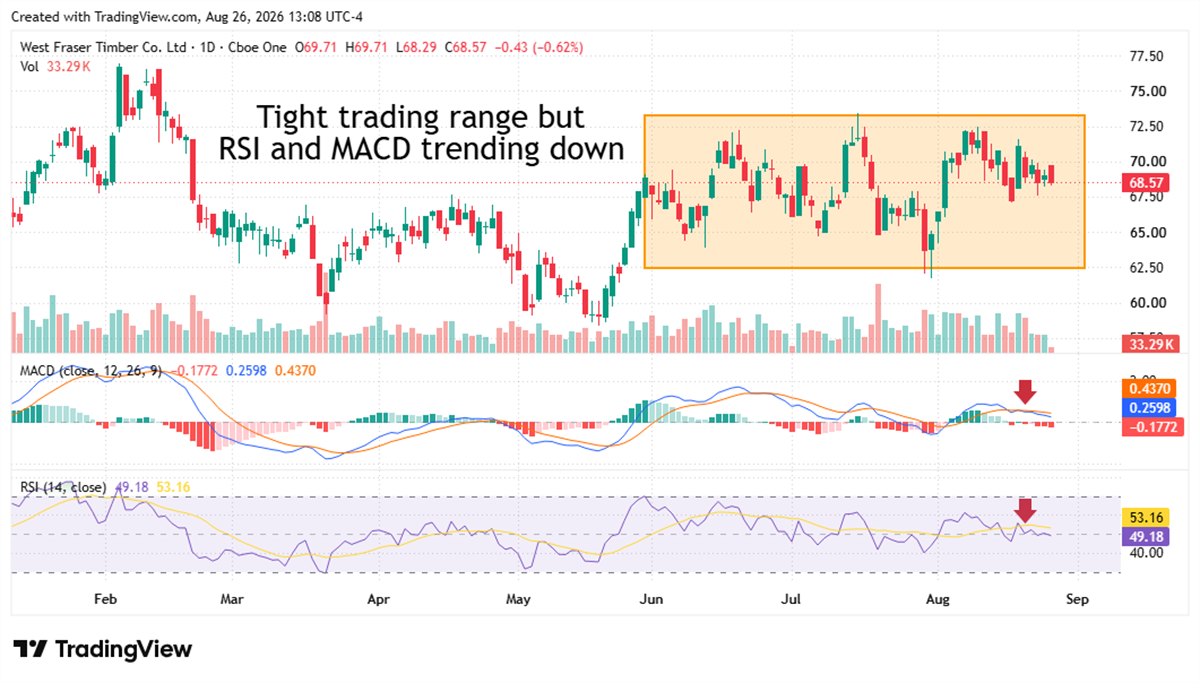
WFG shares peaked over $100 shortly before the 2024 U.S. presidential election, but the incoming administration’s tariff plans scared investors out of the stock, and now these impacts are beginning to show up in earnings. Recently, the stock has traded in a tight range between $72.50 and $62.50, but both the RSI and Moving Average Convergence Divergence (MACD) indicators show momentum is weakening again after the collapse of tariff negotiations.
Amrize: A Stock to Watch to Understand the Cement Mechanism
Before discussing the prospects of Amrize Inc. Ltd. (NYSE: AMRZ), we’ll need to discuss how the imported cement trade works in the U.S. The U.S. imported approximately 20% of its cement in 2025, but those imports aren’t evenly distributed. Cement imports, of which Canada, Turkey, and Vietnam supply 70%, mostly route through coastal ports, with Canadian supply moving by rail or Great Lakes shipping.
Canadian cement represents only 7% of total U.S. consumption, but most of that consumption is concentrated in New York, Washington, and New England. In these combined states, Canadian cement represents more than one-third of total consumption, and domestic capacity hasn’t expanded in more than a decade. Unlike its Vietnamese and Turkish counterparts, Canada has no rerouting options to blunt the impact of inland delivery pricing.
Here’s where the tradable information comes in. Amrize operates plants in Alpena, Michigan, Joppa, Illinois, and Ravena, New York (the last cement plant in New York), which sit in the shipping corridors most likely to be affected by tariff-induced disruption. But it also owns plants in Alberta, Ontario, and Quebec that would face 50% tariffs on any shipments into the mainland U.S.
The company hopes to mitigate some tariffs with dual labels citing ‘Made in America’ and ‘Product of Canada’, but cited high material costs as a headwind during its Q2 2026 results released earlier this month. Management expected profitability to improve by fiscal Q4, but made that statement before Canada/U.S. negotiations fell apart. It also didn’t stop analyst downgrades and price-target reductions.
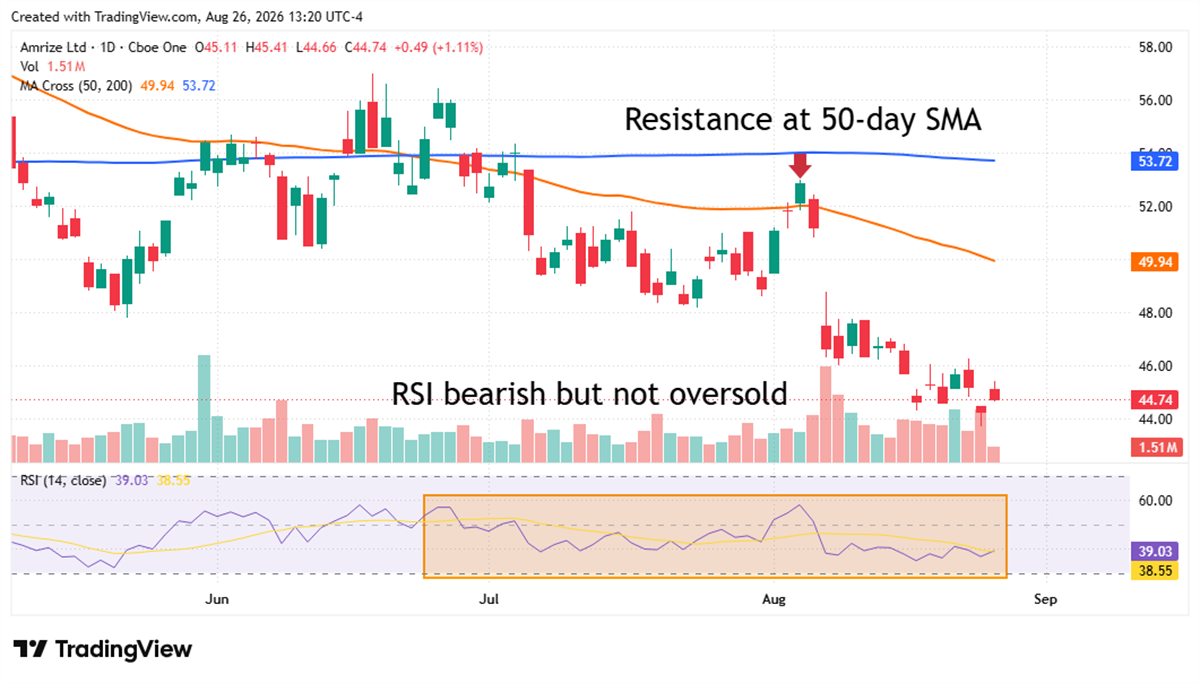
AMRZ shares are also stuck in a technical downtrend, highlighted by a Death Cross in June that created stiff resistance at the 50-day moving average. The RSI has also fallen below 50 into bearish territory but remains stubbornly above the Oversold threshold.
Where Should You Invest $1,000 Right Now?
Before you make your next trade, you'll want to hear this.
MarketBeat keeps track of Wall Street's top-rated and best performing research analysts and the stocks they recommend to their clients on a daily basis.
Our team has identified the five stocks that top analysts are quietly whispering to their clients to buy now before the broader market catches on... and none of the big name stocks were on the list.
They believe these five stocks are the five best companies for investors to buy now...
The article "3 Stocks Facing New Pressure From Section 338 Tariffs on Canadian Goods" first appeared on MarketBeat.


/AI%20(artificial%20intelligence)/Ai%20chip%20by%20Quality%20Stock%20Arts%20via%20Shutterstock.jpg)

/A%20close-up%20of%20the%20Broadcom%20logo%20on%20a%20smartphone%20by%20Timon%20via%20Adobe%20Stock.jpeg)